
Microsoft's MAI-Image-2.6 Tops Editing Charts and Challenges GPT Image 2
Microsoft's newest image model takes the top spot for editing and second place for text-to-image on Artificial Analysis, closing the gap with OpenAI.
Takeaways
- MAI-Image-2.6-Preview debuts at #1 on Artificial Analysis Image Editing, #2 on Text to Image.
- Beats Microsoft's own 2.5-Pro, Reve 2.1, and OpenAI GPT Image 2 on editing; only GPT Image 2 leads generation.
- Microsoft reports +79 Elo overall gain and +91 Elo on text rendering versus MAI-Image-2.5.
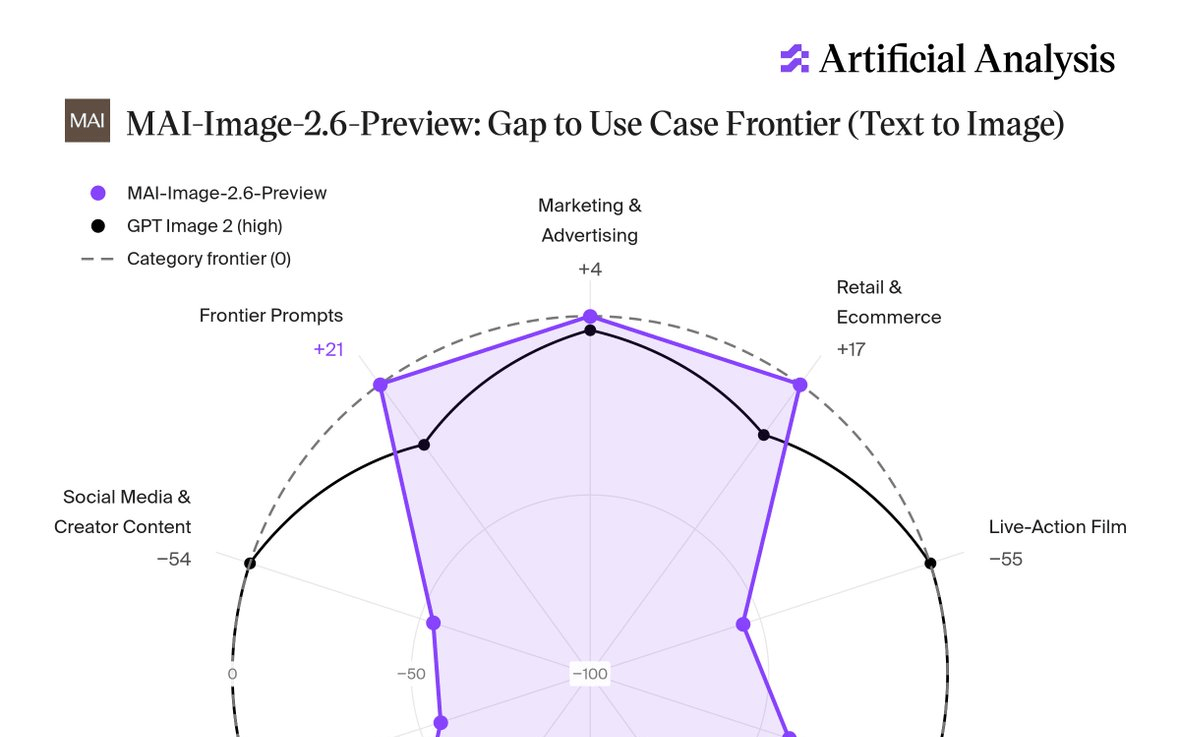
- Tops 5 of 19 categories: Material, Knowledge, Frontier, Retail and Ecommerce, Marketing and Advertising.
- Available in MAI Playground and private preview on Microsoft Foundry, with broader rollout planned.
- Cheaper Flash sibling later launched at $19 per million image output tokens, twice as fast as GPT-Image-2-Medium.
Microsoft’s MAI-Image-2.6-Preview has displaced its predecessor at the top of an independent image-model benchmark. At the time of publication, Artificial Analysis ranks it first for image editing and second for text-to-image generation, behind OpenAI’s GPT Image 2. Microsoft models now occupy the top two editing positions.
Built by Microsoft AI, MAI-Image-2.6-Preview handles generation and editing within one model. Microsoft announced 2.6 with an emphasis on legible in-image text, stronger portraits and 3D scenes, and more polished commercial and photorealistic output.
Two benchmarks, two top-two finishes
| Benchmark | Rank | Nearby models |
|---|---|---|
| Image editing | 1 | Ahead of MAI-Image-2.5-Pro, Reve 2.1, and GPT Image 2 |
| Text-to-image generation | 2 | Behind GPT Image 2 and ahead of Reve 2.1 |
Microsoft reports a 79-point overall Elo gain over MAI-Image-2.5, with improvements across every Arena text-to-image category. Text rendering recorded the largest cited increase at 91 points. Elo is a relative rating derived from head-to-head results, so the score reflects performance against the other models in the evaluation pool.
Artificial Analysis divides its benchmark into nine capability categories and 10 use-case categories. MAI-Image-2.6-Preview leads five of the 19:
- Material
- Knowledge
- Frontier
- Retail and Ecommerce
- Marketing and Advertising
GPT Image 2 leads the remaining 14 categories, while Microsoft’s margins in its two winning use cases remain narrow. MAI-Image-2.6-Preview leads by 17 Elo points in Retail and Ecommerce and four points in Marketing and Advertising. The models are also separated by only a few points in Lighting and UI/UX Design.
Because Elo ratings change as evaluations accumulate and new models enter the pool, the positions represent a snapshot rather than a permanent ranking. The category results are more useful for workload selection than the overall rank alone.
Three ranked releases in two months
Microsoft AI released three ranked MAI-Image models in less than two months. MAI-Image-2.5 debuted at number two for text-to-image generation in June 2026. MAI-Image-2.5-Pro followed on July 23 and reached first place for editing when Artificial Analysis published its results. MAI-Image-2.6-Preview displaced it one week later and pushed 2.5-Pro to eighth place for text-to-image generation.
The broader sequence began with MAI-Image-1 on October 13, 2025. Microsoft then delivered five major releases within nine months, before adding the later Flash variant. The company describes its development process as a “hill-climbing machine,” with each release targeting measurable gains over the previous version.
Playground now, production later
MAI-Image-2.6 is available through the MAI Playground and through a private preview in Microsoft Foundry. Private preview limits access and lacks general-availability status, so teams need to check the applicable Azure terms before using it in production.
Microsoft plans a broader Foundry release and integrations with products including Copilot and Bing Image Creator, but it has announced no rollout date. Public details also leave several implementation questions unresolved:
- Regional availability and quota limits
- Flagship model pricing
- API support for image editing
- Support for multiple reference images
- Production service-level commitments
Microsoft has also introduced MAI-Image-2.6-Flash, a lower-cost sibling with token-based pricing:
| Usage type | Price per million tokens |
|---|---|
| Text input | $1.75 |
| Image input | $2.50 |
| Image output | $19.00 |
Token billing makes the cost of each request depend on its input and output size. Teams accustomed to fixed per-image prices will need to measure token consumption across representative prompts, resolutions, edits, and batch sizes.
Microsoft says Flash generates images twice as fast as GPT Image 2 Medium and improves GPU efficiency by 72%. Those speed and efficiency figures are vendor claims. The Artificial Analysis positions cited above belong to MAI-Image-2.6-Preview, while Flash has no ranking stated in these results.
A first-party option for Microsoft’s stack
Microsoft has long used OpenAI image models in Bing Image Creator, Copilot, and Designer. A competitive first-party model gives the company another component for those products and reduces the technical cost of substituting providers. Several category gaps between MAI-Image-2.6-Preview and GPT Image 2 have narrowed to single-digit Elo differences.
For developers using Microsoft Foundry, production suitability will depend on API behavior, availability, quotas, latency, safety controls, and total cost. Leaderboard results provide an initial quality signal, but they do not answer those operational questions.
Put the claims through a workload test
The category results make MAI-Image-2.6-Preview a candidate for four demanding workload types:
- Product photography and packshots that require convincing materials, lighting falloff, and contact shadows.
- Marketing creative that combines headline copy, brand marks, and layout within one generated asset.
- Knowledge-sensitive scenes containing specific objects, textures, products, or architectural details.
- Localized edits that must preserve identity, composition, and unaffected regions.
A representative evaluation should compare exact text rendering, prompt adherence, edit locality, identity preservation, latency, token consumption, and failure rates. Teams should also test their own languages, brand assets, safety requirements, and output resolutions because aggregate Elo scores can conceal workload-specific weaknesses.
Latency-sensitive and high-volume pipelines may favor the Flash variant, while the flagship preview targets maximum output quality. Microsoft’s rapid release cadence and current benchmark position give developers a credible first-party alternative to the OpenAI image models already used across the company’s product stack.