

Microsoft's MAI-Image-2.6 Jumps to #2, Beating GPT Image 2 in 3D
Microsoft's MAI-Image-2.6 debuts at #2 on Arena's text-to-image leaderboard, closing within 45 points of GPT Image 2 across every major image category.
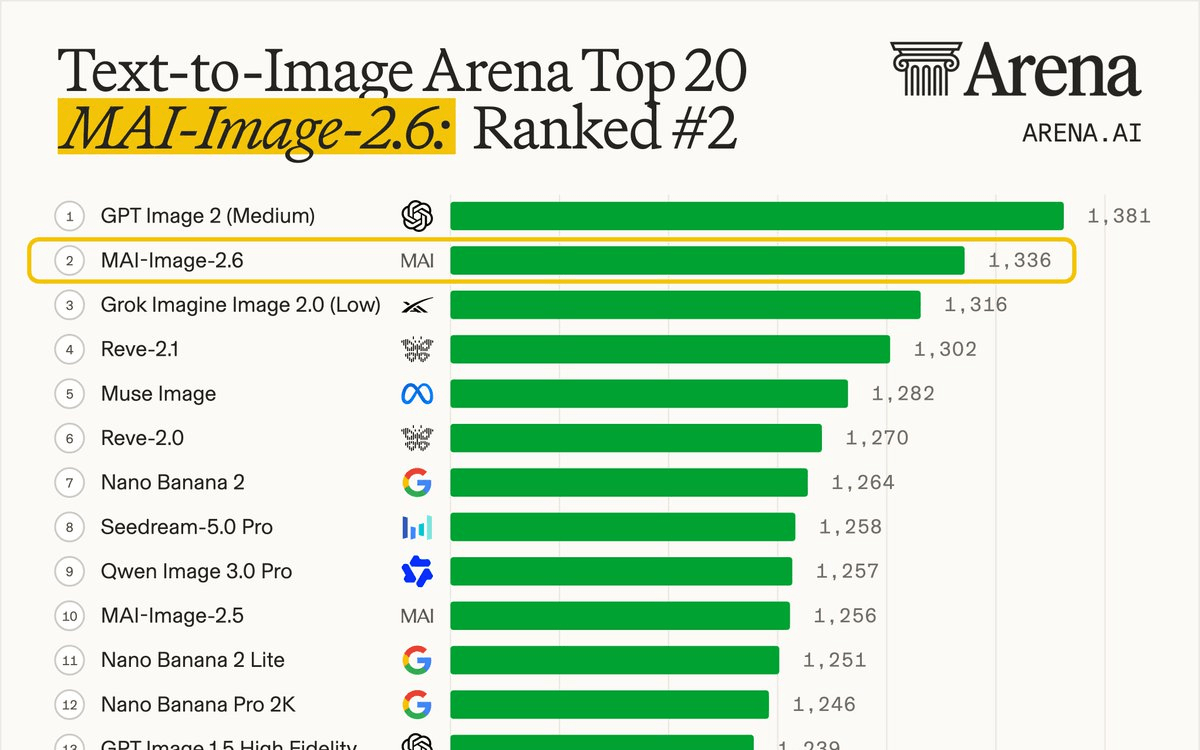
- MAI-Image-2.6 debuts at #2 on Arena's Text-to-Image leaderboard with 1,336 Elo points, just 45 pts behind GPT Image 2.
- Massive category jumps: #1 in 3D Imaging, #2 in Cartoon/Anime, Text Rendering, Product Design, and Art.
- 80-point overall Elo gain over MAI-Image-2.5 (currently at #10 with 1,256 pts) in a single generation.
- API access coming soon via Microsoft Foundry; playground access available now on MAI Playground.
- Diffusion model with flow-matching loss, trained on licensed data with no distillation from other models.
- Part of Microsoft's AI independence push — the company is actively replacing OpenAI models in its own products with MAI models.
Microsoft's in-house image model just made its biggest leap yet. MAI-Image-2.6 landed at #2 on Arena's Text-to-Image leaderboard with 1,336 Elo points, sitting just 45 points behind the current leader, GPT Image 2 (Medium), and 20 points ahead of Grok Imagine Image 2.0 in third. For context, the previous version, MAI-Image-2.5, sits at #10 with 1,256 points , meaning 2.6 gained 80 Elo points overall in a single generation.
From middle of the pack to the podium
The category-level jumps are where the story gets interesting. Arena scores models across seven specialized image domains, and MAI-Image-2.6 improved in every single one:
- 3D Imaging & Modeling: #6 → #1
- Cartoon, Anime & Fantasy: #8 → #2
- Product, Branding & Commercial Design: #7 → #2
- Text Rendering: #8 → #2
- Art: #4 → #2
- Photorealistic & Cinematic Imagery: #11 → #3
- Portraits: #11 → #3
The most dramatic swing is in 3D Imaging, where the model went from sixth to first outright. But arguably the most commercially significant jump is Text Rendering , moving from eighth to second. Text rendering is the area where the MAI-Image family has been consistently improving. Words in generated images are sharper and more legible, layouts hold together better across different styles and sizes , directly addressing one of the most common weaknesses in AI-generated images, where text on posters, labels, and packaging tends to distort or break down.
The architecture behind the family
MAI-Image uses a diffusion-based approach to create high-quality, visually rich images from natural language prompts. Diffusion models work by starting from random noise and iteratively denoising toward a coherent image guided by the text prompt. The MAI-Image model card describes the family as a diffusion-based text-to-image architecture trained with a flow-matching loss , a training technique that learns a direct path from noise to image rather than the traditional multi-step denoising schedule, which tends to produce sharper results with fewer inference steps.
All MAI models were trained without distillation on licensed data, reducing legal risk for businesses. That's a meaningful enterprise differentiator: no training signal borrowed from other proprietary models means cleaner IP provenance for regulated industries.
A rapid release cadence
The pace at which Microsoft is shipping this family is worth noting. Microsoft shipped the first model, MAI-Image-1, on October 13, 2025, debuting in the top 10 for text-to-image on LMArena. The cadence since has been fast: five releases in nine months. Each generation has moved the needle on the leaderboard:
- MAI-Image-1 (Oct 2025): Debuted top-10
- MAI-Image-2 (Mar 2026): Reached top-5, major gains in text rendering and photorealism
- MAI-Image-2-Efficient (Apr 2026): Same architecture, 22% faster, ~41% cheaper
- MAI-Image-2.5 (Jun 2026): Added image editing, debuted at #2 on image-editing leaderboard
- MAI-Image-2.6 (Aug 2026): #2 overall text-to-image, #1 in 3D
MAI Image is Microsoft AI's in-house image model family , the line Microsoft built to power Bing Image Creator, PowerPoint, and OneDrive with its own generator instead of relying solely on OpenAI's image models. MAI-Image-2.5 introduced a unified generation-and-editing model: one model that both creates images from text and performs precise, localized edits , swapping an object, updating in-image text, changing a background , while preserving faces and leaving the rest of the frame untouched.
The strategic picture
This isn't just a model update , it's a signal about Microsoft's broader AI independence strategy. Bloomberg reported that Microsoft had begun replacing OpenAI and Anthropic models with its own MAI models in Excel and Outlook to reduce AI costs. In its Build 2026 notes, the company projected a tenfold improvement in output tokens per dollar from a fine-tuned MAI model compared with GPT-5.5, based on public GPT pricing and Microsoft's own MAI pricing data. MAI-Image-2.6 landing at #2 , just behind GPT Image 2 , makes that substitution argument much easier to make for visual workloads.
Where it fits and where to use it
The category breakdown tells you exactly when to reach for this model over alternatives:
- Product and brand imagery: Particularly strong on in-image text rendering for posters, labels, and packaging, and on commercial product photography with believable lighting, scale, and spatial structure.
- 3D-style reference images: Now the top-ranked model in this category on Arena , useful for concept art, game assets, and 3D pipeline references.
- Stylized illustration: Cartoon, anime, and fantasy now at #2, making it competitive for creative and entertainment workflows.
- Enterprise creative: The combination of editing capability, identity preservation, and slide-ready output makes it the engine for enterprise creative and productivity workflows , designers iterating on a single subject across compositions, marketers stylizing assets at scale, and Office users generating presentation visuals without leaving the application.
How to access it
According to Arena's announcement, MAI-Image-2.6 will be available on the MAI Playground with early API access on Microsoft Foundry coming next week. The MAI-Image API ships through Microsoft Foundry , the same catalog where you deploy other first-party and partner image models. You provision a deployment from the Foundry Model Catalog, get an Azure endpoint, authenticate with an Entra ID token or API key, and call the standard MAI image API surface.
For the 2.5 generation, the standard tier was priced at $5/M tokens text input, $8/M image input, and $47/M image output. Flash drops to $1.75/M for text and image input, and $33/M for image output. Pricing for 2.6 has not been officially confirmed yet , check the Microsoft Foundry docs for the latest. You can also test the model directly in Arena's Image Arena before committing to an API integration.
The gap to GPT Image 2 is now 45 points , close enough that for specific categories like 3D and commercial design, MAI-Image-2.6 is already the better choice. Whether it closes that gap entirely in the next release is the question worth watching.
Comments
