
Microsoft's MAI-Image-2.5 Hits #2 Globally, Challenging OpenAI's Image Dominance
Microsoft's MAI-Image-2.5 lands at #2 for image editing and #2 for text-to-image on Artificial Analysis's Arena, signaling a credible first-party challenge to OpenAI and Google in the image generation market.
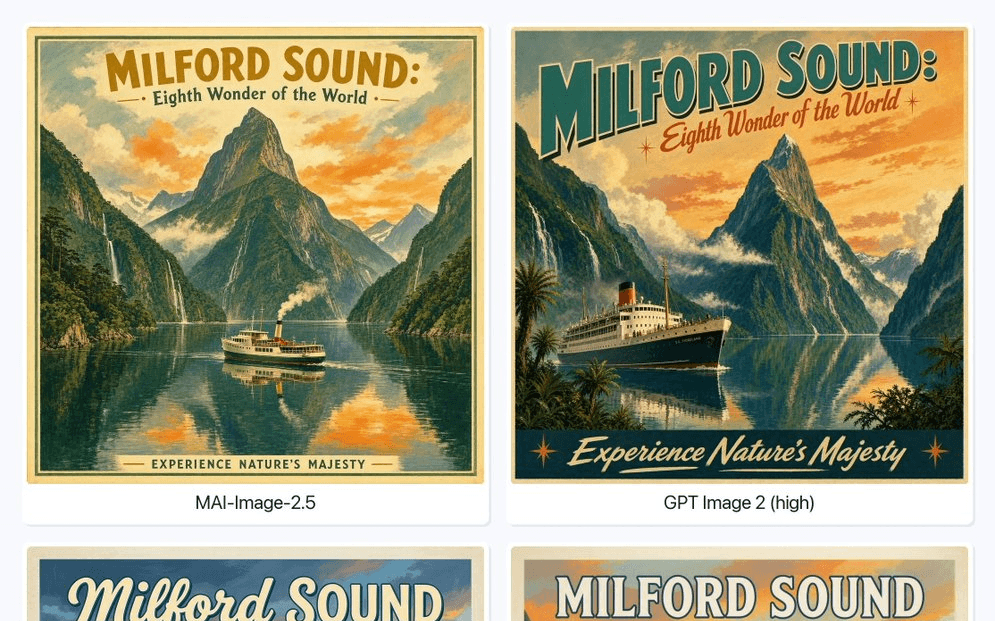
Takeaways
- Microsoft's MAI-Image-2.5 ranks #2 in text-to-image (Elo 1276) and #3 in image editing (Elo 1251) on the Artificial Analysis Arena, behind only OpenAI's GPT Image models.
- The model delivers a +75 point Arena improvement over MAI-Image-2, with the biggest gains in text rendering (+107) and cartoon/anime/fantasy (+90).
- Pricing: $48/1k images for MAI-Image-2.5 and $20/1k images for the Flash variant on Microsoft Foundry.
- Both models are live in PowerPoint and rolling out to OneDrive, plus available on Foundry, MAI Playground, and OpenRouter.
- MAI-Image-2.5 is part of a seven-model MAI family launched at Build 2026, trained from scratch with zero distillation from third-party models including OpenAI's.
- The launch reflects Microsoft's broader push to reduce OpenAI dependency after renegotiating its exclusivity deal in April 2026, recapturing margin on every Azure workload it can shift to first-party models.
Microsoft just posted one of the strongest image model debuts in recent memory. MAI-Image-2.5, the latest release from the company's in-house MAI Superintelligence team, ranks #1 for GPT Image 2 with an Elo of 1339, while MAI-Image-2.5 lands at #2 with an Elo of 1276 on the Artificial Analysis Text-to-Image Arena. On the editing side, the image editing leaderboard puts GPT Image 1.5 at #1 (Elo 1261), GPT Image 2 at #2 (Elo 1260), and MAI-Image-2.5 at #3 (Elo 1251). For a model family that didn't exist eight months ago, that's a remarkable trajectory.
What actually shipped
Microsoft is launching MAI-Image-2.5 for maximum fidelity, and MAI-Image-2.5-Flash for fast, scalable production workloads. Both handle text-to-image generation and image editing in a single model, supporting up to roughly 1MP output at flexible aspect ratios with a 32K token context window.
The headline capability improvements over the previous MAI-Image-2 are significant:
- MAI-Image-2.5 delivers an overall +75 point improvement over MAI-Image-2, with the largest gains in Text Rendering (+107) and Cartoon, Anime & Fantasy (+90).
- The model understands scene structure, lighting, scale, and spatial relationships, helping it make edits that fit the image context, such as adding an object with the right perspective and shadows.
- MAI-Image-2.5 supports precise, localized edits -- from replacing an object or updating text to removing motion blur -- without changing the rest of the image.
- MAI-Image-2.5 preserves facial identity across edits, maintaining recognizable likeness even through changes in pose, expression or viewpoint.
Microsoft positions 2.5 as a step change over MAI-Image-2, with the largest gains concentrated in text rendering, stylized illustration, and commercial imagery. That last point matters more than it sounds: legible text inside generated images -- think posters, packaging, infographics -- has historically been one of the hardest problems for diffusion-based models.
The pricing picture
On Microsoft Foundry, MAI-Image-2.5 is $5 per 1M text input tokens, $8 per 1M image input tokens, and $47 per 1M image output tokens. MAI-Image-2.5-Flash is cheaper at $1.75 per 1M text input tokens, $1.75 per 1M image input tokens, and $19.50 per 1M image output tokens. Translated to the per-image pricing that Artificial Analysis tracks, that works out to roughly $48 per 1,000 images for the full model and $20 per 1,000 images for Flash.
Together, they deliver the best price-to-performance ELO in the market, giving customers the flexibility to optimize production image workflows for quality, speed, or cost. Whether that claim holds up under independent scrutiny remains to be seen, but the pricing is competitive with GPT Image 2 at similar quality tiers.
Where it's already deployed
MAI-Image-2.5 is live on PowerPoint for high-quality image generation and rolling out to OneDrive for precise editing. In PowerPoint, users can generate presentation-ready visuals and slides from prompts. In OneDrive, users can make precise photo edits -- removing unwanted distractions, cleaning up backgrounds, and enhancing images while preserving the original scene.
MAI-Image-2.5 is in Foundry, and several models are also available on OpenRouter, Fireworks, and Baseten, where developers can tune the weights. The OpenRouter distribution is notable -- it means developers outside the Azure ecosystem can access the model through the same API they already use for other providers.
The bigger play: Microsoft's independence from OpenAI
MAI-Image-2.5 doesn't exist in isolation. It's part of a seven-model family that Microsoft unveiled at Build 2026, and the strategic subtext is hard to miss. Microsoft has spent years routing its AI strategy through OpenAI. At Build 2026, that changed. The company unveiled seven in-house AI models under the MAI banner -- its first serious attempt to build and ship frontier-quality models without leaning on a third-party lab.
In April 2026, Microsoft renegotiated its OpenAI deal, ending exclusivity and revenue-sharing arrangements. That created the contractual room to build from scratch. The MAI family is the result. The entire family was trained end-to-end in-house with zero distillation from third-party models, using clean and appropriately licensed data with AI-generated content excluded from pre-training.
The more consequential interpretation is about margin and control. Every token processed through OpenAI's models costs Microsoft real money through revenue-sharing obligations embedded in the partnership agreement. Every enterprise customer running Azure Foundry workloads on MAI models instead generates revenue without those obligations.
Who wins, who feels the pressure
For developers and enterprise teams, this is straightforwardly good news. A credible #2 image model at competitive pricing, natively integrated into Azure Foundry, with no third-party data routing, is a meaningful new option. For enterprises worried about vendor lock-in and data sovereignty, having a first-party option under the same Azure compliance umbrella is a strong selling point.
For OpenAI, the picture is more complicated. For OpenAI, the enterprise implication is uncomfortable. If Microsoft can move more Copilot, coding, transcription, image and customized enterprise workloads onto its own models, OpenAI's future revenue story becomes less dependent on Microsoft distribution and more dependent on its direct customer base. That matters even more as investors keep watching OpenAI's path toward a public-market outcome.
For Google and the Gemini image team, MAI-Image-2.5 now sits directly above Nano Banana 2 and Nano Banana Pro on both leaderboards. Midjourney, Ideogram, and Adobe Firefly remain established alternatives for creator and marketing workflows, but they don't have the enterprise distribution muscle that Microsoft can deploy through PowerPoint, OneDrive, and Azure.
What's now possible
MAI-Image-2.5 introduces image-to-image editing with a suite of other capabilities that add control while preserving identity and brand: identity and character consistency preserves recognizable faces (plus hair, clothing, full-body identity) across stylization, pose, and layout changes -- built for branded characters, spokespeople, and social campaigns. Combined with its text rendering gains, this opens up production workflows -- think e-commerce product shots, branded marketing assets, and presentation visuals -- that previously required a human designer to clean up AI output.
For builders, the takeaway is practical: the era of defaulting to one model on Azure is over. The Artificial Analysis leaderboard now shows Microsoft sitting alongside OpenAI and Google at the very top of both image generation and editing rankings -- a position that would have seemed unlikely when MAI-Image-1 launched in October 2025. You can try both models directly in the MAI Playground or access them via the Artificial Analysis Image Arena.