

Microsoft's MAI-Image-2.5 Beats GPT-Image-1.5 With 75-Point Arena Jump
Microsoft's new image model takes #2 on Arena's editing leaderboard and #3 on text-to-image, with both a fidelity tier and a Flash variant priced for production.
- Microsoft launched MAI-Image-2.5, ranking #2 on Arena image-edit and #3 on text-to-image leaderboards.
- Two variants: flagship for fidelity, Flash for production scale at roughly one-third the price.
- Beats Nano Banana Pro 2K and GPT-Image-1.5; +75 point gain over MAI-Image-2 overall.
- Available now in Azure AI Foundry, OpenRouter, and the MAI Playground.
- Already rolling into OneDrive Photos editing and PowerPoint Copilot slide generation.
- Engineered to run on H100s for existing infrastructure; trained on Microsoft's new GB200 cluster.
Microsoft's in-house image generation lineup just made its biggest jump yet. MAI-Image-2.5 arrived on the Arena leaderboards with two notable placements: it surpasses GPT-Image-1.5 and Nano Banana Pro 2K, ranking No. 3 for text-to-image and No. 2 on Arena's image-editing leaderboard. The model ships in two flavors, plugs into Microsoft's own products, and is already exposed through Foundry, OpenRouter, and the MAI Playground.
What actually shipped
There are two variants. The flagship MAI-Image-2.5 targets maximum fidelity, while MAI-Image-2.5-Flash is built for fast, scalable production workloads. Both accept text prompts and image inputs, meaning they handle generation and editing in the same model.
That dual capability is the headline architectural change for the MAI-Image line. MAI-Image-2 was generation-only: you provided a text prompt, you got an image. MAI-Image-2.5 accepts image uploads alongside text prompts. You can submit an existing image and a modification instruction, change the background, alter a style, swap an element, and get back a modified version. That puts it in the same capability class as OpenAI's gpt-image-2 and Google's Nano Banana line.
Where it actually wins
Microsoft is leaning hard on the editing benchmark. On Arena's Image Edit leaderboard for Single-Image Edit, MAI-Image-2.5 is listed at #2 with a 1401±8 score in the current snapshot, behind GPT-Image-2 (medium). Arena's announcement on X also notes that MAI-Image-2.5 advanced the Pareto frontier and sits 10 points above those closely watched models in this leaderboard view.
On text-to-image, the gains over Microsoft's prior release are blunt. MAI-Image-2.5 Arena scores across all text-to-image categories were compared against MAI-Image-2 and MAI-Image-1. MAI-Image-2.5 delivers an overall +75 point improvement over MAI-Image-2, with the largest gains in Text Rendering (+107) and Cartoon, Anime & Fantasy (+90).
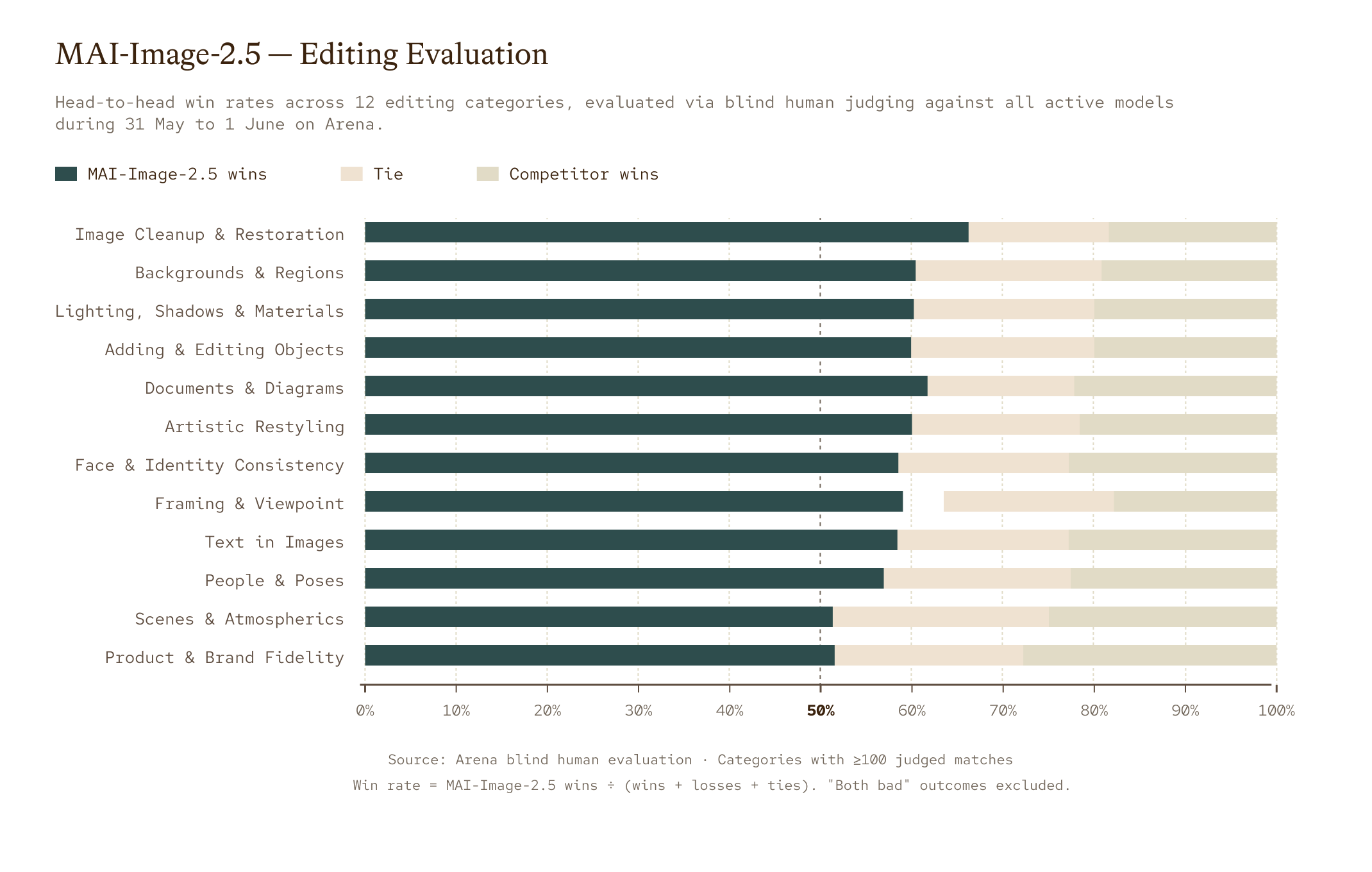
The editing evaluation breaks performance down by category. Win rates across 12 editing categories on Arena were evaluated via blind human preference judging against all active models. Each bar shows the share of matches won by MAI-Image-2.5, won by the competitor, or judged a tie. Microsoft groups the wins around four claims: better text-to-image quality, stronger visual reasoning, fine-grained edit control, and face or identity consistency.
The editing problem it's actually solving
Pure generation has been a solved problem for a while. The interesting frontier is controlled modification of an existing image without destroying everything else in the frame. Image editing is where many models still feel fragile. A model can generate an impressive new picture, but still struggle when asked to keep a product, face, layout, or logo unchanged while changing only one part of the image.
Microsoft is targeting the failure modes directly. MAI-Image-2.5 supports precise, localized edits, from replacing an object or updating text to removing motion blur, without changing the rest of the image. The model understands scene structure, lighting, scale, and spatial relationships, helping it make edits that fit the image context, such as adding an object with the right perspective and shadows. Identity preservation matters here too, because past models would subtly mutate a face when asked to change pose or expression.
Pricing and deployment
The pricing is structured like a frontier text model: per-million-token rates split across text input, image input, and image output. MAI-Image-2.5-Flash offers faster, lower-cost generation and editing at $1.75 per 1M text input tokens, $1.75 per 1M image input tokens, and $19.50 per 1M image output tokens. The flagship sits roughly 2.5x to 3x higher across each axis.
| Tier | Text input / 1M | Image input / 1M | Image output / 1M |
|---|---|---|---|
| MAI-Image-2.5 | $5.00 | $8.00 | $47.00 |
| MAI-Image-2.5-Flash | $1.75 | $1.75 | $19.50 |
Microsoft is also emphasizing the deployment story. The model is engineered to run well on the H100 generation of GPUs, which means it slots into existing data center capacity rather than demanding the latest Blackwell hardware. The training side, however, has been scaling up: Microsoft has an exciting roadmap of compute at MAI, with its next-generation GB200 cluster now operational.
Where you can actually run it
Three surfaces matter for developers:
- Azure AI Foundry, where both variants are listed as preview models
- OpenRouter, which adds them to its unified routing API
- The MAI Playground for direct browser experimentation
OpenRouter's CEO Alex Atallah framed the integration as a multimodal expansion, noting that the goal is for the developers building on OpenRouter to use new models immediately through the same API they already use.
On the consumer side, the model is already powering features inside Microsoft's products. Microsoft gives examples such as replacing an object, updating text, removing motion blur, cleaning up a background, or preserving a face across edits. In other words, the pitch is less about making a beautiful image from scratch and more about making controlled changes to an existing one. Those exact capabilities are now rolling out inside OneDrive Photos and PowerPoint's Copilot editing features.
Limitations and the obvious caveats
Two caveats matter before you wire this into anything important. First, the benchmark signal is still hardening. The Arena signal is strong but still preliminary. Arena lists the MAI Image 2.5 Image Edit score as preliminary, so treat it as a serious benchmark signal, not a final production guarantee.
Second, Microsoft is direct about the failure surface. Like all image models, MAI-Image-2.5 can reflect biases in its training data and may produce plausible but inaccurate or misleading visual details. Generated images should be reviewed before use in sensitive contexts, including identity, legal, medical, financial, or news-related workflows. Layered prompt and output filtering is included, but the responsibility for review still sits with you.
Industry context
Microsoft's image generation effort started from behind. MAI-Image-1 debuted at the ninth position on Arena's leaderboard, well behind the leading AI tools from other labs. The trajectory since then has been steep, and the company now ships its own model rather than reselling DALL-E behind Designer and Bing Image Creator.
The practical takeaway for anyone building image pipelines: the editing tier of the market is now competitive across at least three labs. If your workflow depends on identity consistency, legible in-image text, or surgical edits that preserve composition, MAI-Image-2.5 is worth slotting into a blind evaluation alongside whatever you're routing to today. The Flash variant in particular makes it cheap enough to A/B at scale without committing the whole pipeline.
Comments
