

Microsoft's MAI-Code-1-Flash Hits All GitHub Copilot Users, Cutting Tokens by 60%
Microsoft's first in-house coding model, MAI-Code-1-Flash, is now fully rolled out to all GitHub Copilot individual subscribers in VS Code — promising 60% fewer tokens and a 16-point SWE-Bench Pro lead over Claude Haiku 4.5.
- MAI-Code-1-Flash is now live for 100% of GitHub Copilot Free, Education, Pro, Pro+, and Max subscribers in VS Code — no setup needed.
- It's Microsoft's first fully in-house coding model: 137B total / 5B active MoE parameters, 256K context, trained without any OpenAI data.
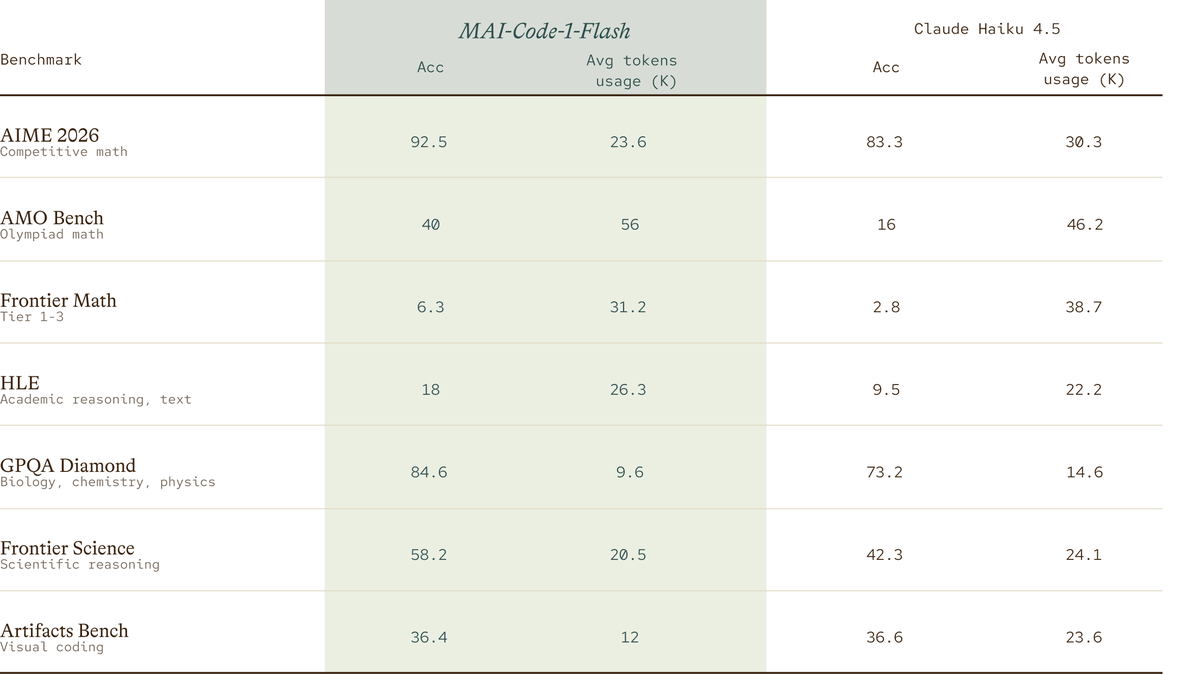
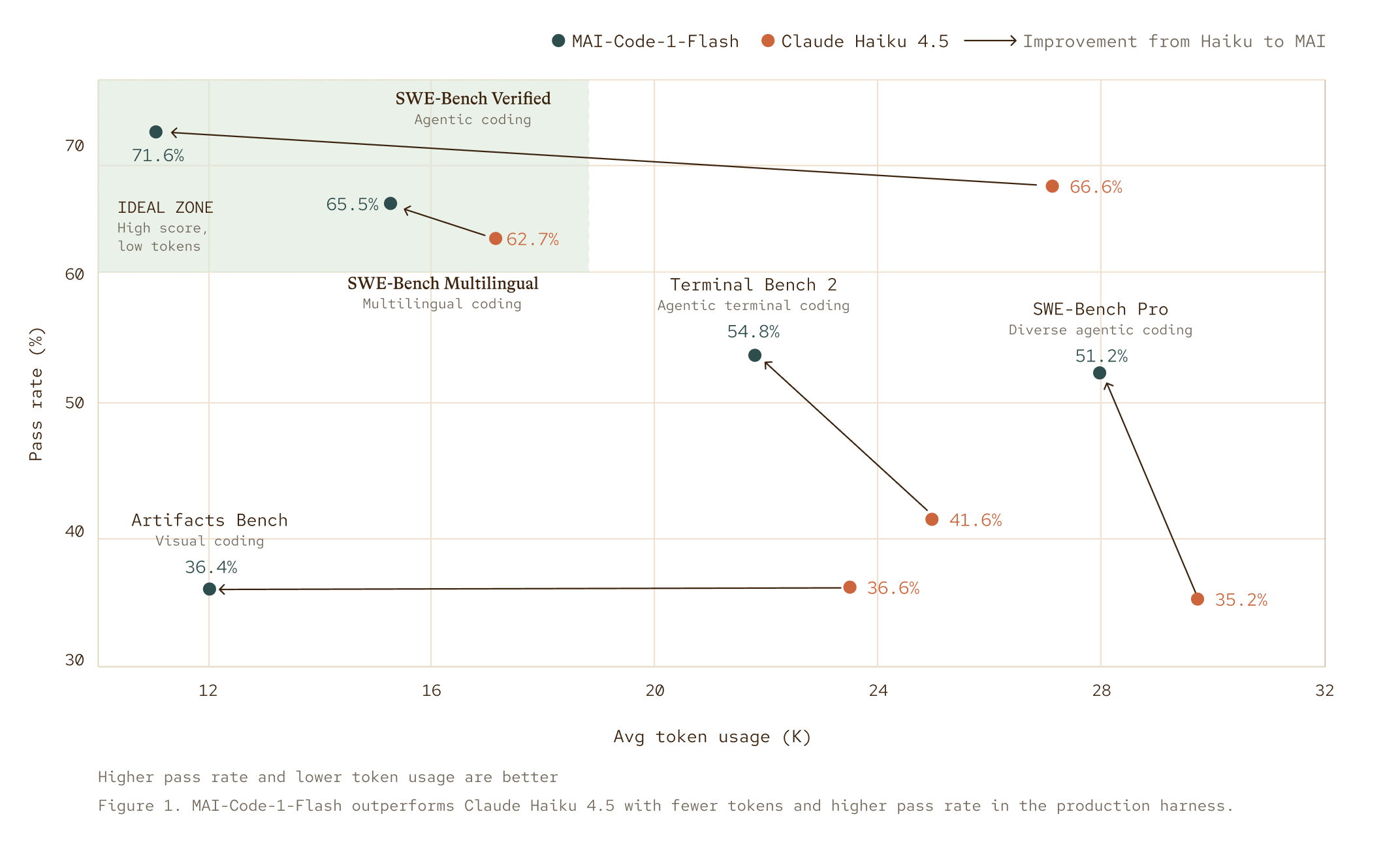
- Benchmarks show a 16-point lead over Claude Haiku 4.5 on SWE-Bench Pro (51.2% vs 35.2%) and up to 60% fewer tokens on hard tasks.
- The key innovation: trained directly inside GitHub Copilot's production harness, not just evaluated against it — so it learns real editor workflows, not synthetic benchmarks.
- Enterprise/Business preview is still incoming; API access available via Fireworks AI, Baseten, and OpenRouter at $0.75/$4.50 per million input/output tokens.
- Known limitation: adversarial reasoning categories like Einstellung traps stay below 50% accuracy — it's a fast workhorse, not a frontier reasoning model.
MAI-Code-1-Flash has completed its rollout to 100% of GitHub Copilot Free, Education, Pro, Pro+, and Max subscribers in VS Code. What started as a gradual launch at Microsoft Build 2026 is now live for every individual Copilot user , no configuration required. Copilot CLI support and an Enterprise/Business preview are still on the way.
Microsoft's first model it truly owns
MAI-Code-1-Flash is Microsoft's first coding model built entirely without OpenAI. For years, Microsoft's AI strategy ran through a single supplier , OpenAI powered Copilot, Azure OpenAI Service, and most of Microsoft's product surface. That relationship created dependency, and dependency creates cost exposure. MAI-Code-1-Flash is the first public signal that Microsoft is building serious in-house model capacity that doesn't route through OpenAI.
In April 2026, restrictions in the Microsoft-OpenAI partnership were lifted, giving Microsoft the right to serve its own models in products rather than defaulting to OpenAI. Build 2026 is the first full public exercise of that right. The one-line summary: Microsoft just stopped being only a customer of frontier labs and started being a competitor to them, starting in the place it controls most , the IDE.
Under the hood: a lean MoE built for the editor
The architecture is a sparse Mixture-of-Experts (MoE) model with 137 billion total parameters but only 5 billion active per token, with a 256,000 token context window. MoE means the model routes each input through a small subset of its total capacity, keeping inference fast and cheap without sacrificing the breadth of a larger model. Microsoft trained it from the ground up on clean, traceable, and enterprise-grade data, without distillation from third-party models.
Not just a new model for Copilot to use, but a model trained inside Copilot's production harness , which is a different thing and the part worth paying attention to. Most coding model benchmarks are evaluated against coding tasks: solve a GitHub issue, pass unit tests, implement a function from a docstring. The model is trained, then evaluated on those tasks, then deployed to tools like Copilot. MAI-Code-1-Flash inverts that.
Microsoft trained it directly against the GitHub Copilot harness used in production, rather than optimizing only for offline benchmarks. That means the model learned to interact with the surrounding tools and systems that agentic coding actually requires: invoking commands, reading repository context, and working through multi-step tasks the way Copilot orchestrates them. During training, Microsoft evaluated checkpoints across core software engineering tasks, repository question answering, refactoring, and telemetry-grounded tasks adapted from real GitHub Copilot usage. The payoff is that offline gains translate into real-world developer quality instead of evaporating when the model hits a real codebase.
The token efficiency story
The headline claim isn't just accuracy , it's doing more with less. MAI-Code-1-Flash was trained with adaptive solution length control, which helps the model adjust the depth of its response to the task. It can stay concise for simpler requests and spend more reasoning budget when a problem requires deeper analysis or broader code changes. In practice, this means developers start seeing useful output sooner , solving harder problems with up to 60% fewer tokens. This helps reduce latency, lower cost, and make interactive workflows feel smoother.
The mechanism: the model adjusts how much reasoning it applies based on task complexity. A variable rename uses minimal budget; a multi-file refactor gets the full allocation. This avoids the latency penalty of always-on chain-of-thought while preserving quality on hard tasks.
Comments
