

Microsoft's MAI-Code-1.1-Flash Hits GitHub Copilot at 73% Lower Cost
MAI-Code-1.1-Flash lands in GitHub Copilot with native vision, 25% better token efficiency, and a 73% price cut over its predecessor
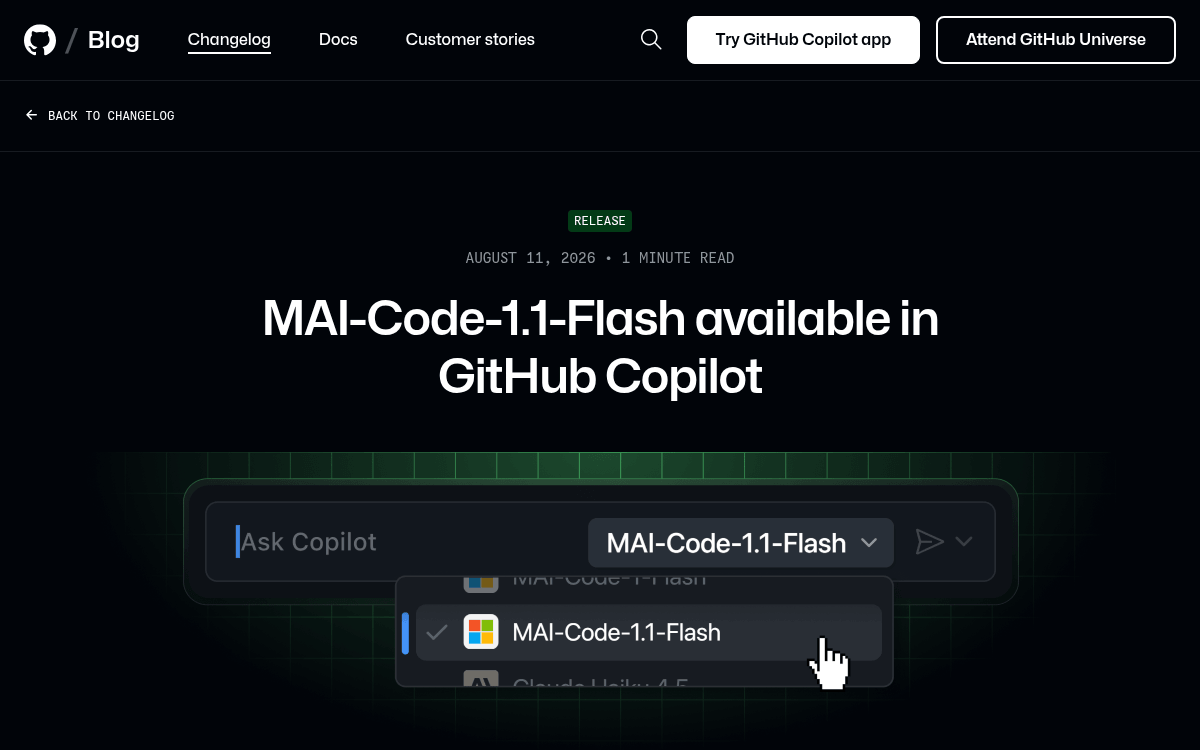
- MAI-Code-1.1-Flash is now rolling out in GitHub Copilot across all tiers and surfaces.
- Costs 73% less than its predecessor (0.25x premium request multiplier for annual subscribers).
- Adds native vision support for image understanding, a first for the MAI-Code line.
- 25% faster token streaming, 25% fewer tokens per task, 22% better CLI performance, 15% better on .NET.
- Trained directly on GitHub Copilot production harnesses using reinforcement learning across hundreds of thousands of real-world environments.
- Enterprise and Business admins must manually enable the policy in Copilot settings; it is off by default.
Microsoft's MAI-Code-1.1-Flash is now rolling out inside GitHub Copilot, and the headline number is hard to ignore: it costs 73% less than the model it replaces while actually being faster and more capable. That's a rare combination in AI, where capability improvements almost always come with a price hike.
What changed from 1.0 to 1.1
MAI-Code-1.1-Flash is Microsoft's latest small-tier coding model, building on MAI-Code-1-Flash with native vision support for image understanding and improvements across coding quality, instruction following, tool use, and performance. The vision addition is new territory for the MAI-Code line, letting the model reason over screenshots, diagrams, and UI mockups alongside code.
The efficiency story is just as compelling as the feature additions. MAI-Code-1.1-Flash produces higher quality code at 25% greater token efficiency and at a quarter of the cost compared to the model launched in June. In practical terms, better training and serving efficiency let Microsoft offer a stronger, faster model at one quarter of the price of 1.0, achieved by optimizing for real-world use across hundreds of thousands of reinforcement-learning environments in GitHub Copilot.
The numbers that matter
Microsoft published concrete benchmark improvements driven by developer feedback on what actually mattered in daily use:
- 22% improvement on Terminal-Bench 2.1 for GitHub Copilot CLI tasks
- 15% improvement on .NET tasks
- 25% faster token streaming in GitHub Copilot
- 25% fewer tokens used to complete the same tasks
- 4% rise in code survival (code that stays in the codebase) and 9% increase in return visits
The last two metrics are the most meaningful. Code survival and return visits are production signals, not benchmark scores. They tell you whether the model's output is actually useful enough that developers keep it and come back for more.
How it was built
Microsoft trained MAI-Code-1-Flash from the ground up on clean, traceable, and enterprise-grade data, without distillation from third-party models. The 1.1 iteration follows the same philosophy but pushes harder on real-world alignment. The model was trained directly with GitHub Copilot harnesses used in production, allowing it to learn how to interact with surrounding tools and systems in agentic coding tasks, making it uniquely well-suited to real-world Copilot workflows.
The underlying architecture is a Mixture-of-Experts (MoE) design, a setup where a large pool of specialized sub-networks ("experts") exists, but only a small subset activates for any given input. The model has 137B total parameters and 5B active parameters, numbers that describe different parts of the MoE architecture. This means you get the knowledge capacity of a large model at the inference cost of a small one.
Where it fits and when to use it
MAI-Code-1-Flash, the predecessor, was purpose-built for coding and optimized for GitHub Copilot, delivering fast, low-latency responses well-suited for high-volume, iterative agentic coding workflows where speed and efficiency matter most. The 1.1 version keeps that positioning but extends it with vision and better CLI performance. Think of it as the model you route most of your Copilot traffic through, not the one you pull out for the hardest architectural problems.
Practical use cases where it shines:
- High-volume agentic loops where you need fast, cheap completions
- CLI-driven workflows (Terminal-Bench improvements are real)
- .NET development
- Multimodal tasks: sharing a UI screenshot or a diagram and asking for code to match it
- Instruction-following chains in multi-turn agent sessions
Availability and pricing
Advances in model and serving efficiency have enabled a 73% lower list price than MAI-Code-1-Flash. For annual GitHub Copilot subscribers, the model is charged at a 0.25x premium request multiplier. This model is billed at provider list pricing under usage-based billing.
MAI-Code-1.1-Flash is available to Copilot Free and Student users through auto model selection. Copilot Pro, Pro+, Max, Business, and Enterprise SKUs can manually select the model in addition to having auto model select it.
You can reach it from the model picker in:
- GitHub Copilot app
- Copilot CLI
- Visual Studio Code
- Visual Studio
- JetBrains IDEs
- Eclipse and Xcode
- GitHub Mobile
- Copilot Chat on GitHub and the cloud agent
Copilot Enterprise and Copilot Business plan administrators must enable the MAI-Code-1.1-Flash policy in Copilot settings. The policy is off by default.
The bigger picture
The MAI-Code line is Microsoft's bet that a model trained natively inside the Copilot harness, on real production workflows, will outperform general-purpose models that are later adapted for coding. Coding models are most useful when they perform well in the same environment developers use every day, which is why Microsoft built MAI-Code with production workflows at the center rather than optimizing only for benchmarks. The 1.1 release is the first public evidence that this feedback loop is working: ship, measure real production signals, iterate. The 73% price drop while improving quality suggests the efficiency gains from that tight training loop are compounding quickly.
For teams running Copilot at scale, the math is straightforward: a model that uses 25% fewer tokens and costs 73% less per token, while producing code that survives at a higher rate, is a meaningful operational improvement. The official changelog has the full availability details, and you can share feedback directly in the GitHub Community Discussion.
Comments
