

Microsoft's BitNet b1.58 Runs a 100B AI Model on a Single CPU
Microsoft's bitnet.cpp runs 100B-parameter models on a single CPU with no GPU, using ternary weights that replace float math with add/subtract ops
 PRO
- CPU-native inference: bitnet.cpp runs 100B-parameter models on a single CPU at 5-7 tokens/sec with no GPU required.
- Ternary weights: Every model weight is constrained to {-1, 0, +1} during training, eliminating float multiplication and enabling fast integer ops on any CPU.
- Efficiency numbers: 0.4 GB memory footprint, 29ms CPU latency, and 0.028J energy per inference — 6x more efficient than Gemma-3 at similar parameter counts.
- Benchmark competitive: BitNet b1.58 2B4T matches or beats full-precision 1-2B models on GSM8K math (58.38) and WinoGrande (71.90), with an average score of 54.19.
- Latest update: A January 2026 kernel optimization added 1.15x-2.1x additional speedup via parallel kernels and embedding quantization support.
- Limitations: Weaker on instruction-following (IFEval) and multi-turn chat (MT-bench); limited non-English support; not yet recommended for production use.
bitnet.cpp is Microsoft's official inference framework for 1-bit LLMs. It runs a 100-billion-parameter language model on a single consumer CPU at 5–7 tokens per second, with no GPU, no cloud, and no exotic hardware required. The mechanism is a fundamentally different way of representing model weights: expensive floating-point multiplication replaced by cheap integer addition.
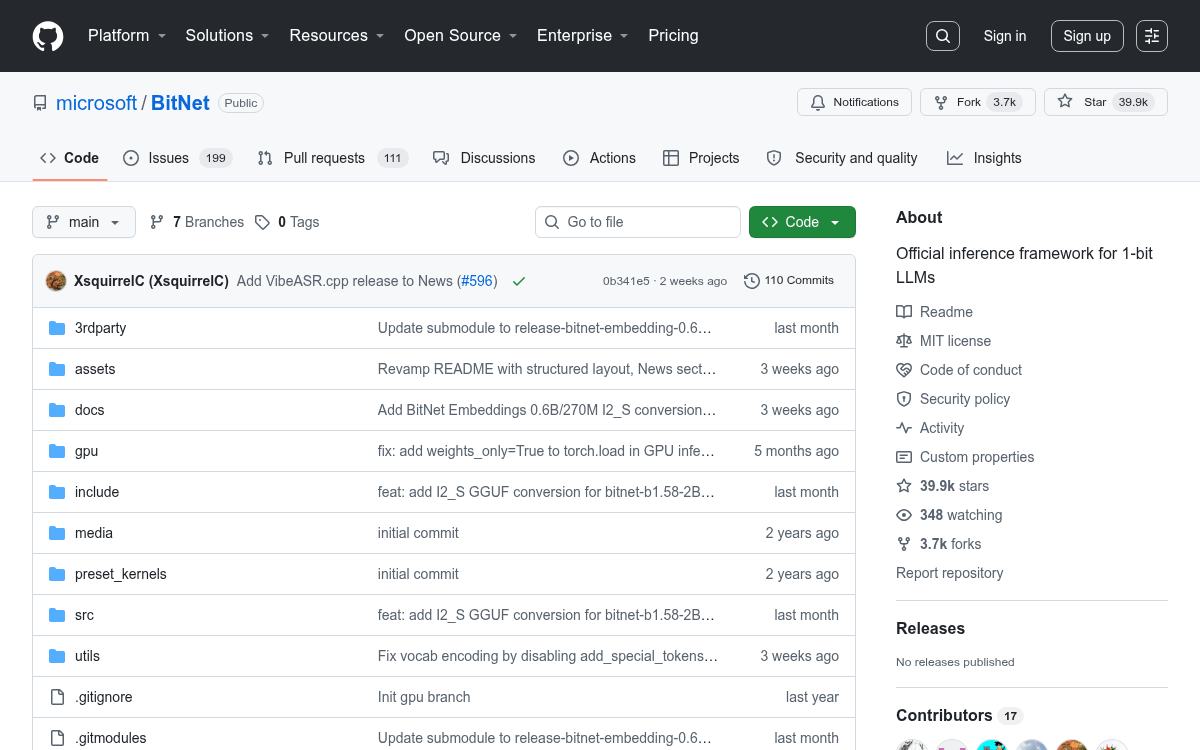
Microsoft released bitnet.cpp as an open-source project under the MIT license, enabling fast and lossless inference of 1.58-bit models on CPU and GPU hardware, with NPU support planned. The repo has crossed 39,000 GitHub stars and draws steady attention from both researchers and engineers.
The math behind it
Standard LLMs store weights as 16-bit or 32-bit floating-point numbers. Every forward pass requires billions of floating-point multiplications, which is precisely why GPUs dominate inference. BitNet constrains every weight in the network to one of three values: -1, 0, or +1. This is ternary quantization. Encoding three distinct values requires log₂(3) = 1.58 bits, hence the "1.58-bit" label.
The consequences are significant. Multiplying by -1, 0, or +1 reduces to a sign flip, a zero, or a pass-through. Matrix multiplication, the most expensive operation in transformer inference, collapses into integer additions and subtractions that any modern CPU handles efficiently. Memory footprint shrinks by over 90% compared to FP16, with surprisingly little quality loss.
Trained ternary, not squeezed down afterward
Post-training quantization (PTQ) methods like GPTQ or AWQ take a trained full-precision model and compress it after the fact, which typically degrades quality. BitNet works differently: all trainable weights are constrained to {-1, 0, +1} from the start of training, guided by 16-bit "shadow weights" that are quantized during each forward pass. A straight-through estimator handles gradient flow through the discrete values. Activations are also quantized within a fixed range. The model learns to operate within the constraint rather than being forced into it retroactively.
This story is for Pro members
You've reached the end of the free preview. Upgrade to AlphaSignal Pro to read the full article - and everything else behind the paywall.
Comments
