
Meta's OpenZL Beats Zstd With 2x Compression by Learning Your Data's Structure
OpenZL v0.2.0 ships a rebuilt SDDL compiler, a native LZ codec, and automatic chunking for multi-GB streams
 Pro
Takeaways
- OpenZL v0.2.0 released: Meta's format-aware compression framework ships its first major update since the v0.1.0 debut.
- SDDL2 is a real compiler: The schema language was rebuilt from scratch — now parses at ~2.4 GB/s, ~300x faster than SDDL1.
- Native LZ codec: New
ZL_GRAPH_LZcodec is 10% faster to compress and 70% faster to decompress vs. zstd level 1. - Multi-GB stream support: Inputs are automatically chunked (~16 MB default), keeping memory bounded and enabling parallel processing.
- Conditional fields in SDDL2: New
whenblocks let you describe optional, version-dependent, or flag-gated fields natively. - Free and open source: BSD-licensed, available on GitHub with C, C++, and Python APIs.
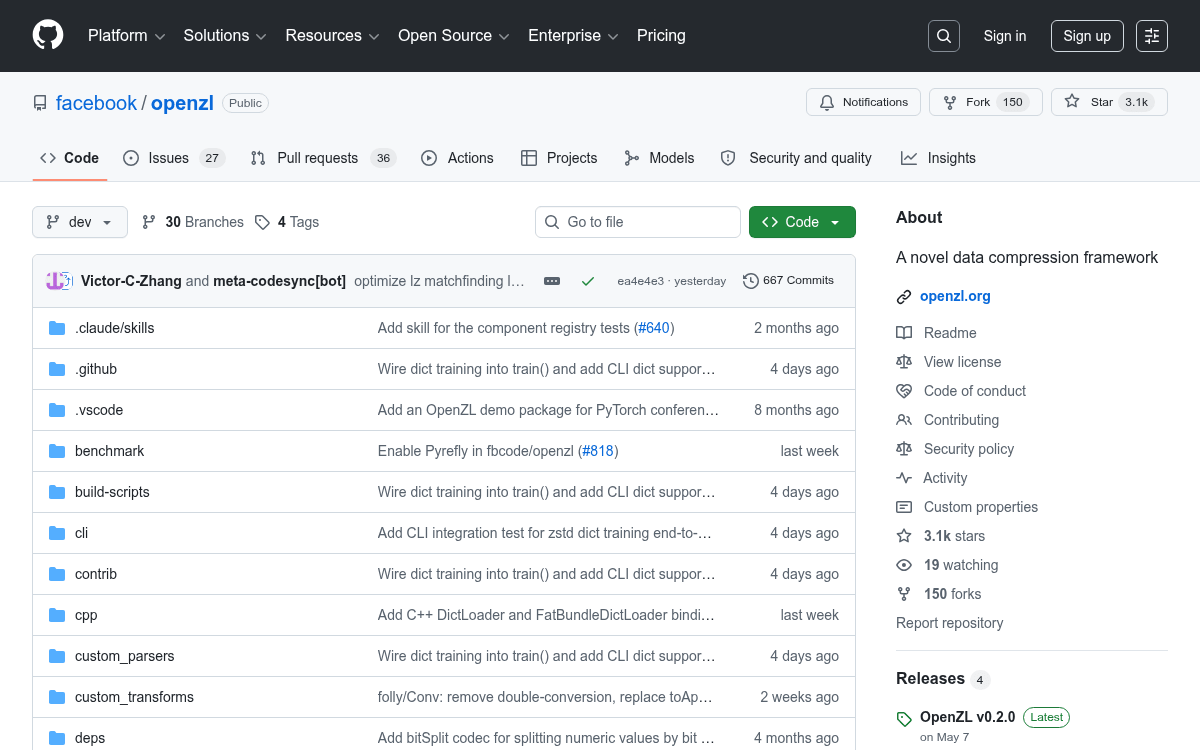
Meta's format-aware compression framework OpenZL just shipped its v0.2.0 release, announced by lead maintainer Yann Collet (Cyan4973 , the same engineer behind Zstandard). This release bundles several months of work since the original v0.1.0. The headline additions: a ground-up rewrite of the SDDL schema engine, a native LZ codec, and the ability to compress gigantic multi-GB input streams without blowing up memory.
If you haven't encountered OpenZL before: the core idea is that most data in production isn't random bytes , it follows a schema. In most datacenters, there are massive data flows, and this data typically follows a well-defined schema or format. If a compression algorithm can be taught about the structure of the data it is compressing, it can achieve significantly better compression performance. OpenZL lets you describe your data's layout, then builds a specialized compressor tuned to that exact format , while still using a single universal decompressor on the other end.
OpenZL is viewed as Meta's next leap in data compression beyond their work on Zstandard (Zstd). On the Silesia SAO corpus benchmark, it already achieves a 2.06x compression ratio at 203 MB/s , compared to zstd -3's 1.31x at 115 MB/s, and xz -9's 1.64x at a painful 3.1 MB/s.
SDDL goes from demo to real compiler
The biggest architectural change in v0.2.0 is SDDL2 , a complete rewrite of the Simple Data Description Language (SDDL), the DSL you use to tell OpenZL about your data's structure. SDDL has been rebuilt from the ground up. Where the original demo was a thin runtime, SDDL2 is a real compiler: a parser feeds a semantic analyzer, the analyzer hands a typed AST to an optimizer, and the optimizer drives a code generator that emits VM bytecode.
The practical payoff is a feature called instant-parse. A record is instant-parse when all its field offsets, sizes, and layout can be computed from parameters and constants alone, without examining the data itself. When a record is instant-parse, the engine can jump directly to any field without scanning through preceding bytes, enabling zero-copy access and multi-GB/s throughput. The result: on the Silesia/sao corpus, SDDL2 parses at ~2.4 GB/s, around 300x faster than SDDL1's ~8 MB/s.
SDDL2 also introduces conditional fields via when blocks, letting you describe formats with optional sections, version-dependent layouts, and flag-controlled features , all resolved at instantiation time rather than at runtime. The compiler now also catches errors like undefined field references and type mismatches at compile time, not at runtime, and ships with VS Code syntax highlighting for .sddl files.
Here's what a record description looks like in SDDL2, using the SAO star catalog as an example:
record StarEntry(STNUM, MPROP, NMAG) {
  when STNUM > 0 { XNO: Float32LE },
  SRA0:  Float64LE,
  SDEC0: Float64LE,
  ISP:   Bytes(2),
  when abs(NMAG) > 0 { MAG: Int16LE[abs(NMAG)] },
  when MPROP >= 1 {
    XRPM: Float32LE,
    XDPM: Float32LE
  }
}
A native LZ codec and multi-GB streaming
OpenZL now ships its own LZ codec, exposed as ZL_GRAPH_LZ and in the serial profile in zli. It is still being actively developed, and today supports the equivalent of zstd level 1 with a 64K window size. Despite being early, OpenZL 0.2's native LZ codec already offers 10% faster compression and 70% faster decompression compared to Zstandard level 1.
The other major operational improvement is large-stream support. OpenZL's zli tool is now compatible with huge inputs (multi-GBs). They are now split automatically into chunks of controllable size (roughly 16 MB by default) before compression, which keeps memory bounded, improves locality, and opens the door to parallel processing. SDDL2 has gained equivalent automatic chunking on the schema-driven path.
New segmenters have been created or updated for CSV, Parquet, and standard numeric data , and all segmenters are now serializable and parameterizable, so a chosen layout can be persisted in a compressor and reused later. Worth noting: the training pipeline is different and remains unaffected , it is not designed to accept gigantic inputs as training material.
Who should care
- ML infrastructure teams storing or streaming large tensor datasets, embeddings, or training checkpoints
- Data engineers working with high-volume structured formats like Parquet, Protobuf, or CSV at datacenter scale
- Anyone bottlenecked on I/O in pipelines where generic compressors like zstd are already in use but format structure is being left on the table
This technology is best suited for data that can be described and structured. It is not intended for compressing arbitrary or random files from the internet. If your data has a schema, you can describe it in SDDL and let OpenZL build a compressor around it. If it doesn't, stick with zstd.
OpenZL is BSD-licensed and available now on GitHub. The quick-start guide walks through building and running your first compressor. The project also has a whitepaper on arXiv covering the theoretical underpinnings in depth.