

Meta's Muse Spark 1.3 Cuts Tool Calls 20% and Stops Agents From Hallucinating
Meta's latest agentic model trims tool calls by 20 percent and tokens by 25 percent while learning when to ask for help.
- Meta released Muse Spark 1.3 with improved agentic and coding performance.
- Uses ~20% fewer tool calls and ~25% fewer tokens versus Muse Spark 1.2 internally.
- Trained to ask clarifying questions, flag when stuck, and confirm irreversible actions.
- Better calibrated on its own limits instead of hallucinating outcomes on hard tasks.
- Available now in Muse Code and Meta Model API at dev.meta.ai; max reasoning pending safety testing.
- Roadmap includes bigger models and Muse Spark 1.2 open weights release.
Meta Superintelligence Labs released Muse Spark 1.3, an incremental upgrade to its agentic coding model that targets the failure modes most likely to bite developers in production: dropped constraints, runaway tool calls, and confident hallucinations when the model hits a wall.
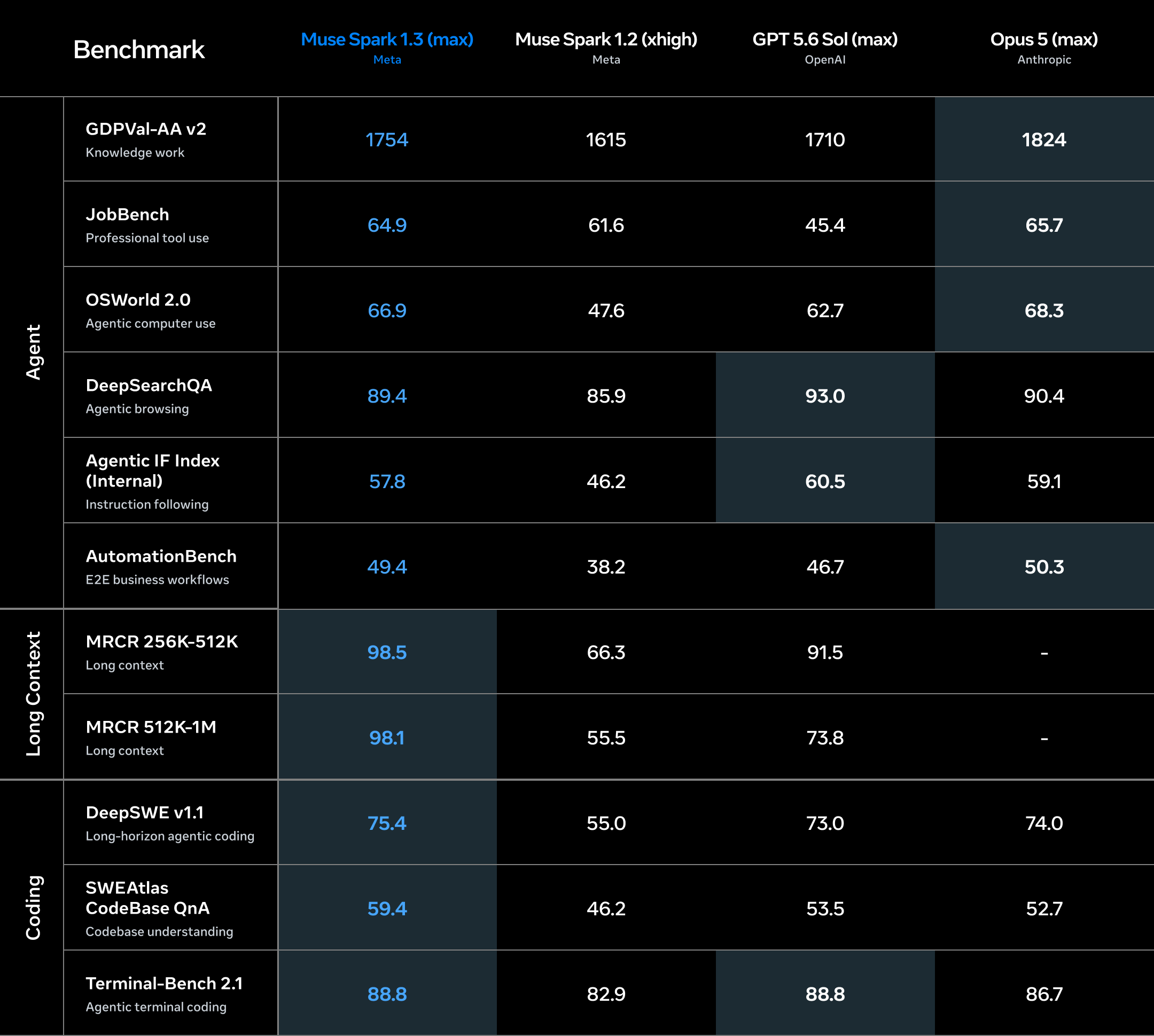
The efficiency gains are concrete. In internal comparisons, Muse Spark 1.3 uses roughly 20% fewer tool calls and 25% fewer tokens than 1.2 on identical tasks, which cuts cost and latency directly on long-horizon agent runs.
An agent that admits when it is stuck
The most substantive behavioral change is calibration. Muse Spark 1.3 asks clarifying questions on ambiguous prompts, surfaces uncertainty instead of fabricating answers, and confirms before taking consequential actions. Meta describes training it to recognize the boundaries of its own knowledge and to pause at hurdles rather than hallucinate past them. Paired with tighter instruction-following, the model is designed to carry detailed requirements through a long task without drifting.
If you have watched an agent confidently rm -rf the wrong directory or invent an API response rather than admit ignorance, that is the failure mode this release targets.
Longer threads, messier contexts
Muse Spark 1.3 is built to sustain open-ended work inside a single long thread, juggling multiple workflows simultaneously. Given a broad objective, it generates its own context from messy or conflicting sources, proactively closes gaps in its plan, and tracks what it has learned toward a final deliverable. In practice, that means you can work across a CFD simulation report, an audio edit, and a slide deck inside one thread without the model losing track of which task an incoming prompt belongs to, even when you are overriding or interrupting earlier requests.
What changed under the hood
Meta is light on architectural specifics but describes the training approach in broad strokes:
- Training across diverse agentic harnesses to generalize across scaffolds rather than optimizing for one.
- More long-horizon coding tasks in the mix, producing shorter outputs with fewer unnecessary turns.
- Stronger adversarial robustness, with improved resistance to prompt injection and other agentic misuse vectors.
- Better calibration around irreversible actions, so the model proceeds more carefully when the stakes of a mistake are high.
Where it fits
Based on Meta's published demos and evaluations, the strongest use cases are:
- Long-running engineering agents that call many tools and need to stay on-plan.
- Document generation from messy inputs, such as drafting a CFD report from a STEP file plus raw simulation data.
- Multi-step office work where dropped constraints are expensive, like producing an 8-to-10 slide deck with strict content requirements.
- Coding sessions where token efficiency matters and you want less preamble and self-narration.
Max reasoning mode is not live yet. Previously available reasoning modes ship today, with max reasoning following after additional safety testing. Workflows that depend on the highest reasoning tier will need to wait.
How to get it
Muse Spark 1.3 is available now in Muse Code and through the Meta Model API. Access starts at dev.meta.ai, which routes to both. Pricing was not published alongside the model card; existing Meta Model API rates apply.
What is on the roadmap
Meta previewed larger models and an open weights release of Muse Spark 1.2 pending final safety fine-tuning. The open weights drop is the one worth tracking: it would give the community a capable agentic base model to fine-tune, arriving at a moment when the gap between closed frontier labs and open-weight alternatives has been one of the defining tensions in the field.
Muse Spark 1.3 will not move any leaderboards on its own. Agents that call fewer tools, surface uncertainty, and confirm before causing damage are more useful for anyone shipping to real users than a few extra points on a coding benchmark, and that is the direction this release moves.
Comments
