
Meta's Muse Image Hits Top 5 Rankings for Just One Cent
Meta Superintelligence Labs' first image model lands at #4 for editing and #5 for text-to-image, undercutting Google's Nano Banana 2 by more than 6x on price.
Takeaways
- Meta's Muse Image debuts at #4 in editing, #5 in text-to-image on Artificial Analysis Arena.
- Priced at $0.01 per image, over 6x cheaper than next Pareto-frontier model Nano Banana 2.
- First image model from Meta Superintelligence Labs, the group led by Alexandr Wang.
- Agentic architecture: planner plus diffuser, with tool calls and self-refinement in one chain of thought.
- Strongest at lighting, reasoning, scene/style edits, identity-preserving edits, and social/creator content.
- Available via Meta Model API, fal, Runway, OpenRouter, Meta AI app, Instagram Stories, WhatsApp.
Meta's Muse Image entered the Artificial Analysis rankings at No. 4 for image editing and No. 5 for text-to-image generation. Both boards place it on the quality-price Pareto frontier, meaning no listed alternative combines a higher score with a lower price. At $0.01 per generation, Muse Image is the least expensive model among the top five on either board.
Muse Image is the first image system from Meta Superintelligence Labs, the organization created after Meta acquired a reported Scale AI stake and consolidated FAIR, the Llama teams, and other groups under Alexandr Wang. The model is available through the Meta AI app, meta.ai, Instagram Stories, and WhatsApp in a limited set of countries. Developers can access it through the Meta Model API and partner platforms including fal, Runway, and OpenRouter.
A planner in the loop
Muse Image handles each request as a multi-step workflow: it plans the task, invokes tools when needed, generates an image with a diffusion model, and evaluates drafts before returning the result. Meta describes this approach as agentic. The orchestration can reduce external model routing and manual cleanup when prompts require several coordinated operations.
The planner can use web search to ground factual details and run code to render elements such as charts or QR codes. The diffuser converts the plan into pixels, while a refinement loop checks and revises the draft. Muse Image can also combine multiple reference images within one request.
Near the top for one cent
At publication, the Artificial Analysis Image Arena ranked Muse Image behind three models for editing and four for text-to-image generation:
| Task | Muse Image rank | Higher-ranked models |
|---|---|---|
| Image editing | No. 4 | MAI-Image-2.6-Preview, GPT Image 2 (high), Nano Banana 2 |
| Text-to-image | No. 5 | MAI-Image-2.6-Preview, GPT Image 2 (high), Nano Banana 2, Reve 2.1 |
At $0.01 per image through the Meta Model API, Muse Image costs less than one-sixth as much as Nano Banana 2, the next model on the quality-price frontier. That difference compounds quickly in workloads producing thousands or millions of assets.
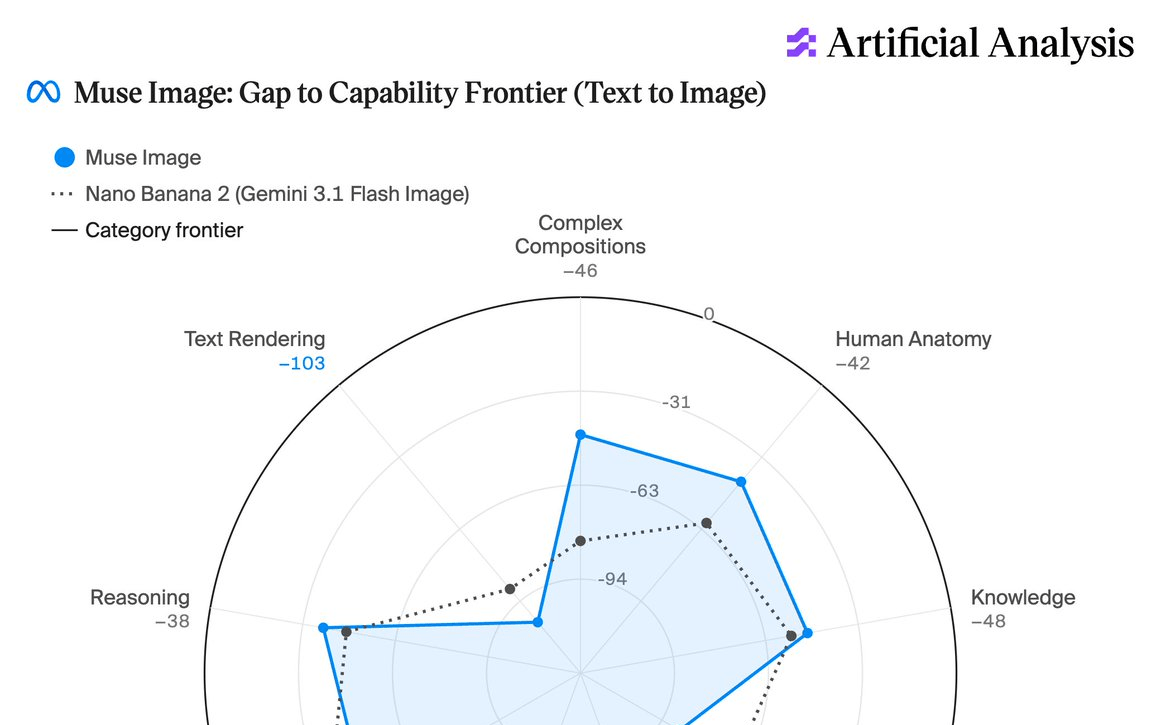
Artificial Analysis gives Muse Image its strongest scores in these areas:
- Lighting and Reasoning for text-to-image generation, covering light direction, falloff, shadows, and prompts that require inference.
- Scene and Style Edits and Identity Preserving Edits, including relighting, restyling, and changes that retain a person's or character's identity.
- Social Media and Creator Content across both boards, followed by Animation and Gaming for text-to-image generation and Frontier Prompts for editing.
An OpenAI-shaped API
The Meta Model API follows OpenAI Images conventions for text-to-image generation and editing, which limits migration work for teams already using that interface. Image-to-image editing and multi-image composition use POST /v1/images/edits.
With an OpenAI-compatible client configured for Meta's base URL and API key, a minimal edit request looks like this:
with open("tagged.webp", "rb") as listing:
    response = client.images.edit(
        model="muse-image-1.0",
        prompt="remove the boots, leave bare floor; update the book price tag to $12",
        image=listing,
    )
Operational constraints
- Resolution: The model supports images up to 1,600 pixels.
- Text rendering: Exact lettering can vary between runs. Keep embedded text short, specify numbers explicitly, and allow for retries when labels must be precise.
- Composition: Multi-image requests may reflow the layout, rearrange elements, or redraw inputs instead of reproducing them exactly.
- Determinism: Repeating the same prompt can produce a different image on each call.
Where the economics work
Muse Image ranks below GPT Image 2, Nano Banana 2, and other leaders on raw benchmark quality. Its one-cent price, OpenAI-compatible interface, and availability through established platforms create a practical option for high-volume generation.
Ad variants, catalog assets, social posts, and personalized creative often require many outputs rather than one final image. Lower per-image costs can make those workloads viable while preserving scores close to the benchmark leaders. Meta also gains a first-party model it can integrate into its advertising systems and consumer products, giving Muse Image a role beyond the developer API.