

Meta's Muse Glimmer Runs 100-Tool Agent Loops on a Single GPU
Meta's 30B agentic vision model lands with Unsloth GGUF quants that fit inside 14GB VRAM and still fire off hundreds of tool calls without breaking.
 PRO
PRO- Meta released Muse Glimmer 30B, its first open-weight model from Superintelligence Labs, under Apache 2.0.
- Distilled from Muse Spark, it targets local agentic workflows with tool use, reasoning and vision built in.
- Unsloth GGUF quants run it on 18GB VRAM, with 2-bit builds fitting inside 14GB.
- DFlash block-diffusion drafter delivers 3.1x decode speedup on an RTX 5090, hitting 233 tok/s.
- Leads Gemma4-31B and Qwen3.6-27B on MCP Atlas, DeepSearch QA and SWE-Bench Pro benchmarks.
- Trails Qwen3.6-27B on OSWorld-Verified and TerminalBench, weaker at direct computer-use tasks.
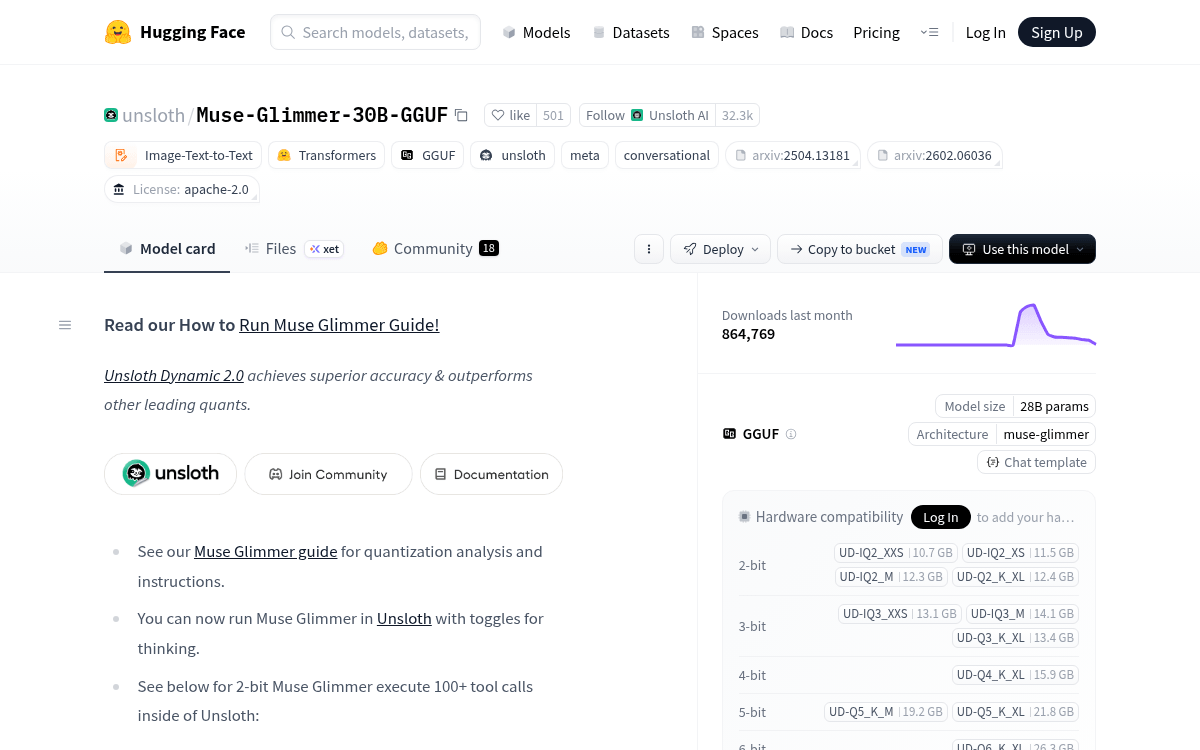
Meta's Superintelligence Lab has dropped its first open-weight model in the post-Llama era, and Unsloth's GGUF conversion makes it runnable on the machine sitting on your desk. Muse Glimmer is a 30-billion-parameter multimodal model distilled from Muse Spark, tuned for always-on local agent workflows, and shipping under Apache 2.0. The Unsloth build has already crossed 860,000 downloads, and community demos show 2-bit quants chaining more than 100 tool calls on a single mid-range GPU.
At full precision the 30B model requires more than 55GB of memory, but Meta developed roughly 4-bit quantized versions that shrink the language-model weights to under 20GB, leaving headroom for the KV cache, the perception encoder, and a companion speculative-decoding model. That headroom is the entire point. Muse Glimmer was designed from the start to sit inside an agent loop on consumer silicon, not to be a chat toy that happens to fit.
What Meta actually shipped
Muse Glimmer is a 30-billion-parameter causal language model with a dedicated perception encoder, distilled from Muse Spark and purpose-built for autonomous agentic tasks on consumer hardware. It folds multi-step reasoning, reliable tool use, multimodal understanding, and failure recovery into a single model that runs locally without cloud infrastructure or network access. Under the hood sits a dense transformer, meaning all 30B parameters activate on every forward pass rather than routing through a smaller subset like a mixture-of-experts design.
The architecture details matter for anyone trying to squeeze it onto a card. Grouped-query attention runs with 32 query heads and only 2 KV heads, and attention repeats a [Local, Local, Local, Global] pattern with a 2,048 sliding window. The vision side is a ~1.8B ViT-G/14 perception encoder that accepts up to 4,096 visual tokens per image. Context length is 131,072+ tokens, and the vocabulary is 202,048 tokens.
This story is for Pro members
You've reached the end of the free preview. Upgrade to AlphaSignal Pro to read the full article - and everything else behind the paywall.
Comments
