

Meta Reveals Muse Spark 1.2's Multimodal Jump From 59.8 to 72.0 With Tools
Meta shared new benchmarks, robotics demos, and a real-world agent evaluation for Muse Spark 1.2, its coding-focused multimodal model ahead of an open-weights release.
- Meta released the multimodal side of Muse Spark 1.2 with new benchmarks and demos.
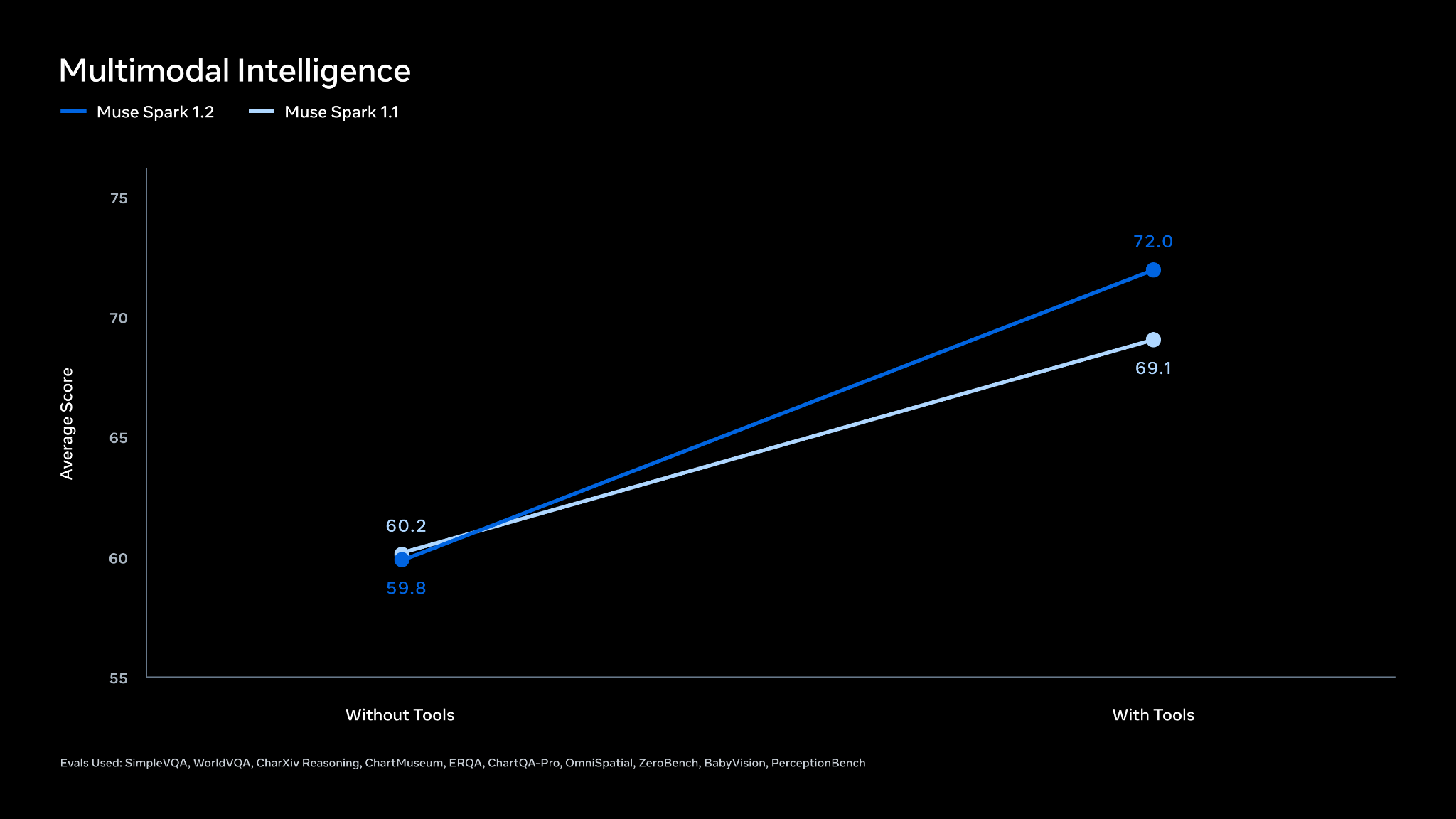
- Tool use boosts average multimodal score from 59.8 to 72.0 across evaluations.
- Muse Spark 1.2 leads Design Arena Video-to-Website at 1279 Elo, ahead of Kimi K3.
- A specialized variant plans subtasks for a bimanual robot using a lower-level VLA policy.
- Meta previewed WildArtifactBench, a real-world agentic evaluation with 10 public tasks.
- Available in Meta Model API and Muse Code, with open weights coming.
Meta's Superintelligence Labs pulled back the curtain on the multimodal side of Muse Spark 1.2, the coding-focused update to Muse Spark 1.1 that shipped earlier this month. The team paired new visual reasoning benchmarks with robotics and audio-visual demos, and previewed WildArtifactBench, an internal evaluation for real agentic work. An open-weights release is on the way.
The headline: Muse Spark 1.2's multimodal gains are most pronounced when the model can use tools, because it can inspect visual inputs more closely and incorporate what it finds into its reasoning. On the aggregated multimodal suite, average score climbs from 59.8 without tools to 72.0 with tools, a meaningful jump for agentic pipelines that already give the model a shell, a browser, or a rendering environment.
Where it lands on the leaderboards
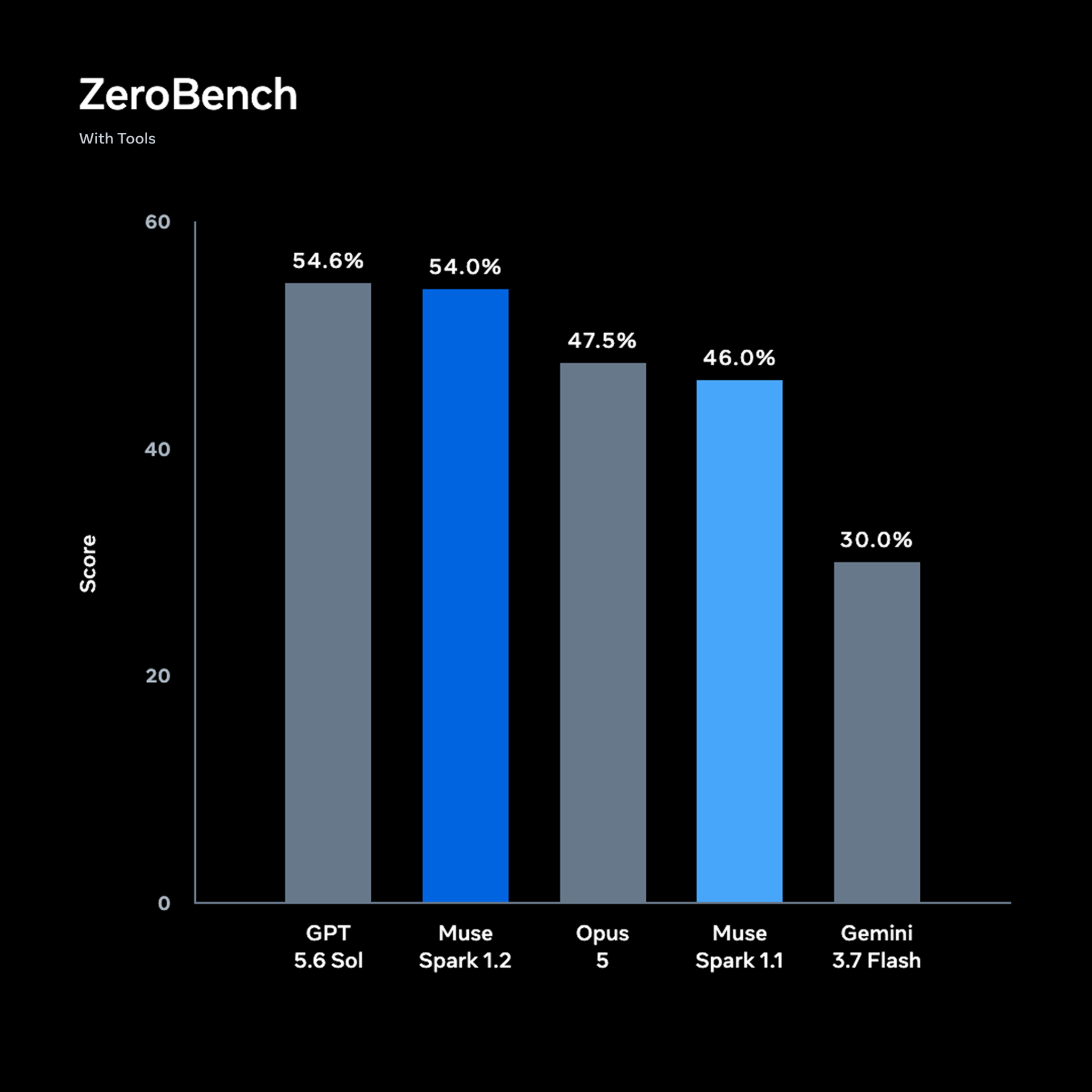
Meta ran Muse Spark 1.2 against the current frontier on three visual reasoning benchmarks. On ZeroBench it hits 54.0%, just behind GPT 5.6 Sol at 54.6% and ahead of Opus 5 at 47.5%. On SimpleVQA it scores 75.0%, trailing Gemini 3.7 Flash at 77.8% but well above GPT 5.6 Sol at 64.7%. On CharXiv Reasoning, the field is tight: Opus 5 at 89.3%, Muse Spark 1.2 at 87.6%.
The visual-to-code numbers are more decisive. On Design Arena's Video to Website task, Muse Spark 1.2 tops the board at 1279 Elo, ahead of Kimi K3 (1243) and its own 1.1 predecessor (1236). Image to Website and Image to Frontend are competitive but not first place, with Kimi K3 leading both.
Visual coding as a self-improving loop
Muse Spark 1.2 creates digital artifacts such as web pages and games, where correctness is judged by whether the result renders and behaves as intended. Given an image or video, the model must translate its layout, hierarchy, and style into working code. By re-examining the artifacts it generates, it drives a continuous self-improvement loop.
That behavior-based grading is the interesting piece. Instead of matching against a reference solution, the model runs the artifact, inspects the rendered output, and iterates. A previously shown demo took a fly-through video of a home input into the terminal as an mp4 file, which Muse Code interpreted to produce a visually rich vacation home marketing and booking page.
A planner brain for bimanual robots
The robotics work is where Muse Spark stops being a chatbot. A specialized variant acts as the robot brain and orchestrator, taking user instruction, decoding tool calls, observing results, and looping until the task is done. For manipulation, Meta uses a two-level system: a high-level planner performs scene understanding, disambiguates similar objects, and decomposes the goal into subtasks, each executed by a low-level Muse Spark Vision-Language-Action (VLA) policy.
The demos include a bimanual robot tidying a desk (correctly separating a hair brush from a makeup brush and stashing lipstick in a drawer), packing fruit into a lunch box, and navigating an unstructured environment to find a rubber duck. A VLA policy, for readers new to the term, is a model that maps camera frames plus a language instruction directly to robot actions. Splitting planning from low-level control lets the planner reason with a bigger model while the actuator runs something smaller and faster.
WildArtifactBench: judging agents by what they ship
Meta is also previewing WildArtifactBench, an internal evaluation aimed at the gap between benchmark scores and real deliverables. Win rate and Elo scores are obtained by comparing the deliverables of the tested and baseline agents. Both agentic judges and human judges can do the comparison and choose a preference, which broadens task coverage and diversity by removing the need for ground-truth deliverables and objective rubrics.
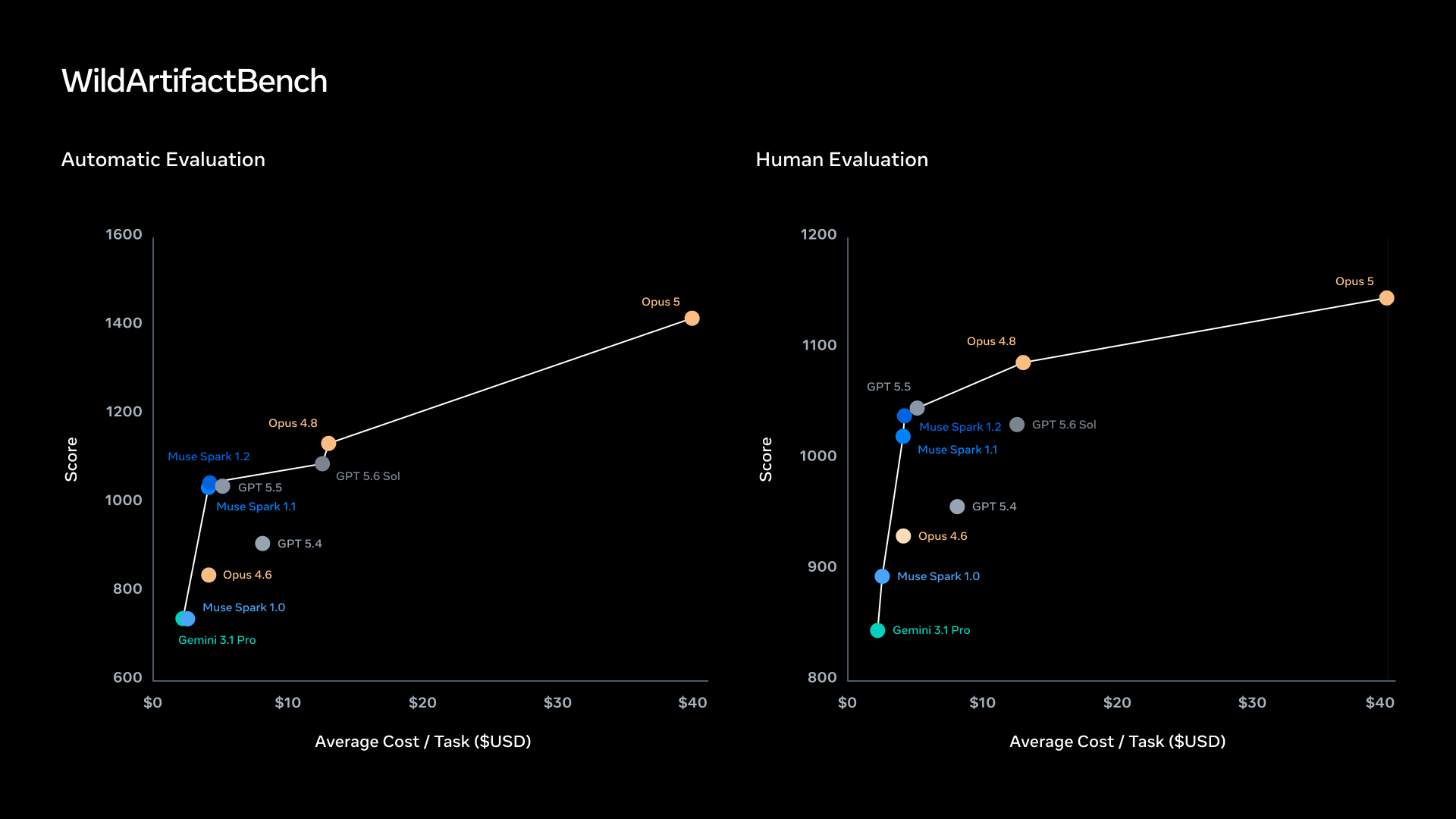
Sample tasks include analyzing a 16-frame cardiac ultrasound sequence and building a DQN driving trainer with a 3D environment and metrics dashboard. Meta is releasing 10 tasks from WildArtifactBench as a preview, framed as an attempt to measure practical utility rather than isolated capability.
How it was built
Muse Spark 1.2 is a coding-focused update to 1.1. Under the hood, Meta made a few decisions worth flagging:
- Meta significantly scaled up training compute on coding tasks while expanding training environment diversity, and the model retains general-agent strength.
- The model was co-trained with Muse Code using rejection-sampled harness trajectories and recipe optimizations for goals, compaction, and subagents, alongside integration of the Muse Code toolset.
- It was extensively trained on long-horizon coding tasks including whole-repository generation, large end-to-end projects, and auto-research, using planning to sequence work, goal conditioning to maintain direction, and context compaction to retain progress.
- Meta used Muse Spark 1.1 to generate challenging coding environments and instruction-following templates, then graded candidate solutions on how well they satisfied requirements. That self-improvement loop produced a scalable training set for 1.2.
The kernel optimization case study is a good indicator of where this model wants to be used. Meta ran the agent for 1,000+ tool calls over up to 24 hours, writing, compiling, profiling, and progressively improving KDA and MLA kernel performance on NVIDIA Hopper GPUs, and reported substantial speedups over the PyTorch baseline.
Where it slots into your stack
Practical uses this release is clearly aimed at:
- Turning designs, screenshots, or video walkthroughs into working frontend code, especially where iteration on rendered output matters.
- Video-heavy enterprise workflows that combine dense captioning, real-time search, and spatial grounding.
- Robot planners that need to decompose a natural-language goal into subtasks and coordinate a VLA policy underneath.
- Agentic media generation pipelines. Internally, Muse Spark works with Muse Image for agentic media generation, producing highly detailed captions as training data for Muse Image and Video.
Availability
Muse Spark 1.2 is available now in the Meta Model API and in the Muse Code terminal coding agent. Meta says an open-weights release is coming next, which is the piece most teams outside the Meta ecosystem will be watching for.
Comments
