

Meta Drops Muse Glimmer, a 30B Open Agent That Runs Offline
Meta open-sources Muse Glimmer, a 30B agentic model distilled from Muse Spark 1.2 that runs on a single consumer GPU under Apache 2.0
- Free & open: Meta releases Muse Glimmer 30B weights under Apache 2.0, available now on Hugging Face.
- Runs locally: Fits on 18 GB VRAM after quantization; tested on M4 Max, M5 Max, and RTX 5090 -- no cloud required.
- Distilled from Muse Spark 1.2: Uses logit distillation and RL post-training to transfer agentic reasoning from a much larger teacher model.
- DFlash speculative decoding: A block-diffusion drafter model delivers up to 3.1x faster generation on RTX 5090 with no quality loss.
- Agent-first design: Trained for multi-step tool use, failure recovery, multimodal input, and long-horizon task completion -- not retrofitted from a chat model.
- More open weights coming: Meta has signaled open weights for Muse Spark 1.2 are also on the way.
Meta Superintelligence Labs has released Muse Glimmer, a 30-billion-parameter open-weight model built for agentic workflows that run entirely on local hardware. The weights are available on Hugging Face under an Apache 2.0 license, free to use, modify, and build on.
The gap it fills
Capable models have historically demanded cloud infrastructure. Running AI locally removes that dependency, but until now, models small enough for a consumer GPU lacked the agentic reasoning to be genuinely useful. Muse Glimmer is a distilled version of Meta's Muse Spark 1.2, compressed to fit on a single GPU without gutting the agentic capabilities that make it worth running. Meta's Chief AI Officer Alexandr Wang put it plainly: "a 30B model that runs on a single consumer GPU, with open weights for a version of Muse Spark 1.2 coming soon."
What it can actually do
The model targets always-on local agent workflows: function calling, coding assistance, and LLM-as-a-judge evaluation. A published demo shows Glimmer autonomously discovering a local Home Assistant instance via network tool calls, querying device APIs, writing a full HTML/CSS/JS dashboard from scratch, and deploying a local server to verify it, all from a single natural language prompt.
The full capability set includes:
- End-to-end agentic task completion: Strong results on DeepSearch QA, MCP-Atlas, tau-Bench, and SWE-Bench, which measure scaffolded tool use, code writing and debugging, and multi-turn task resolution.
- Failure recovery: When a tool call fails or returns an unexpected result, the model diagnoses the error and retries rather than halting.
- Multimodal input: A dedicated perception encoder accepts interleaved text and images, so agents can interpret screenshots, charts, and documents.
- Controllable reasoning effort: Adjustable reasoning depth lets you trade quality for speed depending on the task.
- Multilingual: Trained on data from more than 100 languages.
- Long-running sessions: Supports multi-step planning, sequential tool calls, runtime memory, and state persistence across extended tasks.

How it was built
Training ran in three phases, each adding a layer of agentic capability:
- Pre-training via logit distillation: Glimmer learned from Muse Spark's output probability distributions, not just its final answers. This technique, called logit distillation, lets a smaller student model absorb the teacher's reasoning patterns more faithfully than copying outputs alone.
- Mid-training: The model trained on longer-context, agent-heavy data with richer reasoning traces, mixed with organic data.
- Post-training: A combination of supervised fine-tuning, on-policy distillation (the student generates its own rollouts and learns from them), and reinforcement learning across general, reasoning, coding, and agentic domains.
Applying distillation specifically to agentic reasoning traces, rather than general text, is what separates Glimmer from a generic compressed model. It inherits structured tool-use behavior from a much larger system, not just fluency.
Two optimizations that make it fast enough to use
A capable model that takes three minutes to respond is useless as a local agent. Meta applied two targeted optimizations to close the latency gap.
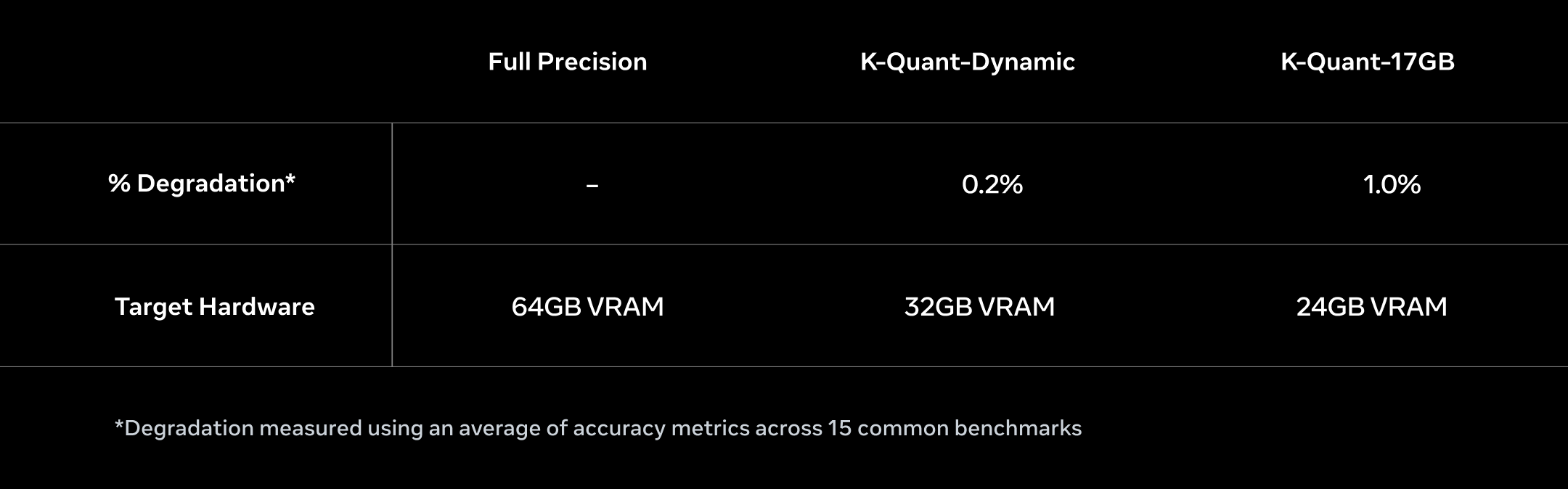
Quantization to fit on-device. At full precision, a 30B model requires over 55 GB of memory. Meta quantized the weights from 16-bit floating point down to roughly 4-bit integers, shrinking the language model to under 20 GB. That leaves enough headroom for the KV cache (the model's working memory for long conversations), the vision encoder, and the speculative decoding drafter to run simultaneously within a 24 GB or 32 GB envelope. Meta reports minimal accuracy degradation on agentic tasks after compression.
Speculative decoding via DFlash. Language models generate one token at a time by default. Glimmer ships with a lightweight companion model based on DFlash, a speculative decoding framework accepted at ICML 2026. DFlash uses a block diffusion model to draft multiple tokens in a single forward pass, conditioning on context features extracted from the main model. The main model then verifies those drafts in parallel, accepting correct tokens and correcting wrong ones. The result is over 6x lossless acceleration across models and tasks, with up to 2.5x higher speedup than EAGLE-3, the previous state-of-the-art speculative decoding method. On an RTX 5090, this translates to a 3.1x decode speedup for Glimmer specifically.
What you need to run it
Muse Glimmer runs on systems with 18 GB of RAM or VRAM, including Macs and GPU/CPU setups. Meta has validated it on MacBook M4 Max, M5 Max, and RTX 5090. Integrations are available across the ecosystem:
- Local inference: Ollama, LM Studio, llama.cpp, MLX, ExecuTorch, Unsloth
- Cloud serving: vLLM, SGLang, Together AI, Fireworks AI, OpenRouter
- Fine-tuning: PyTorch TorchTitan
Meta is also working with AMD, Arm, Dell, Intel, and NVIDIA to optimize performance across devices. Documentation, scaffold setup guides, and additional resources are at Meta's AI Developer Center.
A two-tier open strategy taking shape
Previous local models were general-purpose text generators that developers tried to coerce into agent behavior. Glimmer was trained from the ground up with agentic tasks as the primary objective, then compressed to fit on hardware most developers already own. That combination is new.
Meta has also signaled that open weights for Muse Spark 1.2 are coming soon. A frontier-class foundation model paired with a locally-runnable agentic derivative suggests a deliberate two-tier approach: powerful cloud models and capable edge models sharing the same lineage. For developers building privacy-sensitive agents that handle personal files, calendars, local services, or confidential documents, Glimmer is the first serious option that keeps all data on-device.
Comments
