

Meta and Imperial College Expose the Hidden Effort Problem Corrupting AI Training Data
A new game-theoretic framework shows why 'attention checks' fail for LLM data annotation and how reward models can pick better ones
 PRO
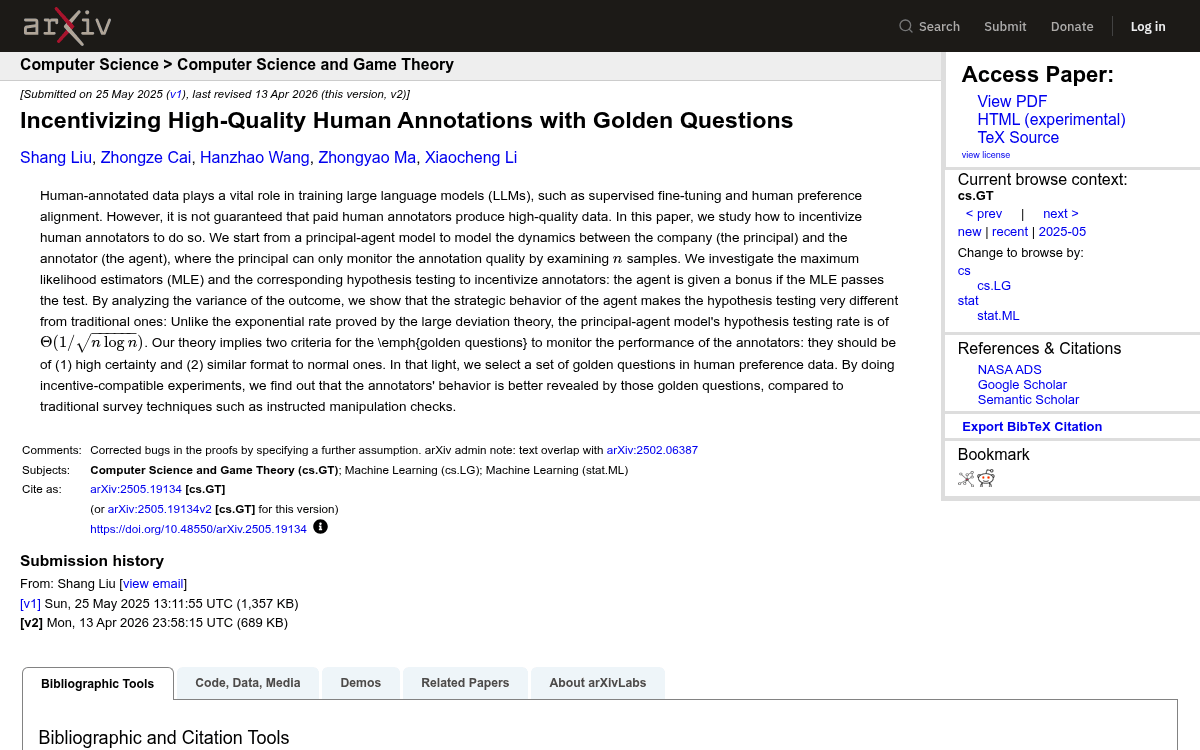
- New paper models LLM data annotation as a principal-agent game where annotator effort is hidden
- Proves monitoring gap closes at Θ(1/√(n log n)), much slower than classical hypothesis testing
- Two criteria for golden questions: high certainty answers and identical format to normal samples
- Reward model confidence used to auto-select golden questions from existing preference datasets
- Real experiment on Prolific with 90 annotators shows RM-selected questions beat instructed attention checks
- Real golden questions produce 11.1 point accuracy gap vs 7.0 for instructed manipulation checks
Paid human annotators do not always work hard. When companies buy the preference data that powers RLHF and DPO, they usually rely on honor codes or spot checks, and the downstream training pipeline treats the labels as ground truth. A new paper from Imperial College London and Meta puts this quality problem on a formal footing and proposes a concrete fix: pick "golden questions" whose answers a reward model already knows with high confidence, then pay a bonus when annotators get them right.
The moral hazard hiding in your preference dataset
The authors frame the annotator-company relationship as a classic principal-agent game. The company hires labelers but cannot observe how much effort they put in, so it must both monitor quality by examining n samples and design a payment scheme that rewards good behavior. Each worker has a hidden commitment level θ that shows up as noise in their labels. When θ = 1 the annotator behaves like the idealized Bradley-Terry model that reward modeling assumes. When θ drifts toward 0, the labels are effectively random.
This is more subtle than the usual "noisy labels" setup studied in RLHF. As the paper notes, language annotation has no clearly correct answer because different people have different preferences, and per-worker quality cannot be inferred from downstream model accuracy when post-training data mixes many sources. So the company needs a way to detect low effort using only the annotations themselves.
Why the convergence rate is surprisingly slow
The proposed monitoring rule is a binary contract: run a maximum likelihood estimate on the golden question set, apply a hypothesis test with some reject region, and pay a bonus if the estimate passes. The theoretical contribution is showing exactly how fast this closes the gap between the ideal case and reality.
This story is for Pro members
You've reached the end of the free preview. Upgrade to AlphaSignal Pro to read the full article - and everything else behind the paywall.
Comments
