
Meridian Unlocks Claude Max for 7 Coding Agents Without Breaking Rules
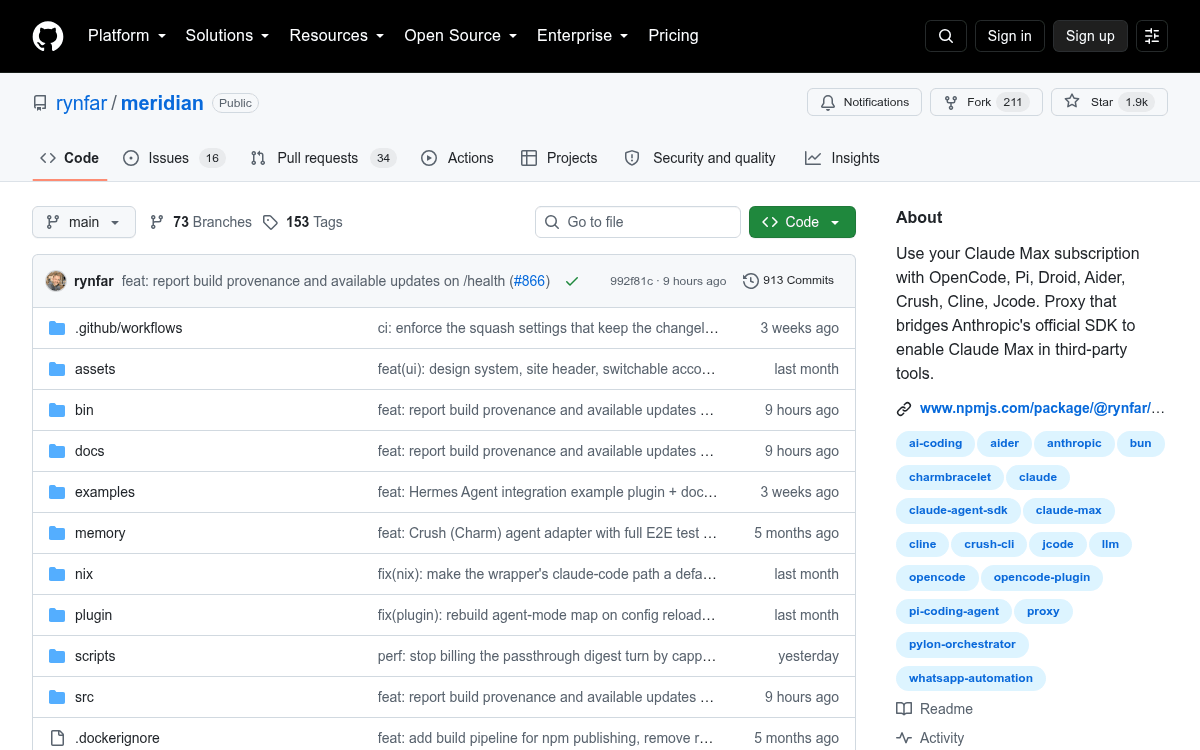
Meridian is an open-source proxy that translates Claude Code SDK calls into Anthropic API responses, letting any compatible coding tool use a Claude Max subscription.
 Pro
Takeaways
- Meridian proxies Claude Code SDK calls into a standard Anthropic API endpoint for third-party tools.
- Works with OpenCode, Aider, Cline, Crush, Droid, Pi, ForgeCode, Open WebUI, and Claude Code itself.
- Available now on npm as @rynfar/meridian, MIT licensed, free to use.
- Supports session resume, streaming, multi-profile accounts, passthrough tool calls, and automatic OAuth refresh.
- Passthrough mode caps tool round-trips at maxTurns=2, blocking multi-step agentic loops without client re-sends.
- Uses documented SDK query() calls only, no OAuth extraction or binary patching involved.
A new open-source proxy called Meridian is quietly solving one of the more annoying problems in AI-assisted coding: paying for a Claude Max subscription and then being locked out of it the moment you leave the official Claude Code CLI. The project has picked up around 1.9k stars on GitHub and now supports a long list of third-party coding agents including OpenCode, Aider, Cline, Crush, Droid, Pi, and ForgeCode.
Claude Max includes programmatic access through the Claude Code SDK, but most coding tools expect to talk to the standard Anthropic API endpoint. Meridian runs locally and bridges that gap by accepting standard API requests and routing them through the SDK. The SDK does the heavy lifting; the proxy translates the output.
No token extraction, no binary patching
What sets Meridian apart from earlier reverse-engineered attempts is that it stays inside official channels. Every request flows through query(), the same documented function Anthropic provides for programmatic access. No OAuth tokens are extracted, no binaries are patched, nothing is reverse-engineered.
Because the proxy uses the SDK, Anthropic remains in full control of prompt caching, context window management, compaction, rate limiting, and authentication. The author frames Meridian as a presentation and interoperability layer that formats Claude Code output into the standard Anthropic API shape, rather than as a workaround for Max plan limits.
Four lines to a working bridge
The proxy is distributed as an npm package and takes over port 3456 on localhost:
npm install -g @rynfar/meridian
claude login
meridian setup   # OpenCode users only
meridian
Once it is running, you point any Anthropic-compatible tool at it by setting two environment variables. ANTHROPIC_API_KEY can be any placeholder value since Meridian authenticates through the Claude Code SDK, and ANTHROPIC_BASE_URL points at http://127.0.0.1:3456.
What actually works under the hood
Meridian goes well beyond dumb protocol translation. A few of the features that matter for real coding sessions:
- Dual protocol support, speaks both the Anthropic Messages API and the OpenAI-compatible
/v1/chat/completionsendpoint, so tools like Open WebUI and Continue can connect without LiteLLM in the middle. - Session management, conversations persist across requests, survive compaction and undo, and resume after proxy restarts.
- Subagent context budgeting, primary agents get 1M context while subagents get 200k, preserving rate-limit budget.
- Auto token refresh, expired OAuth tokens are refreshed automatically so requests continue without interruption.
- Multi-profile, switch between personal, work, and CI Claude accounts with per-request headers or a CLI switch command.
- Passthrough tool calling, Claude generates tool calls, but the client executes them locally using its own sandboxing and file tracking.
An experimental feature set called SDK Feature Toggles lets connected agents opt into Claude Code capabilities that were previously exclusive to the official CLI. Auto-memory, background dream-style memory consolidation, and CLAUDE.md instruction files become available to OpenCode, Crush, Droid, and any other harness routed through the proxy.
Where it falls short
Passthrough mode has a real ceiling. Meridian configures the SDK with maxTurns=2 (or 3 for deferred tools), so multi-step agentic loops where Claude needs several consecutive tool calls require the client to re-send after each round.
A tool blocklist also prevents collisions with the client. Thirteen built-in SDK tools such as Read, Write, and Bash are blocked to avoid conflicts with the client's own implementations, and 15 additional Claude Code-only tools like CronCreate, EnterWorktree, and Agent are blocked because they require capabilities that external clients don't support.
Sonnet defaults to 200k context on purpose. Sonnet 1M is always billed as Extra Usage on Max plans, even when regular usage isn't exhausted, which reflects Anthropic's intended billing model rather than a bug. Opus, thankfully, gets 1M context included with Max.
Who this is for
If you already pay for Claude Max and prefer OpenCode's TUI, Aider's git integration, or Cline's VS Code experience over the official Claude Code interface, Meridian removes the wall between them. Small teams who want to share one Max subscription across multiple machines on a LAN also have a path here; the readme includes a Docker setup and a network-exposed configuration, though the author correctly warns to set MERIDIAN_API_KEY to a strong secret when binding beyond loopback, because an unprotected network-accessible proxy is a Claude Max credential leak.
The broader signal is that Anthropic's decision to ship a documented programmatic SDK, rather than lock Max entirely to a single client, is what makes projects like this possible without lawyers getting involved. That is a healthier equilibrium than the cat-and-mouse patches that plagued earlier Claude proxies, and it hints that the frontier of coding-agent tooling will keep fragmenting across TUIs, IDE extensions, and headless orchestrators regardless of which lab you buy your tokens from.