

Memento-Skills Lets AI Agents Rewrite Their Own Skills, Hitting 116% Accuracy Gains
Memento-Skills turns a frozen LLM into a self-improving agent by letting it write, repair, and route its own reusable skills.
 PRO
- Memento-Skills is an open-source agent framework that learns by rewriting its own skill code, not the LLM weights (repo).
- Uses a Read-Write Reflective Learning loop: retrieve a skill, execute it, reflect on failure, rewrite the skill.
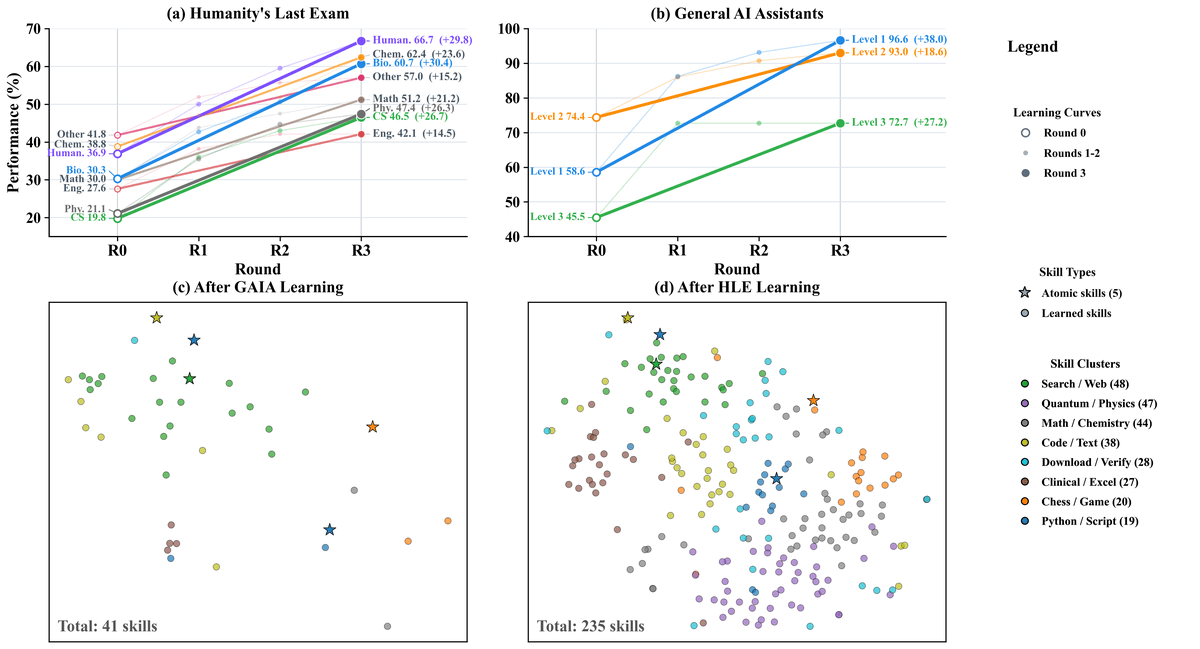
- Reports 26.2% and 116.2% relative accuracy gains on GAIA and Humanity's Last Exam respectively (paper).
- Ships 10 built-in skills, BM25 plus vector hybrid retrieval, local uv sandbox, and MCP client integration.
- Supports Claude, GPT-4o, Ollama, Kimi, MiniMax, GLM, and self-hosted vLLM/SGLang via litellm.
- Desktop apps for Windows and macOS are now live alongside CLI and Flet GUI.
A new open-source framework called Memento-Skills takes a different swing at the agent problem. Rather than fine-tuning a base model or bolting on more tools, it lets the agent maintain its own library of skills and rewrite them from experience. The system functions as an agent-designing agent, autonomously constructing, adapting, and improving task-specific capabilities through use.
Skills, stored as structured markdown plus code, act as external memory. When the agent fails, it locates the offending skill, reflects on why it broke, and rewrites it. The underlying LLM weights never move.
Skills as a growing, editable memory
The framework sits on top of a mechanism the authors call Read-Write Reflective Learning, first introduced in the Memento 2 paper. In the read phase, a behaviour-trainable router selects the most relevant skill conditioned on the current stateful prompt. In the write phase, the agent updates and expands its library based on new experience. This closed loop enables continual learning without updating LLM parameters, since all adaptation is realised through the evolution of externalised skills and prompts.
Deployment-time learning for large language models is traditionally bottlenecked by the cost of parameter updates. By treating the skill library as the trainable surface, Memento-Skills sidesteps that cost and turns failures into training signal rather than errors to log.

How the loop actually runs
This story is for Pro members
You've reached the end of the free preview. Upgrade to AlphaSignal Pro to read the full article - and everything else behind the paywall.
Comments
