

MachinePulse's World2Agent Gives AI Agents Ears to Hear the Real World
An open protocol wraps real-world event streams into a shared schema, letting any AI agent subscribe to sensors as easily as installing an npm package.
 PRO
- World2Agent is an open protocol standardizing how AI agents receive real-time signals from the world
- Sensors are npm packages emitting a shared signal schema, browsable on SensorHub
- Native plugins ship for Claude Code, Hermes, and OpenClaw with slash-command install flows
- A build-w2a-sensor skill scaffolds custom sensors in about 50 lines via natural language
- Apache 2.0 licensed, Sensors as instruction sources need trust review to avoid prompt injection
- Roadmap includes a graph layer to compose and enrich multi-sensor signals before agents
Most agent frameworks focus on giving models tools to act on the world. World2Agent inverts the loop and gives agents a standardized way to perceive what is happening in the first place. The project pitches itself with an analogy borrowed from the ecosystem: MCP gives agents hands, W2A gives them ears.
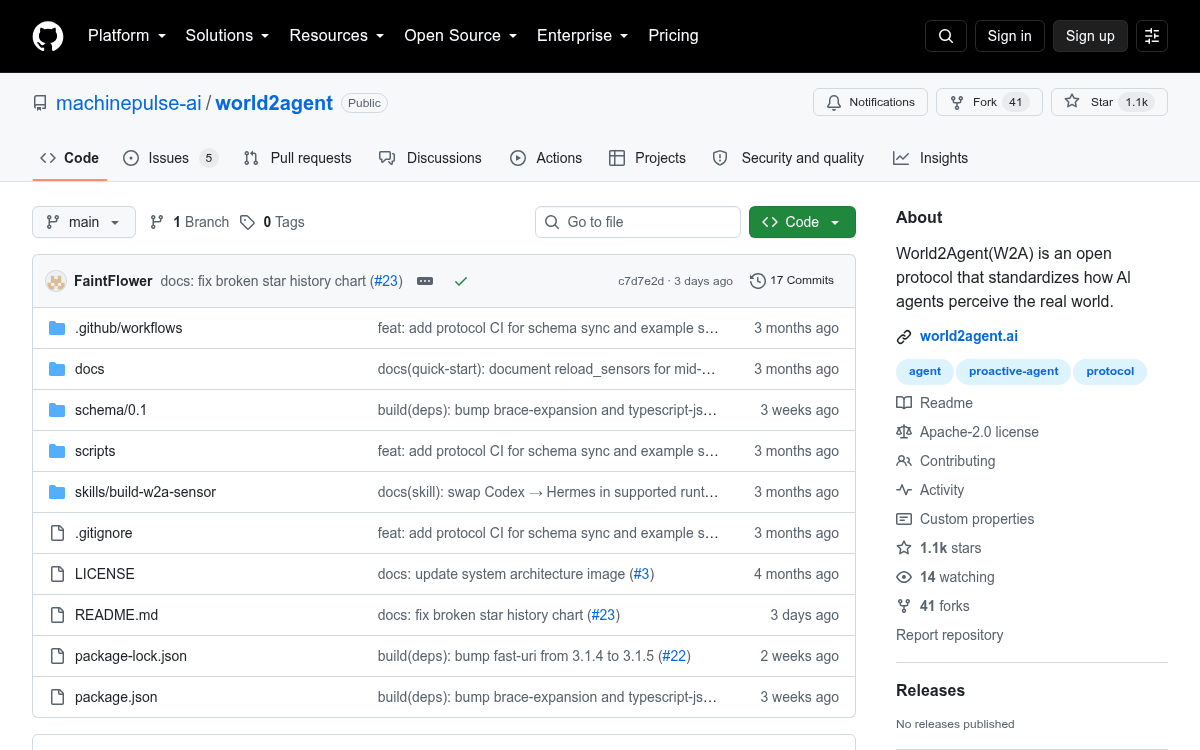
World2Agent (W2A) is an Apache-2.0 protocol from MachinePulse that standardizes how AI agents perceive the real world. Install a sensor, your agent gets structured, real-time data. Swap sensors freely, they all speak the same schema. The maintainers are explicit that W2A is a spec plus reference SDK rather than a product, with the expectation that most sensors will come from the community.
Sensors, signals, and a shared schema
The architecture is intentionally simple. Sensors watch data sources and emit structured events following the W2A protocol. Your agent receives signals and decides what to do. A sensor can be anything that produces events: a Hacker News watcher, a GitHub trending tracker, a Steam price drop monitor, or a bug detector that triggers a fix PR.

Every sensor ships as a standard npm module and publishes signals in a schema defined by the protocol. An agent runtime does not need to know anything about the underlying API (Twitter, weather, calendar, flights, and so on) to consume a signal. It just subscribes and reacts. The catalog lives on
This story is for Pro members
You've reached the end of the free preview. Upgrade to AlphaSignal Pro to read the full article - and everything else behind the paywall.
Comments
