

Luxembourg Researchers' ASTER Framework Beats Every LLM Anomaly Detector on TAB
A new unsupervised framework generates pseudo-anomalies inside a latent space shaped by a pre-trained LLM, beating existing baselines on the TAB benchmark.
 PRO
- ASTER generates pseudo-anomalies in latent space, avoiding handcrafted augmentations for unsupervised time-series anomaly detection.
- Combines a LoRA-tuned GPT-2 embedder, a VAE-based perturbator, and a BERT-style Transformer classifier.
- A reverse-gradient trick trains the anomaly generator adversarially against the classifier, no labels needed.
- Sets state of the art on PSM and PUMP in the TAB benchmark, strong on SWaT, second on CATSv2.
- F1 on PSM jumps from 0.403 to 0.512; SWaT F1 goes from 0.613 to 0.695.
- Main limits: quadratic memory in window length, limited pseudo-anomaly diversity, unbalanced loss magnitudes.
Time-series anomaly detection has a chicken-and-egg problem. You need examples of anomalies to train a detector, but real anomalies are rare, weird, and often unlabeled. The standard workaround is to synthesize fake ones by adding noise, masking chunks, or shuffling values in the raw signal. That works until the anomalies you actually care about look nothing like the ones you invented.
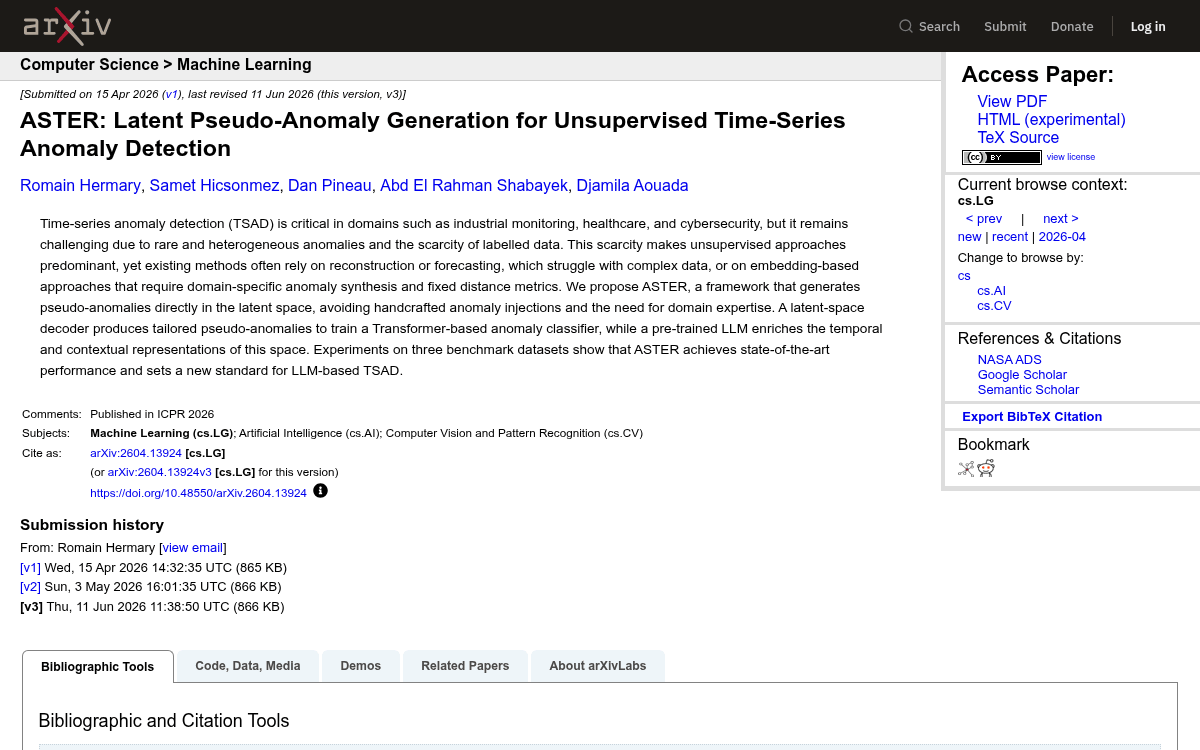
A team at the University of Luxembourg is proposing a different route. Their new framework, ASTER (Anomaly Synthesis through Transformer-based Embedding Representation), skips handcrafted corruptions entirely and learns to generate pseudo-anomalies directly in a latent space shaped by a pre-trained language model. On the recently released TAB benchmark, it sets a new state of the art for LLM-based time-series anomaly detection.
Why handcrafted anomalies hit a wall
Most unsupervised time-series anomaly detectors fall into one of two camps. Reconstruction and forecasting models learn what normal looks like and flag anything they cannot rebuild or predict. Embedding-based methods pull normal samples into a tight region of representation space and push synthetic anomalies away using a contrastive loss.
Both approaches have well-known weaknesses. Reconstruction struggles on complex multivariate data. Contrastive methods like CTAD, CATS, and CARLA depend on curated lists of augmentations (adding bias, injecting noise, masking segments) that need dataset-specific tuning and rarely generalize across domains. They also lean on a fixed distance metric such as cosine or L2 to score anomalies, which bakes assumptions about anomaly geometry into the model.
ASTER argues both problems share the same root cause: making decisions in the raw input space. Move the anomaly generation and scoring into a learned latent space, and both constraints relax.
The three-part architecture
ASTER decomposes the detector into three cooperating components:
- Contextual embedder that maps a time-series window into a rich token sequence using a pre-trained LLM.
This story is for Pro members
You've reached the end of the free preview. Upgrade to AlphaSignal Pro to read the full article - and everything else behind the paywall.
Comments
