

Lovable Gives Every App a Trust Center to Win Enterprise Deals
Lovable gives every published app an auto-generated, always-current security page — removing the biggest friction point in B2B sales for vibe-coded software
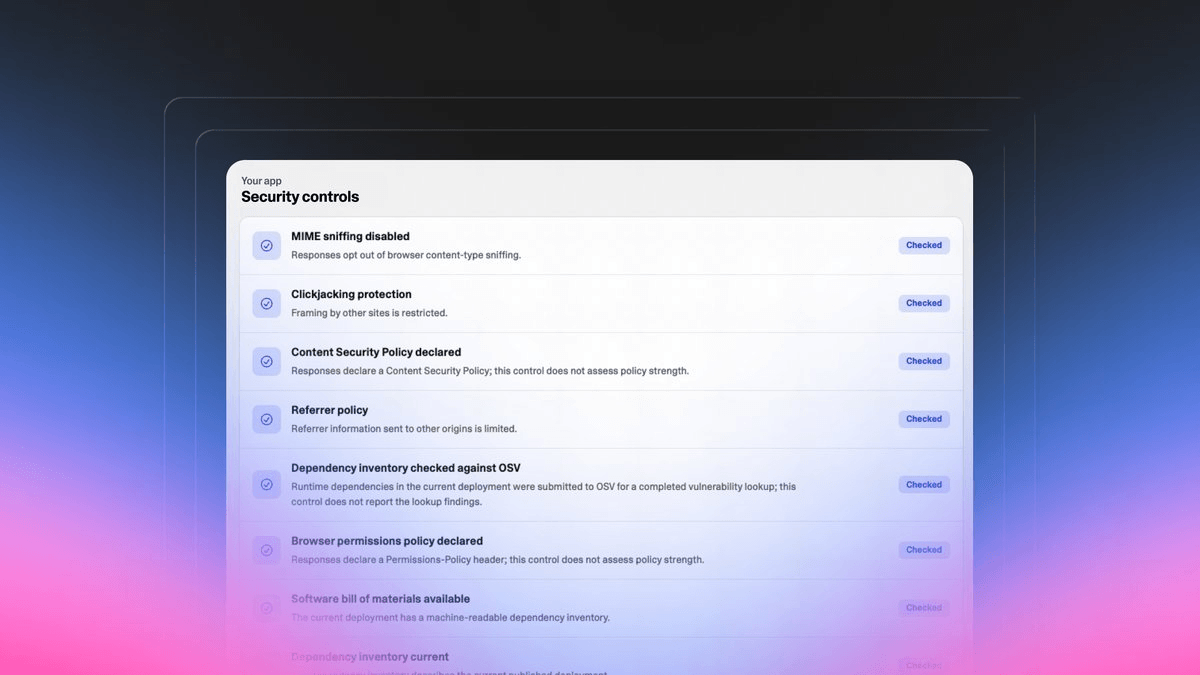
- Auto-generated trust centers: Every publicly published Lovable app now gets a security page at
YOURAPPURL/.well-known/trust.html, built automatically by the platform. - No setup required: The page reads security controls directly from the app — HTTPS, TLS, cookie flags, RLS, SBOMs, dependency scans — with nothing for the builder to fill in or maintain.
- Enterprise sales unblocked: Trust centers cut security review time by up to 90% and accelerate enterprise sales cycles by up to 42%, according to industry research.
- Vibe coding's security gap: A 2026 audit found 45% of AI-generated code contains high-risk security flaws; this feature is Lovable's platform-level answer to that credibility problem.
- Massive scale context: Lovable hit $400M ARR at a $6.6B valuation with 100,000+ new projects daily, meaning a large share of apps are now being sold into real enterprise deals.
- Coming soon: Backend service details, data residency info, AI gateway controls, and a full subprocessor list are on the roadmap for the trust center.
Selling software built with an AI app builder to a real business has always had an awkward moment: the security review. A customer's IT team asks for your compliance posture, your encryption details, your list of third-party services. Until now, the honest answer from most vibe-coded apps was a shrug and a reassuring email. Lovable is changing that with the launch of Trust Centers, automatically generated, always-current security pages baked into every publicly published app on the platform.
The gap nobody was filling
A trust center is a single public page that answers the security questions a buyer, investor, or IT reviewer would otherwise submit via a 200-question questionnaire: Is data encrypted in transit? What third-party services does this app rely on? How are known vulnerabilities handled? For businesses selling into the enterprise market, a trust center is a revenue enabler, not a compliance checkbox.
The catch has always been that building one required a security team, an audit budget, and someone to keep the page current. According to Orbiq's 2026 research, 87% of enterprise buyers check a vendor's security posture before they ever talk to procurement. That is a brutal filter for a two-person startup shipping their first SaaS product on a vibe-coding platform.
What Lovable actually ships
Every app published on Lovable now gets a dedicated security page at YOURAPPURL/.well-known/trust.html, generated entirely by the platform. Builders cannot edit or restyle it, which is the point: it reads directly from platform data rather than functioning as a marketing page.
The trust center surfaces the following automatically:
- Connection security: HTTPS enforcement, HSTS headers, valid TLS certificates, clickjacking protection, and Content Security Policy rules
- Cookie protections: Secure, HttpOnly, and SameSite flags on observed session cookies
- Dependency vulnerability checking: Lovable checks the current deployment's identified dependencies against OSV, Google's public database of known open-source software vulnerabilities
- Software Bill of Materials (SBOM): A machine-readable CycloneDX inventory of every software component in the deployment. An SBOM is essentially an ingredient list for your app's code, and many enterprise procurement teams require one
- Database row-level security: Confirms whether every table in the database has row-level security (RLS) enabled, the control that prevents one user from reading another user's data
- Aikido integration: Lovable integrates with Aikido Security for AI-powered penetration testing directly from the Security Center, with findings synced to the trust page
- Deployment traceability: Links the trust center's observations to the exact published revision, content hash, and deployment time
Lovable is clear about scope: the trust center shows observed controls, not certifications. It does not claim SOC 2 compliance. It shows what the platform guarantees at the infrastructure level and is explicit about that distinction.
Why the timing is deliberate
Lovable recently hit $400M in ARR at a $6.6 billion valuation, with over 25 million total projects created and 100,000 new projects launching every day. At that scale, a meaningful slice of those projects are being sold to real businesses and running into real security reviews.
The broader vibe-coding ecosystem has a credibility problem on this front. A 2026 security audit found that 45% of AI-generated code contains high-risk security flaws. Reporting from Axios and Wired has highlighted a growing risk: thousands of AI-generated apps can expose sensitive data when published without the right access controls. Lovable has been investing in platform-level controls, including automated scanning, RLS enforcement, and Aikido pen testing. The trust center makes all of that work visible to the people who need to see it: buyers.
Replit has defined what platform-level security tooling looks like in 2026, with publish-time scanning, hybrid SAST, an ops dashboard with remediation actions, and downloadable SBOMs. The trust center is Lovable's answer to that competitive pressure, and it goes further by making the output customer-facing rather than just developer-facing.
Who benefits
The clearest winner is the solo founder or small team trying to close their first enterprise deal. Previously, getting through a security review meant hiring a consultant, paying $8,000 to $15,000 a year for a dedicated trust center platform like SafeBase or Drata, or hoping the buyer would skip the question. Now that answer is a URL.
Lovable benefits too. The company has been building toward enterprise demand with features including Single Sign-On, data protection agreements, and enterprise deployment options. The trust center is the public-facing proof point that ties those features into a story a non-technical buyer can follow.
The losers, at least at the margin, are standalone trust center vendors who have charged for what Lovable now gives every user automatically. That premium positioning made sense when the category was new. In 2026, the underlying capability is commoditized.
What comes next
Lovable has flagged several additions as coming soon: more detail on backend services, data residency, AI gateway controls, and a full subprocessor list covering the third-party vendors that touch your data. Those additions would bring the page much closer to what a full enterprise security review actually demands.
The larger question is whether this becomes a template for the rest of the category. Research suggests trust centers cut security review time by up to 90% and accelerate enterprise sales cycles by up to 42%. If those numbers hold for AI-built apps, every competing platform, including Bolt, Replit, and Base44, will face pressure to ship something equivalent. Lovable's claim that no other platform does this yet has a shelf life, but being first to solve the enterprise credibility gap carries real weight when buyers are already checking security posture before the first sales call.
For builders using Lovable today, the action is straightforward: publish your app to public rather than just a workspace, then navigate to YOURAPPURL/.well-known/trust.html. That URL is now your answer to every security questionnaire a potential customer sends your way.
Comments
