
LocalAI Shrinks Ornith-1.0-35B to Run on a Single Consumer GPU
Ornith-1.0-35B, a self-scaffolding agentic coding MoE, gets APEX quantization for consumer GPU deployment with near-lossless compression
 Pro
Takeaways
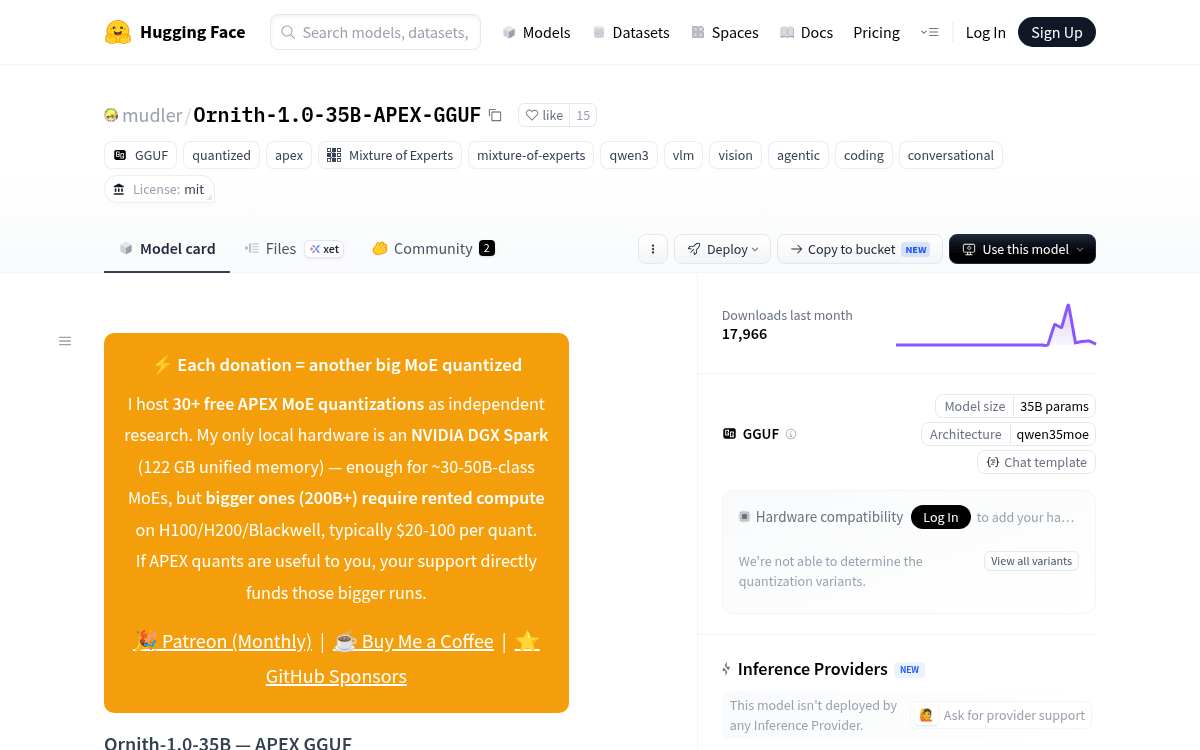
- Ornith-1.0-35B-APEX-GGUF is a quantized, locally-runnable build of DeepReinforce AI's agentic coding model, released under MIT license.
- Ornith-1.0-35B scores 75.6 on SWE-Bench Verified and 64.2 on Terminal-Bench 2.1, beating models up to 10x its size.
- The model uses self-scaffolding RL: it learns to design its own task plans and tool-call workflows, not just solutions.
- APEX quantization applies different precision levels per tensor type and layer position, achieving Q8_0 quality at 38% smaller size.
- Eight GGUF variants are available for different hardware budgets, from consumer GPUs to the I-Quality tier at ~21 GB.
- Runs via llama.cpp, Ollama, LM Studio, or LocalAI; compatible with OpenAI-style tool-calling APIs.
A powerful agentic coding model just got a lot more accessible. The LocalAI team has released Ornith-1.0-35B-APEX-GGUF, a suite of quantized builds of DeepReinforce AI's Ornith-1.0-35B that can run on a single consumer GPU. The story here is actually two stories in one: a genuinely impressive open-source agentic coding model, and a smarter-than-usual quantization method purpose-built for the architecture it runs on.
The model underneath
Ornith 1.0 is a family of open-source large language models built by DeepReinforce AI specifically for agentic coding, spanning four parameter sizes -- 9B Dense, 31B Dense, 35B MoE, and 397B MoE -- all under MIT license with no regional restrictions. The 35B variant is the mid-tier option: big enough to be competitive, small enough to run locally.
Ornith-1.0-35B is a 35B Mixture-of-Experts reasoning model post-trained on Qwen 3.5 using a self-improving RL framework that jointly learns solution rollouts and the task-specific scaffolds guiding them. MoE (Mixture-of-Experts) means the model has many specialized sub-networks ("experts"), but only a small subset activates for any given token -- keeping compute low despite the large parameter count.
Self-scaffolding: the real innovation
The core innovation behind Ornith 1.0 is self-scaffolding reinforcement learning. Traditional coding agents rely on human-designed harnesses -- fixed workflows for tool calls, error recovery, and task decomposition. Ornith 1.0 treats the scaffold as a learnable object that co-evolves with the model's policy during RL training, meaning it generates its own task plans, launches tools, inspects intermediate results, and rewrites failing steps without human intervention.
The core innovation is a self-improving RL training framework: rather than relying on fixed human-designed harnesses, the model co-learns solution rollouts and the task-specific scaffolds that guide them. Reward is propagated to both stages, enabling per-task orchestration strategies to emerge automatically. In plain terms: the model learns not just how to solve a coding task, but how to plan the process of solving it.
Benchmark numbers that matter
Ornith-1.0-35B scores 75.6 on SWE-Bench Verified and 64.2 on Terminal-Bench 2.1. To put those in context, here is how it stacks up against same-class models:
| Model | SWE-Bench Verified | Terminal-Bench 2.1 |
|---|---|---|
| Ornith-1.0-35B | 75.6 | 64.2 |
| Qwen3.6-35B | 73.4 | 52.5 |
| Qwen3.5-35B | 70.0 | 41.4 |
| Gemma4-31B | 52.0 | 42.1 |
| Qwen3.5-397B | 76.4 | 53.5 |
That last row is the striking one: Ornith-1.0-35B nearly matches the 397B model on SWE-Bench and beats it by over 10 points on Terminal-Bench, at roughly 1/10th the parameter count. The model also supports native function calling and a 262K context window.
APEX: quantization that actually understands MoE
This is where the LocalAI team's contribution comes in. Standard quantization (reducing numerical precision to shrink model size) treats all weights equally. APEX does not.
APEX (Adaptive Precision for EXpert Models) is a quantization strategy for Mixture-of-Experts models. It classifies tensors by role and applies a layer-wise precision gradient -- edge layers (first/last 5) get higher precision, middle layers get more aggressive compression.
The key insight exploits something specific to MoE architectures:
- In MoE models, expert FFN tensors make up the bulk of model weight but only ~8/256 experts activate per token.
- Uniform quantization allocates equal precision to the 97% of expert parameters that are inactive for any given token and to the shared/attention parameters that are active for every token. It also ignores layer-position sensitivity: edge layers that handle input embedding alignment and output logit generation are measurably more sensitive to quantization noise than middle layers.
- Unlike uniform quantization methods that apply the same precision to every tensor, APEX introduces a layer-wise precision gradient combined with MoE-aware tensor classification and diverse imatrix calibration to achieve Q8_0-level quality at a fraction of the size.
By combining MoE-aware tensor classification, a layer-wise precision gradient, and diverse imatrix calibration spanning chat, code, reasoning, and tool-calling data, APEX achieves Q8_0-level quality at 38% less model size -- and in its best configuration surpasses even F16 perplexity on wikitext-2-raw. Perplexity is the standard measure of how well a language model predicts text; lower is better, and beating F16 (full 16-bit precision) with a compressed model is a meaningful result.
APEX I-Quality (21.3 GB) achieves PPL 6.552 and 83.5% HellaSwag vs Unsloth UD-Q8_K_XL (45.3 GB) at PPL 6.536 and 82.5% HellaSwag. Better accuracy, half the disk space.
Eight files, one choice
The release ships eight GGUF variants to cover different hardware budgets. The "I" prefix means imatrix-calibrated -- the quantization was tuned using a diverse dataset of chat, code, reasoning, and agentic traces, which generally yields better real-world quality. I-variants use diverse imatrix calibration covering chat, code, reasoning, tool-calling, agentic traces, and Wikipedia.
- I-Balanced -- best overall pick, lowest worst-case quality drop
- I-Quality -- highest quality with imatrix calibration
- Quality / Balanced -- non-imatrix equivalents, slightly smaller
- I-Compact / Compact -- consumer GPU targets
- I-Mini -- smallest viable, fastest inference
- mmproj.gguf -- the vision projector, required for image inputs
Running it locally
The APEX GGUF is available today, free, under MIT license. You can pull it through llama.cpp, Ollama, LM Studio, or LocalAI directly:
# llama.cpp (macOS/Linux)
curl -LsSf https://llama.app/install.sh | sh
llama serve -hf mudler/Ornith-1.0-35B-APEX-GGUF
# Ollama
ollama run hf.co/mudler/Ornith-1.0-35B-APEX-GGUF
# LocalAI (recommended for agentic use)
local-ai run mudler/Ornith-1.0-35B-APEX-GGUF@Ornith-1.0-35B-APEX-I-Balanced.gguf
For Python users, llama-cpp-python works out of the box:
from llama_cpp import Llama
llm = Llama.from_pretrained(
    repo_id="mudler/Ornith-1.0-35B-APEX-GGUF",
    filename="Ornith-1.0-35B-APEX-Balanced.gguf",
)
response = llm.create_chat_completion(
    messages=[{"role": "user", "content": "Refactor this function to be async."}]
)
Because Ornith-1.0-35B exposes an OpenAI-compatible endpoint with tool calling, it works out of the box with standard agent frameworks. That means you can drop it into OpenHands, Hermes Agent, or any MCP-compatible setup with minimal configuration changes.
What it is good for -- and where it falls short
Ornith-1.0-35B is purpose-built for agentic coding workflows: multi-step terminal tasks, repository-level code changes, and tool-calling pipelines. The 9B and 35B models run on consumer hardware -- a gaming GPU or MacBook Pro -- giving you a fully private, offline AI coding assistant with no API costs.
Where to temper expectations: the model's strengths are tightly scoped to coding and agentic tasks. General-purpose reasoning, creative writing, or broad knowledge tasks are not what it was trained for. The APEX quantized versions also introduce some quality tradeoff in the Compact and Mini tiers -- acceptable for fast iteration, but the I-Balanced or I-Quality variants are the right choice for production-grade code generation.
Why this matters beyond the headline
The combination of Ornith-1.0-35B and APEX quantization is a signal of where local AI is heading. DeepReinforce is an AI research startup focused on using reinforcement learning to build agentic AI systems for coding and system optimization. They developed GrandCode (ranked #1 in Codeforces live competitions, beating all human grandmasters), Ornith-1.0, and IterX (agentic code optimizer surpassing NVIDIA's cuBLAS).
The broader implication is that MoE models are not just for data centers anymore. APEX demonstrates that the structural properties of MoE -- sparse expert activation, layer sensitivity gradients -- can be exploited to compress these models far more efficiently than uniform quantization allows. APEX enables models like Qwen3.5-35B-A3B to outperform standard Q8_0 perplexity at roughly half the size, often even surpassing F16 quality in specific configurations. As more frontier-class models adopt MoE architectures, techniques like APEX will become increasingly important for making them usable outside of cloud infrastructure.