

LM Arena Breaks Down 52 Image Models Across 7 Categories With 28M Votes
Arena.ai adds seven granular categories to its image editing leaderboards, revealing GPT Image 2 leads every dimension across 28M+ human votes
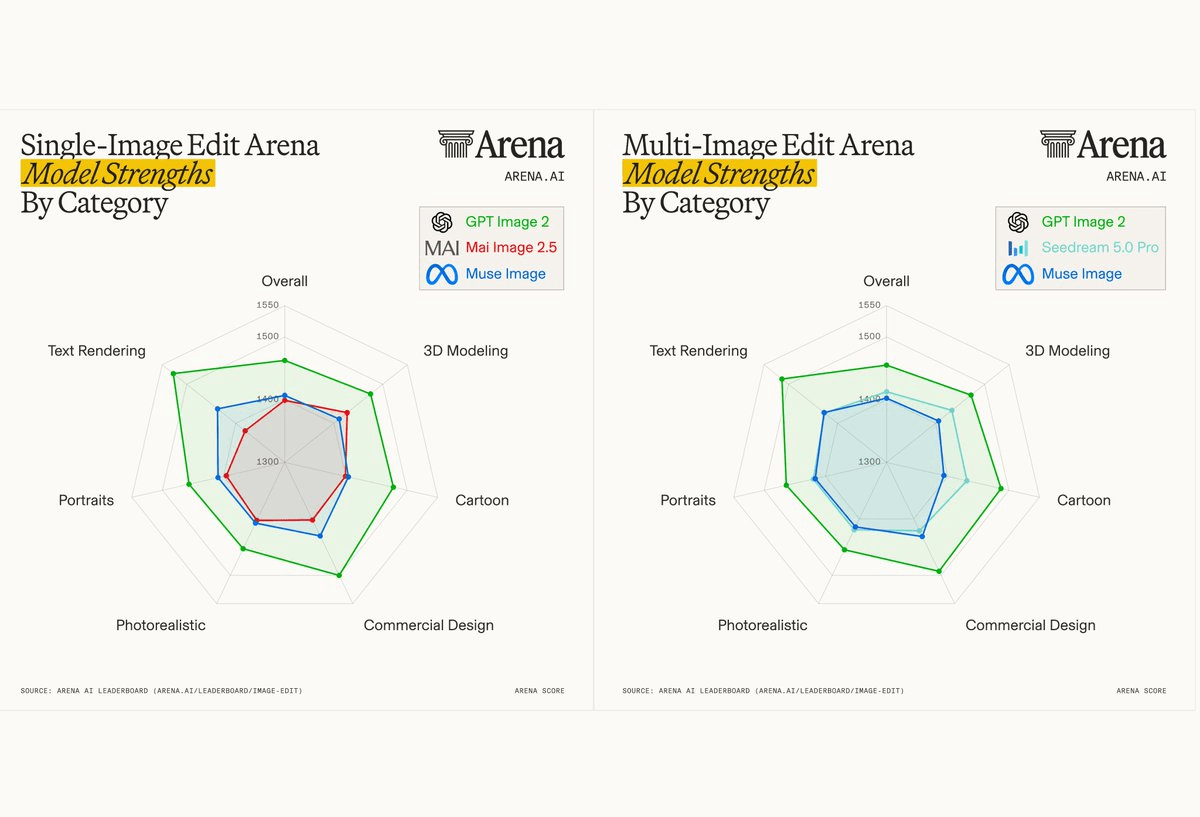
- Arena.ai launched seven granular categories (Photorealistic, Portraits, Cartoon, Art, 3D, Commercial Design, Text Rendering) for its Single and Multi-Image Edit leaderboards.
- GPT Image 2 ranks #1 in all seven categories, with its largest margin in Text Rendering; the leaderboard covers 52 models and 28M+ votes.
- For Single-Image Edit, Meta's Muse Image (#2) and Microsoft's MAI-Image-2.5 (#3) are closely matched behind GPT Image 2.
- For Multi-Image Edit, Bytedance's Seedream 5.0 Pro and Meta's Muse Image are nearly tied, with divergence in 3D Modeling and Cartoon.
- Analysis of 3M+ votes found Photorealistic and Portraits overlap 64%, but Photorealistic and Art overlap under 1%, confirming they measure genuinely different capabilities.
- The full leaderboard is free at arena.ai/leaderboard/image-edit; historical data is on Hugging Face.
A single overall score has always been a blunt instrument for picking an image model. The best portrait editor might be mediocre at rendering logos, and the best 3D renderer might struggle with photorealism. Arena.ai's image editing leaderboard now breaks results into seven granular categories for both its Single-Image Edit and Multi-Image Edit arenas, letting you see exactly where each model wins and loses.
What changed
Until now, Arena's image editing leaderboards showed one aggregate Elo score per model. The update mirrors the category structure already live in the Text-to-Image arena, bringing the same seven buckets to editing:
- Photorealistic & Cinematic Imagery
- Portraits
- Cartoon, Anime & Fantasy
- Art
- 3D Imaging & Modeling
- Product, Branding & Commercial Design
- Text Rendering
The leaderboard now covers 52 models and has accumulated over 28 million votes. Each category gets its own ranked list, so you can filter by the exact output type you need rather than trusting a single averaged number.
How the scoring works
Arena uses a blind pairwise voting system. Users submit a prompt, receive outputs from two anonymous models, and choose the better one. The platform aggregates millions of those votes using a Bradley-Terry-Luce model to estimate per-model strength, reported as Elo-style numbers. A 10-point Elo gap means one model wins roughly 55–60% of head-to-head matchups.
For the category breakdown, Arena classifies each vote based on what the source image contains, what the edit changes, and what remains in the final output. A single vote can count toward multiple categories if the prompt spans more than one domain, but it counts only once on the overall leaderboard.
The standings
OpenAI's GPT Image 2 holds the top spot across every category on the Image Arena leaderboard. On the current Single-Image Edit board it sits at an Elo of 1463, eleven ranks above the next cluster of models. Its largest margin is in Text Rendering, the category where most image models have historically struggled.
| Rank | Model | Lab | Single-Edit Elo |
|---|---|---|---|
| 1 | gpt-image-2 (medium) | OpenAI | 1463 ± 4 |
| 2 | muse-image | Meta | 1407 ± 6 |
| 3 | mai-image-2.5 | Microsoft AI | 1400 ± 4 |
| 4 | grok-imagine-image-quality | xAI | 1390 ± 6 |
| 5 | gemini-3-pro-image-2k | 1389 ± 3 |
The Multi-Image Edit leaderboard, where you provide multiple reference images and ask the model to synthesize or edit across them, tells a different story. Bytedance's Seedream 5.0 Pro and Meta's Muse Image cluster tightly across most categories, with separation widening around 3D Modeling and Cartoon.
Categories are not independent
Arena analyzed over 3 million votes to test whether the seven categories were actually measuring different things. The answer: mostly yes, but with meaningful overlap in two specific pairs.
- Photorealistic + Portraits overlap 64%. Portrait prompts almost always expect photorealism, so votes in one bucket heavily inform the other.
- Commercial Design + Text Rendering overlap 36%. Logos and product shots frequently require readable text, so these categories share substantial signal.
- Photorealistic and Art overlap under 1%. A model that excels at cinematic photography can be mediocre at painterly illustration, and the data confirms it.
That overlap structure changes how you should read the rankings. A model ranked high in Portraits is probably also solid at Photorealistic. A model ranked high in Art tells you almost nothing about its Photorealistic performance.
Why category scores beat a single number
Every model in the dataset has a distinct performance profile. A model ranked outside the top 10 overall can still reach the top 5 in Portraits. A model leading the aggregate can be weak at Text Rendering. That kind of signal is invisible in a single Elo score, and it directly affects tooling decisions in real production pipelines, where you rarely ship the first generation and iterate constantly.
How to use it
The leaderboard is free to browse at arena.ai/leaderboard/image-edit. Filter by Single-Image Edit or Multi-Image Edit, then click any of the seven category tabs to re-rank models by that domain. A license filter separates proprietary from open-source models, which matters if you need a self-hostable option.
To contribute votes and shape the rankings, arena.ai/image lets you run blind comparisons directly. For programmatic access, the full leaderboard history is available as a Hugging Face dataset.
If you are building a pipeline that touches image editing, pick models by category score rather than overall Elo. The overlap analysis tells you which category scores generalize to adjacent domains and which ones stand alone.
Comments
