

Liquid AI's LFM2.5 Beats a 7.7B Voice Model at Just 1.5B Parameters
Liquid AI releases two sub-2B Japanese models: a state-of-the-art text chat model and the first end-to-end Japanese speech-to-speech model at this scale

- Two new Japanese models released: LFM2.5-Audio-1.5B-JP (speech-to-speech) and LFM2.5-1.2B-JP-202606 (text chat), both open-weight on Hugging Face.
- First end-to-end Japanese audio model at this scale: 1.5B params, no separate ASR/TTS pipeline, handles voice chat, transcription, and TTS in one model.
- Audio model beats 7.7B J-Moshi on spoken Japanese benchmarks and is competitive with Qwen2.5-Omni-3B (~5.5B) on VoiceBench.
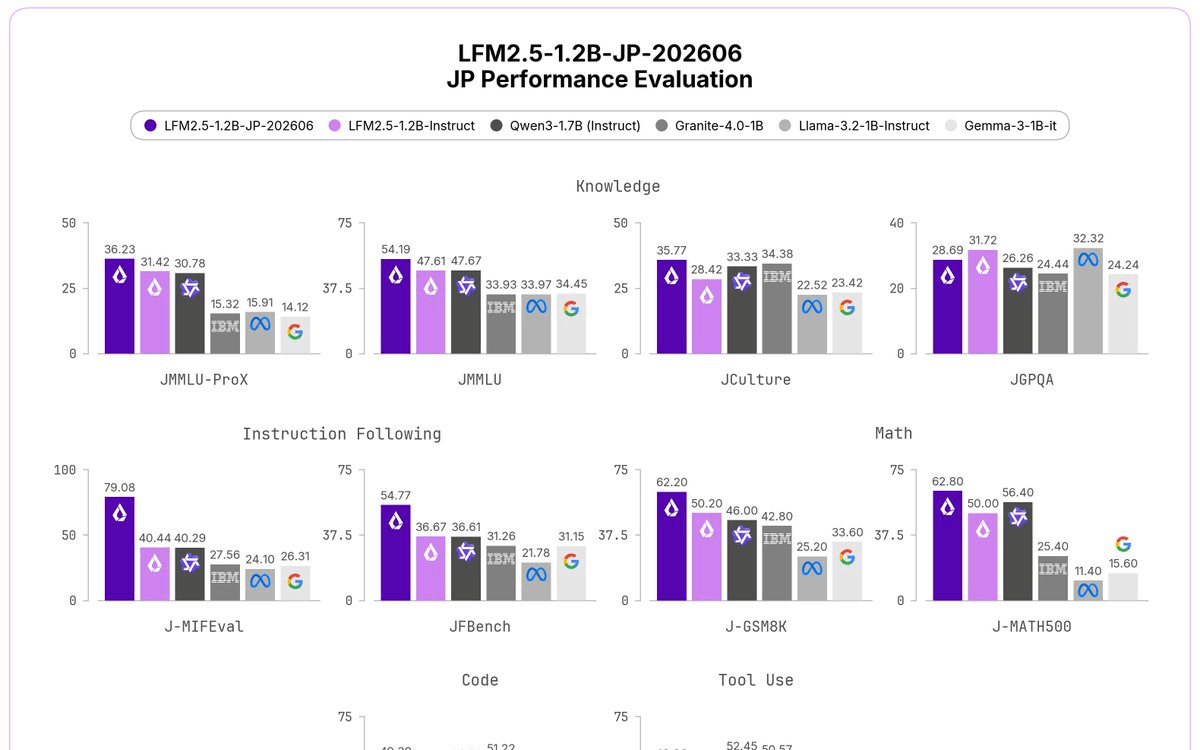
- Text model dominates sub-2B Japanese benchmarks: 53.11 domain average vs. Qwen3-1.7B at 44.83 across knowledge, math, code, and tool-use tasks.
- Designed for edge and on-device deployment: GGUF, ONNX, and MLX formats available; text model runs via vLLM, llama.cpp, SGLang, and LM Studio.
- Both are fine-tunable: Text model supports SFT/DPO/GRPO via TRL and Unsloth; audio model has a dedicated training interface via the
liquid-audiopackage.
Liquid AI just dropped two new open-weight models targeting the Japanese language market, and the headline number is hard to ignore: a 1.5B-parameter audio model that beats a 7.7B competitor in conversational benchmarks. The two releases are LFM2.5-Audio-1.5B-JP, the company's first Japanese speech-to-speech model, and LFM2.5-1.2B-JP-202606, an updated Japanese text model. Both are available now on Hugging Face.
One model, no pipeline glue
The audio model is the more technically interesting of the two. Most production voice systems are stitched together from three separate components: a speech recognizer (ASR) to transcribe the user, a language model to generate a response, and a text-to-speech engine (TTS) to speak it back. That pipeline adds latency at every seam and creates failure modes at each handoff.
LFM2.5-Audio-1.5B-JP is an end-to-end multimodal speech and text language model that does not require separate ASR and TTS components. Designed with low latency and real-time conversation in mind, it enables seamless Japanese conversational interaction at only 1.5 billion parameters.
The model consists of a pretrained LFM2.5 backbone, a FastConformer-based audio encoder to handle continuous audio inputs, and an RQ-transformer generating discrete tokens coupled with a lightweight audio detokenizer for audio output. The FastConformer encoder (115M parameters) is based on NVIDIA's Canary checkpoint, and audio output uses Kyutai's Mimi codec with 8 codebooks at 24kHz.

Two generation modes for different tasks
The audio model supports two distinct generation routines. Interleaved generation enables real-time speech-to-speech conversational chatbot capabilities where audio generation latency is key. Sequential generation is suited for non-conversational tasks such as ASR or TTS, and allows the model to switch generated modality on the fly.
In practice, you set the system prompt to control the mode. For a voice chatbot, you pass "Respond with interleaved text and audio.". For pure transcription, you use "Perform ASR in japanese.". For speech synthesis, "Perform TTS in japanese.". The same model weights handle all three.
Punching above its weight class
The benchmark story for both models is compelling, especially given the parameter counts.
On the audio side, LFM2.5-Audio-1.5B-JP achieves capabilities on par with much larger models. On the VoiceBench evaluation suite for Japanese:
- On the spoken_Elyza benchmark, LFM2.5-Audio-1.5B-JP scores 2.118, outperforming Qwen2.5-Omni-3B (a ~5.5B model) at 2.094, and far ahead of J-Moshi at 1.012 despite J-Moshi being a 7.7B model.
- On ASR character error rate, LFM2.5-Audio-1.5B-JP achieves a CER of 4.42 on the CommonVoice Japanese test set, beating Whisper large-v3's 8.5 on the same benchmark.
On the text side, LFM2.5-1.2B-JP-202606 delivers significant improvements in knowledge, instruction following, math, code, and tool-use over both models of comparable size and the previous LFM2.5-1.2B-JP. Its overall domain average of 53.11 across 12 benchmarks compares to Qwen3-1.7B at 44.83 and Llama-3.2-1B-Instruct at 21.23, despite being a smaller or similar parameter count.
Where it falls short
The audio model's ASR performance is uneven. While it achieves a strong 4.42 CER on CommonVoice, it scores 24.24 on the ReazonSpeech held-out test set, where specialized models like reazonspeech-nemo-v2 score 11.2. This suggests the model is optimized for conversational speech rather than diverse or noisy audio conditions.
For the text model, it is not recommended for knowledge-intensive tasks. The model's knowledge cutoff is mid-2024, and with 1.2B parameters, deep factual recall is inherently limited. It performs best when given clear, explicit instructions that define the task, expected behavior, and output format.
Architecture and training details
The text model has 1.17B parameters across 16 layers: 10 double-gated LIV convolution blocks and 6 GQA (grouped-query attention) blocks. It was trained on 31.5 trillion tokens with a 32,768-token context length. The hybrid convolution-attention architecture is Liquid AI's signature design, which they argue enables faster inference than pure-transformer models of equivalent size.
The audio model's total parameter count is roughly 1.5B when including the 115M FastConformer encoder on top of the 1.2B LFM2.5 backbone. Both models use bfloat16 precision and a vocabulary of 65,536 tokens.
Getting started
The text model is a standard Transformers-compatible model. You can load it with AutoModelForCausalLM and run it with vLLM, llama.cpp, SGLang, MLX, or LM Studio. GGUF, ONNX, and MLX quantized variants are already available. The audio model requires the liquid-audio package:
pip install liquid-audio
pip install flash-attn --no-build-isolation  # optional, for Flash Attention 2
Both models are released under the LFM Open License v1.0 and are free to use. Liquid AI recommends using the text model for agentic workflows, tool use, structured outputs, bilingual English-Japanese assistants, and on-device personal-assistant applications. The audio model is explicitly positioned as a base model designed for fine-tuning on specific use cases, such as customer service bots or voice-enabled Japanese apps.
The bigger picture
Japanese is a linguistically complex language with three writing systems and strong honorific conventions, and it has historically been underserved by the open-source model ecosystem. Most competitive Japanese models either come from large Japanese labs or are multilingual models that treat Japanese as a secondary language. LFM2.5-1.2B-JP-202606 sets a new benchmark for state-of-the-art performance in Japanese language understanding at the sub-2B scale, which is the size class that matters for on-device and edge deployment.
The audio model makes an even stronger claim: it is the first Japanese speech-to-speech model at this lightweight scale. If the benchmark numbers hold up in production, it opens the door to running a full Japanese voice assistant on a single consumer GPU or even a high-end mobile device, without any cloud dependency. That is a meaningful shift for anyone building Japanese-language voice products who needs low latency and data privacy.
Both models can be fine-tuned using standard tooling. The text model supports SFT, DPO, and GRPO via TRL and Unsloth, with Colab notebooks provided for each method. The audio model exposes a ChatMessage interface for dataset preparation and a dedicated LFM2DataLoader for training. You can try both models live at playground.liquid.ai.
Comments
