

Liquid AI's LFM2.5-230M Runs at 213 tok/s on a Phone CPU
Liquid AI's 230M-parameter open-weight model runs at 213 tok/s on a phone CPU, beats 1B-parameter rivals at tool use and data extraction
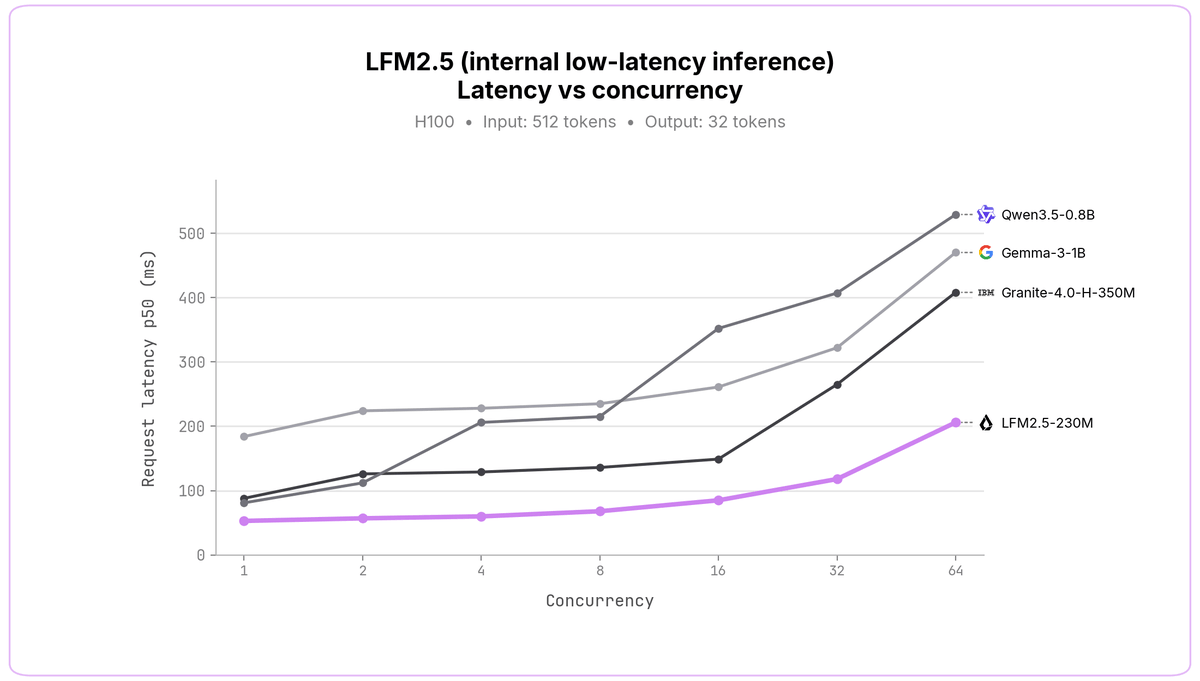 PRO
- Liquid AI releases LFM2.5-230M, their smallest open-weight model at 230M parameters, built for on-device agentic tasks.
- Runs at 213 tok/s on a Samsung Galaxy S25 Ultra and 42 tok/s on a Raspberry Pi 5, with a 293-375 MB footprint.
- Beats Qwen3.5-0.8B and Gemma 3 1B on instruction following and data extraction despite being 3-4x smaller.
- Hybrid architecture: 8 double-gated LIV convolution blocks + 6 grouped-query attention blocks, trained on 19T tokens with 3-stage post-training.
- Day-one support for llama.cpp, MLX, vLLM, SGLang, and ONNX; fine-tuning via Unsloth and TRL with Colab notebooks.
- Free for individuals and companies under $10M annual revenue; enterprise license required above that threshold.
LFM2.5-230M is Liquid AI's smallest model to date: a 230-million-parameter open-weight model built specifically for on-device agentic workloads. The pitch is deliberately narrow. This is not a general-purpose assistant or a reasoning engine. It is a fast, deployable agent layer for data extraction and tool use, designed to run on hardware that most models would choke on.
A different kind of small model
The small-model space in 2026 has split into two camps: reasoning specialists that compress math and coding into compact parameter counts, and edge agents that prioritize throughput and deployability over raw intelligence. LFM2.5-230M is Liquid AI's bet that the next wave of useful AI is a 230M-parameter open-weight agent that runs at 213 tok/s on a phone CPU, parses natural language into tool calls on a humanoid robot, and beats models twice its size on instruction following and data extraction.
This release distinguishes itself from other small models by utilizing the LFM2 architecture to achieve high inference speeds without the massive memory overhead typical of parameter-heavy transformers. The architecture is a hybrid: 14 layers total, with eight double-gated LIV convolution blocks plus six grouped-query attention blocks, targeting fast CPU inference, a 32,768-token context, and ten languages. The convolution blocks are the key differentiator here. Unlike pure-attention transformers, they process sequences more efficiently on constrained hardware by avoiding the quadratic cost of full attention at every layer.
How it was built
The model was pre-trained on 19 trillion tokens, including a 32K context extension phase. After pre-training, the team applied a three-stage post-training recipe:
- Supervised fine-tuning with distillation from the larger LFM2.5-350M -- this is what lets a 230M model punch above its weight; it inherits behavioral patterns from the bigger sibling on targeted tasks.
This story is for Pro members
You've reached the end of the free preview. Upgrade to AlphaSignal Pro to read the full article - and everything else behind the paywall.
Comments
