

Leibniz University Teaches Physics AI to Learn Dynamics Without Velocity Data
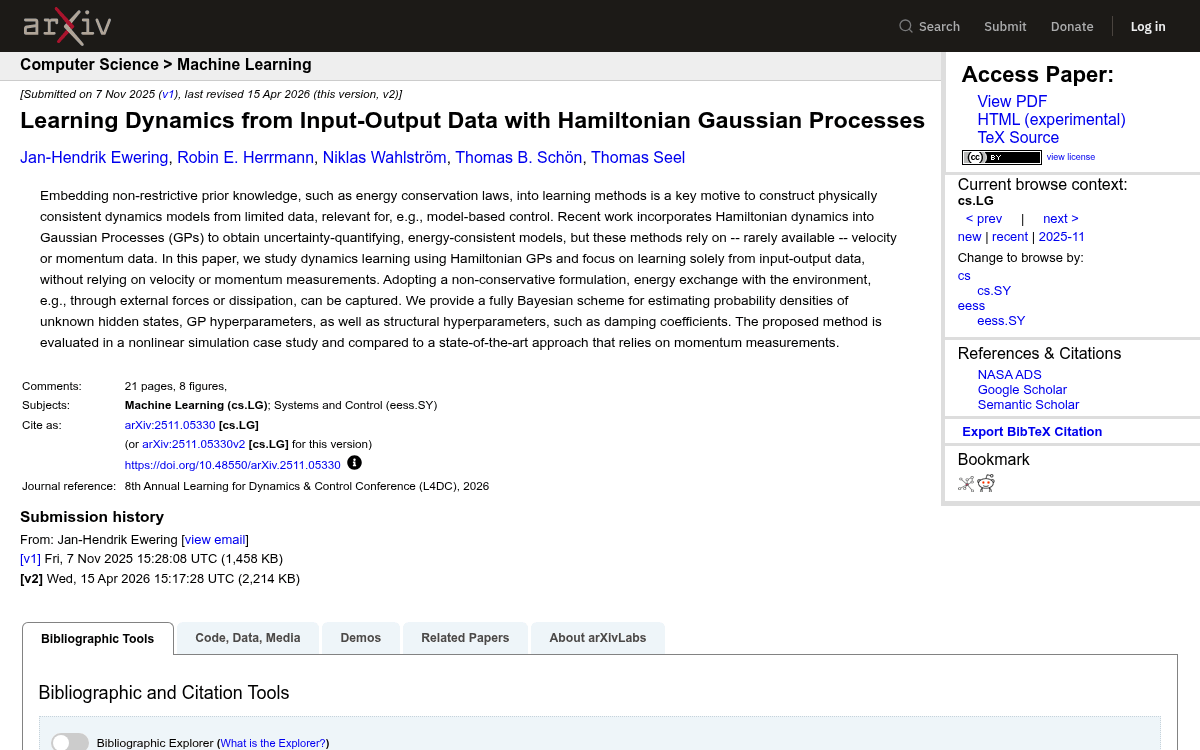
A Bayesian scheme lets Hamiltonian Gaussian Processes learn energy-consistent dynamics using only position measurements, no velocity or momentum data required.
 PRO
- New Hamiltonian GP method learns energy-consistent dynamics from position-only data, no momentum required.
- Non-conservative formulation captures external forcing and damping via a dissipation matrix.
- Reduced-rank GP gives linear-in-parameters model with cost independent of dataset size.
- Particle Gibbs scheme jointly infers latent states, GP hyperparameters, and damping coefficients Bayesianly.
- Matches accuracy of full-state Hamiltonian GP baselines on nonlinear oscillator benchmark.
- Limitations: scales poorly with state dimension, needs symmetry prior for identifiability.
Learning physics-consistent models of dynamical systems from data has become a key tool for model-based control, but most current methods make an awkward demand: they want measurements of momentum or velocity, quantities rarely available in real hardware setups. A new paper from researchers at Leibniz University Hannover and Uppsala University proposes a Hamiltonian Gaussian Process approach that drops that requirement, learning energy-consistent dynamics from plain input-output data while still quantifying uncertainty over hidden states, kernel hyperparameters, and physical parameters like damping.
The measurement problem behind physics-informed learning
Hamiltonian mechanics describes a system through a scalar energy function H(q, p) over generalized positions q and conjugate momenta p. Learn that function, and symplectic structure guarantees predictions respect energy conservation laws. Recent work fuses this Hamiltonian inductive bias into Gaussian Processes to get uncertainty-quantifying dynamics models that make physically plausible, energy-consistent predictions.
The catch is data. Existing methods assume access to the entire system state, meaning that beyond position measurements, momentum or velocity data is required for training, which is restrictive in many practical settings. Approximating velocities from position data via numerical differentiation is highly sensitive to measurement noise, and generalized momenta, required within Hamiltonian mechanics, cannot generally be constructed from position data at all. In practice, a whole category of elegant physics-informed models simply doesn't apply to typical sensor setups.
This story is for Pro members
You've reached the end of the free preview. Upgrade to AlphaSignal Pro to read the full article - and everything else behind the paywall.
Comments
