

lanshu Turns a Script and Photo Into a Polished Talking-Head Video
A new open-source Codex Skill orchestrates voice, avatar, lip-sync, subtitles and QA into a single one-shot pipeline for vertical presenter videos.

 PRO
PRO- New MIT-licensed Codex Skill turns a script plus one authorized photo into a finished vertical presenter video.
- Provider-neutral: it orchestrates whatever video, TTS and lip-sync tools your agent can reach, shipping no models itself.
- Anchors the entire pipeline to a locked voiceover timeline to reduce lip-sync drift and clip-seam artifacts.
- Defaults to 9:16, 1080x1920, 30fps, 45 to 75 seconds, with -16 LUFS loudness and auto subtitles plus cover.
- Bakes in rights, adult-presenter and voice-clone consent checks, plus a hard stop after three failed paid generations.
- Requires Python 3.9+, FFmpeg and standard Unix tools; installs via git clone into
~/.codex/skills/.
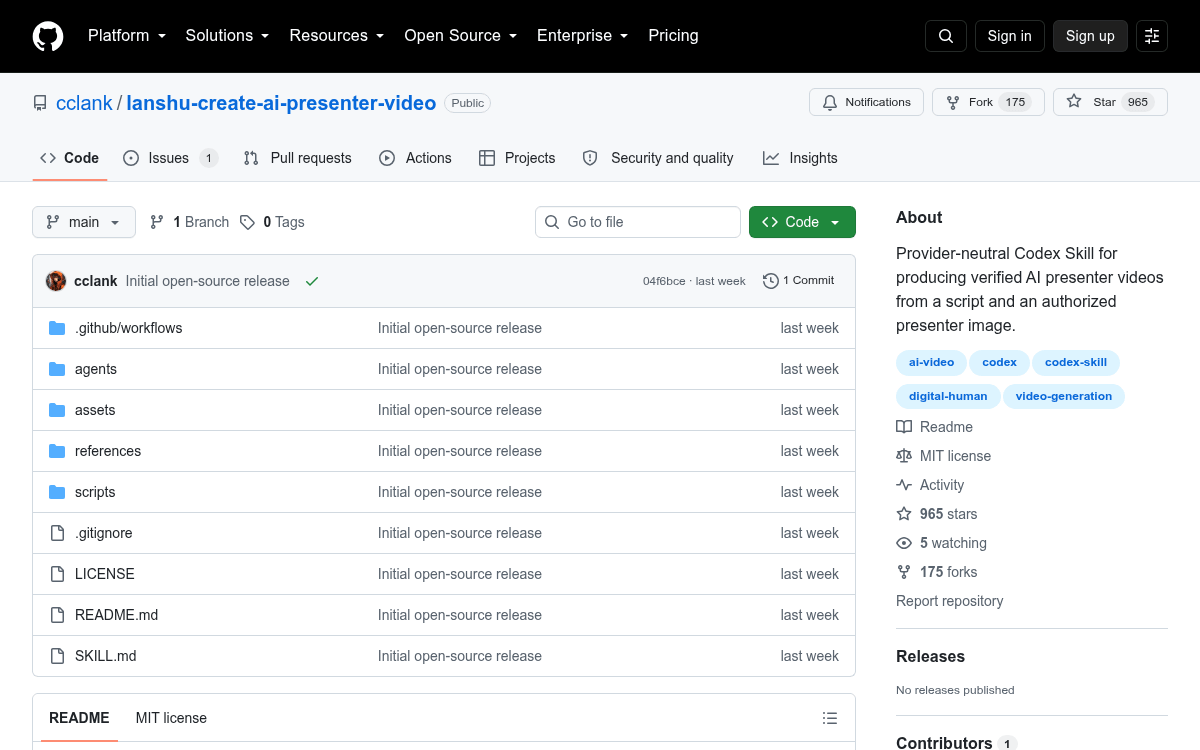
A Chinese developer has quietly dropped an MIT-licensed workflow that turns a script and a single authorized photo into a finished vertical talking-head video, and it has picked up close to a thousand GitHub stars in a matter of days. The project, lanshu-create-ai-presenter-video, ships no new model. It is a Codex Skill: an instruction bundle that tells an agent how to chain together whichever voice, avatar, and lip-sync tools are already available in your environment.
That framing matters. A skill is a versioned bundle of files plus a SKILL.md manifest (front matter plus instructions), designed to codify processes and multi-step workflows. Codex loads the folder from .agents/skills and follows the instructions when your task matches the skill description, or when you mention it with $name. In practice, you install this repo once and then ask Codex to make a video.
What ships in the repo
The codebase itself is tiny (about 21 KB) and provider-neutral by design. It includes a SKILL.md manifest, three reference documents that Codex loads only when it enters the matching phase (generation, editing, QA), a job template, and a handful of Python and Bash scripts. The heavy lifting, meaning the actual video model, the TTS engine, and the lip-sync module, is expected to come from whatever capabilities the agent can already reach.
The pipeline it drives is where the design choices show. According to the README, the flow is:
This story is for Pro members
You've reached the end of the free preview. Upgrade to AlphaSignal Pro to read the full article - and everything else behind the paywall.
Comments
