

LangWatch Unifies Open-Source LLM Tracing and Evals in One Platform
LangWatch bundles tracing, offline and online evaluation, agent simulations, and a Go-based AI gateway into one open-source observability loop.
 PRO
- LangWatch is an open-source platform unifying LLM tracing, offline and online evaluation, prompt management, and agent simulations.
- OpenTelemetry-native so any OTel-compatible library, framework, or model provider works without vendor SDK lock-in.
- New AI Gateway ships as a Go binary with virtual keys, budgets, provider fallback, and ~700 ns overhead.
- One-command local install via
npx @langwatch/server; Docker Compose, Helm, and hybrid on-prem deployments supported. - Open-core Apache 2.0 with free tier (200K events/month), Growth from 29 euros per seat, and enterprise plans.
- Integrates with LangChain, LangGraph, Vercel AI SDK, CrewAI, DSPy, Bedrock, and MCP clients.
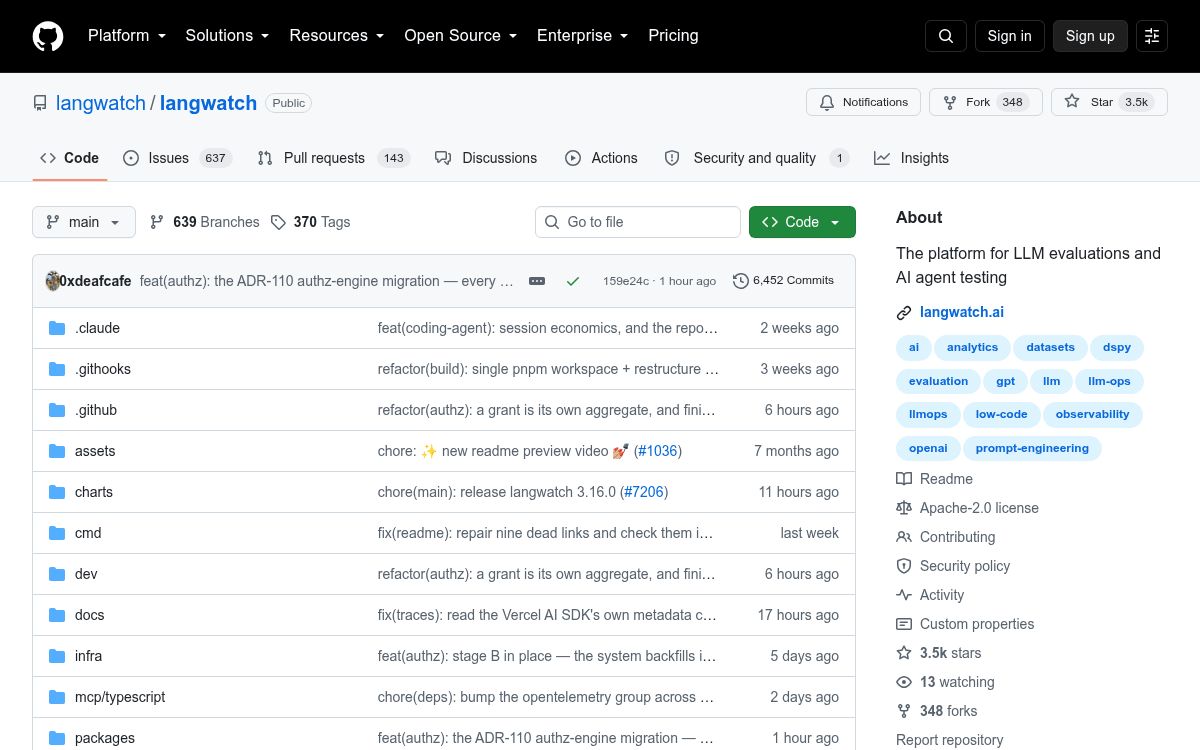
Shipping LLM agents into production still feels like flying blind. Traces live in one tool, evals in another, prompts in a third, and none of them agree on what a failure looks like. LangWatch is trying to collapse that stack into a single open-source platform, and the repo has now crossed 3.5k stars while adding an AI gateway, agent simulations, and a one-command local install.
At its core, LangWatch is a testing and observability platform for LLM applications. It traces production traffic, capturing prompts, completions, tool calls, latency, tokens, and cost, then evaluates quality offline against a curated dataset and online against a sample of live traffic. Trace, dataset, evaluate, and optimize prompts or models all live in one loop, without glue code or tool sprawl.
The tracing and eval loop
The mental model is standard OpenTelemetry. You instrument your application, typically with a decorator or SDK wrapper, so each LLM interaction becomes a trace, which is a tree of spans representing the model calls, retrieval steps, and tool invocations. Each span records inputs, outputs, latency, token usage, and cost. Because the platform is OTLP-native, it accepts data from any OpenTelemetry-compatible library out of the box, which avoids vendor SDK lock-in.
This story is for Pro members
You've reached the end of the free preview. Upgrade to AlphaSignal Pro to read the full article - and everything else behind the paywall.
Comments
