

Kyutai's Pocket TTS Now Speaks 6 Languages Faster Than Real-Time on CPU
Kyutai's Pocket TTS adds French, Spanish, Portuguese, Italian, and German to its 100M-parameter model that runs faster than real-time on a laptop CPU with no GPU required.

 PRO
PRO- Pocket TTS now supports 6 languages: English, French, Spanish, Portuguese, Italian, and German, with improved English quality at the same 100M parameter size.
- Runs faster than real-time on CPU only (6x real-time on MacBook Air M4), with ~200ms latency to first audio chunk and no GPU required.
- Architecture uses CALM (Continuous Audio Language Models): a VAE instead of lossy discrete tokens, plus a single-step consistency model head instead of diffusion.
- Pocket TTS is distilled from a 313M-parameter teacher to a 100M student, matching 750M-parameter competitors on Word Error Rate (1.84) in benchmarks.
- Supports zero-shot voice cloning from a 5-10 second audio clip, streaming, infinitely long inputs, and a local HTTP server mode for low-latency repeated generation.
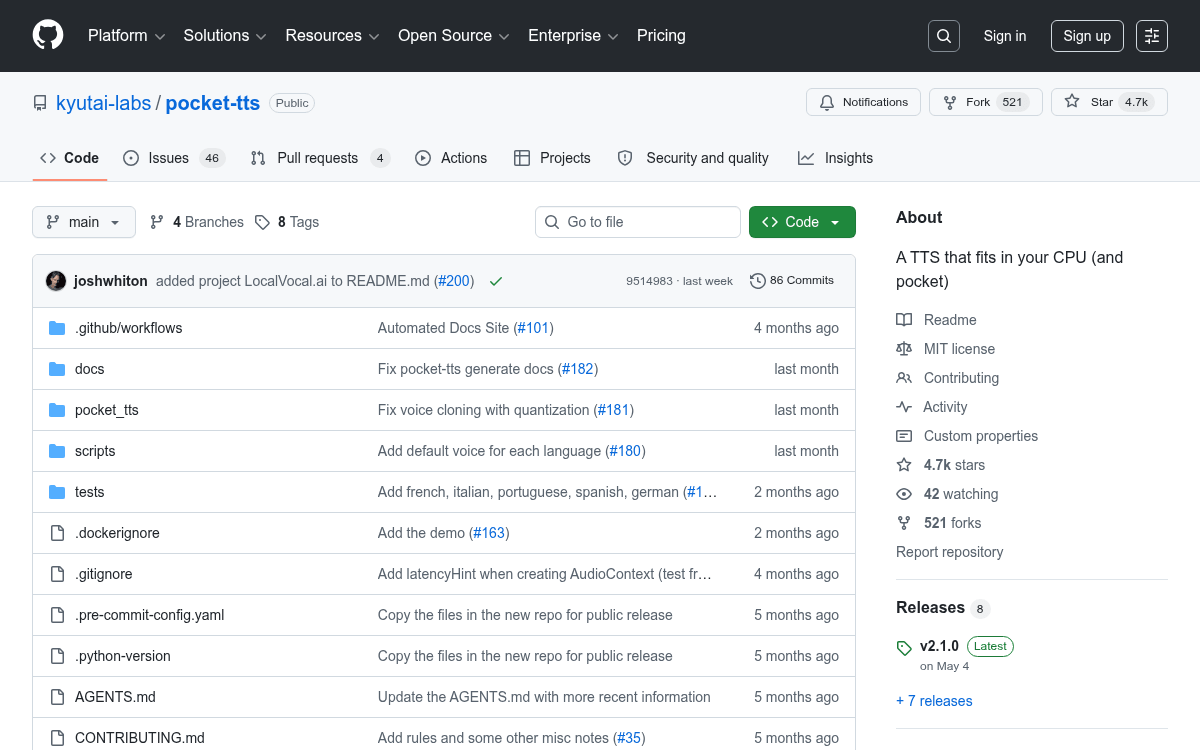
- Free and MIT-licensed; install with
pip install pocket-ttsor try the live demo and GitHub repo.
Pocket TTS, the open-source text-to-speech model from French AI lab Kyutai, just went multilingual. The 100M-parameter model now speaks six languages, runs faster than real-time on a laptop CPU, and still fits in a single pip install. No GPU, no cloud API, no subscription.
Six languages, same tiny footprint
Pocket TTS goes multilingual, with 100M-parameter models that can generate speech in six languages faster than real-time without a GPU, while also improving the quality of the English model while keeping the same size. The supported languages are:
- English
- French
- Spanish
- Portuguese
- Italian
- German
You can switch languages with a single flag. To generate German speech from the command line, for example:
uvx pocket-tts generate --language german --text "Hallo Welt, das ist ein Test."The package supports Python 3.10 through 3.14, requires PyTorch 2.5+, and does not require the GPU version of PyTorch.
The architecture behind the speed
Most TTS systems today work by first compressing audio into discrete tokens using a neural codec (think of it like lossy compression), then running a language model over those tokens. Audio tokens are lossy: unlike text tokens, you cannot perfectly reconstruct audio from them, and improving quality means increasing bitrate, which means more tokens and more computation.
Pocket TTS takes a different approach. CALM (Continuous Audio Language Models) instantiates a large Transformer backbone that produces a contextual embedding at every timestep, and this sequential information then conditions an MLP that generates the next continuous frame of an audio VAE through consistency modeling, achieving higher quality at lower computational cost than discrete counterparts.
This story is for Pro members
You've reached the end of the free preview. Upgrade to AlphaSignal Pro to read the full article - and everything else behind the paywall.
Comments
