

Kyushu University's Schrödinger Bridge Beats CellViT at Cell Segmentation Without Post-Processing
A Kyushu University team reframes cell segmentation as generative image-to-image transport, beating CellViT on PanNuke without SAM pretraining or post-processing.
 PRO
- Kyushu team reformulates cell instance segmentation as a Schrödinger Bridge between image and mask distributions.
- Multi-task setup jointly predicts instance masks and a reverse distance map that emphasizes cell boundaries.
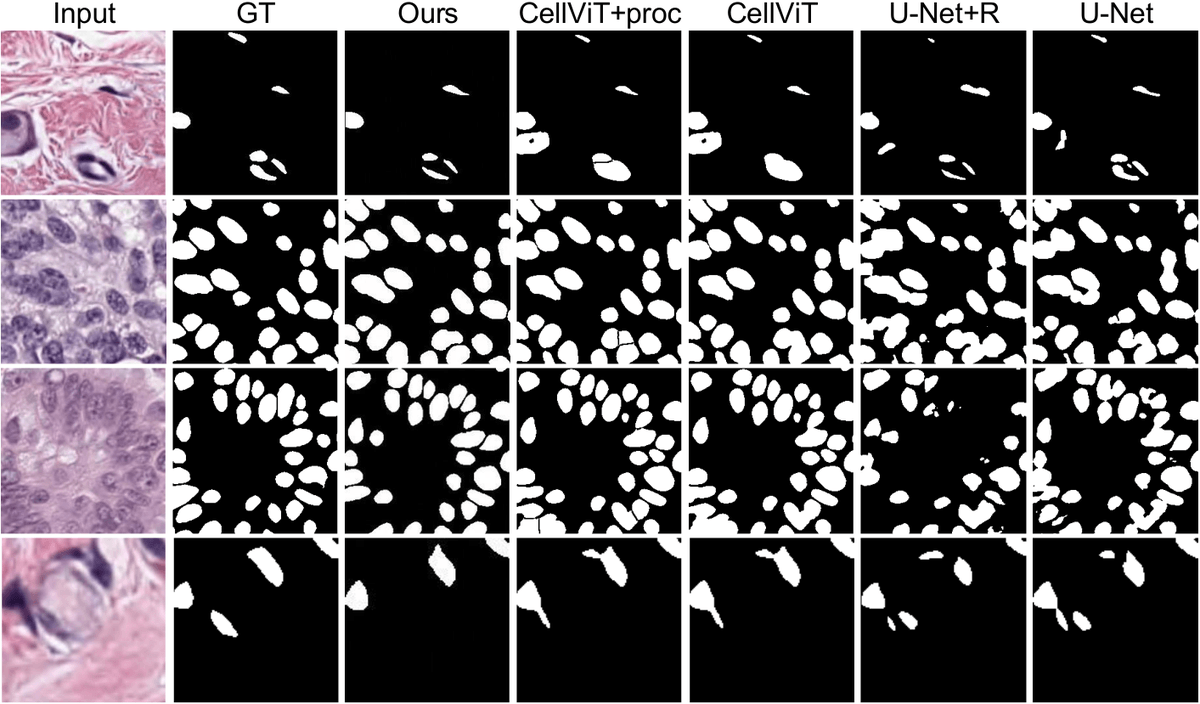
- Hits 0.6362 bPQ on PanNuke, beating CellViT+post-processing at 0.6221 without SAM or heuristics.
- Ablation: single-task mask 0.5044 bPQ, single-task distance map 0.5903, multi-task 0.6341.
- Robust on MoNuSeg's 30 training images, matching CellViT with post-processing on bPQ.
- Trade-off: 3.5 seconds per patch versus 0.35 seconds for CellViT, a 10x inference slowdown.
Cell segmentation pipelines have quietly become Rube Goldberg machines. A convolutional network predicts a probability map, a distance map, or a vector field, then a stack of watershed transforms, morphological operations, and hand-tuned thresholds tries to tease apart cells that are touching. A new paper from Kyushu University tosses out most of that plumbing and treats the whole problem as a Schrödinger Bridge, learning a direct diffusion path from a histology image to its instance mask.
The result, called Multi-Task Image-to-Image Schrödinger Bridge, beats CellViT on PanNuke without using SAM pretraining and without any post-processing pipeline. A generic generative model, trained from an ImageNet checkpoint, edges out a Vision Transformer specifically built on top of Meta's Segment Anything backbone.
Why post-processing is the weak link
In densely packed microscopy images, the boundary between two touching cells is often a single pixel wide, and ground-truth masks label that boundary as background. Most existing frameworks lean on post-processing to separate adjacent cells: a CNN predicts intermediate representations like probability maps, distance maps, or vector fields, and individual instances are recovered through watershed transforms, clustering, or morphological operations.
That works, but it has two problems. Such pipelines often depend on dataset characteristics and hyperparameter choices, which limits robustness and generalizability. And because the network output is deterministic, nothing prevents it from producing morphologically absurd shapes like merged cells or spurious fragments, which the downstream cleanup then has to fix.
This story is for Pro members
You've reached the end of the free preview. Upgrade to AlphaSignal Pro to read the full article - and everything else behind the paywall.
Comments
