

Kyung Hee University's FDN Lets Excavator Arms Feel Without Force Sensors
A frequency-aware network predicts force and torque on a hydraulic arm during grinding without needing a physical F/T sensor, beating baselines on high-frequency vibrations.
 PRO
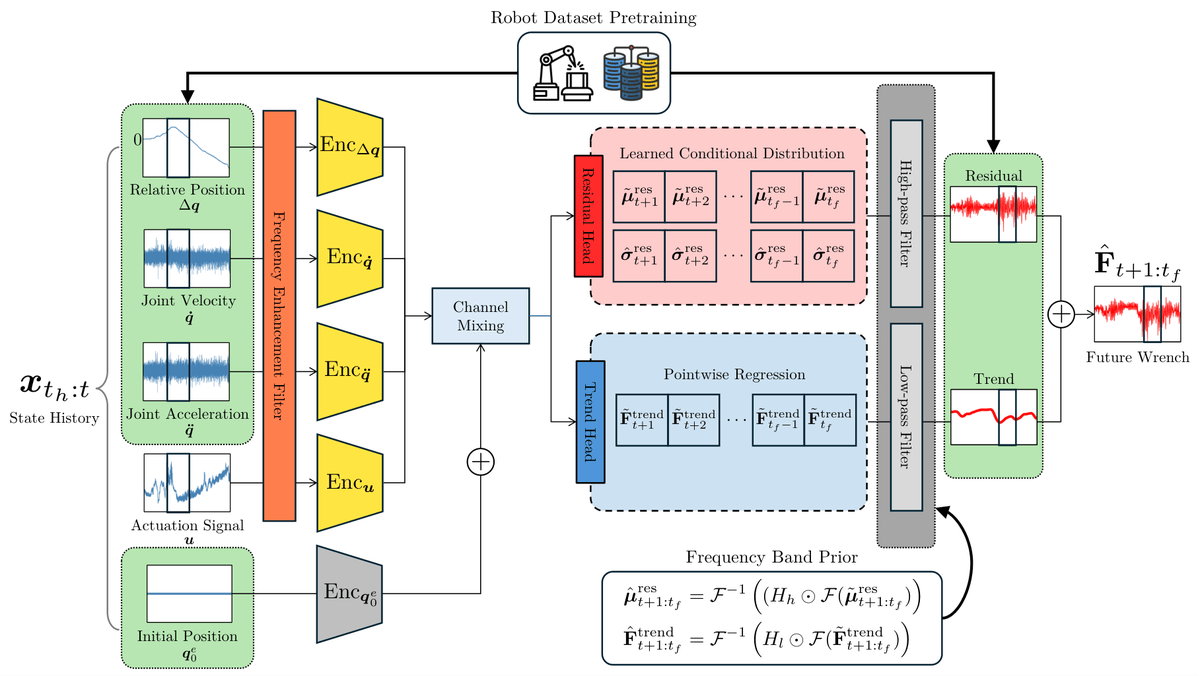
- FDN forecasts force and torque on a hydraulic arm without a physical F/T sensor, using only proprioception.
- Wrench is split into a deterministic low-frequency head and a probabilistic high-frequency residual head.
- Learned frequency filters enhance input spectra and a band prior constrains outputs.
- Tested on real grinding excavation with a 6-DoF hydraulic manipulator against sensorless and forecasting baselines.
- Pretraining on open robot datasets transfers to hydraulics, mainly helping the low-frequency band.
- Paper; code promised via KHU-MASLAB upon acceptance.
Force and torque sensors are the eyes robots use to feel the world, and they are also one of the most annoying components in the entire stack. They are pricey, they take up space at the wrist where you would rather put a tool, and they crack the moment a grinder catches the wrong edge. A team from Kyung Hee University wants to skip them entirely for one of the hardest cases: a heavy hydraulic arm chewing through rock.
Their Frequency-aware Decomposition Network (FDN) forecasts short-term wrench (the six-dimensional vector of forces and torques at the end effector) directly from the robot's own proprioceptive signals such as joint angles and hydraulic pressures. On real-world grinding excavation data from a 6-DoF hydraulic manipulator, and under a delayed estimation setting, FDN beats baseline estimators and forecasters in the high-frequency band while staying competitive in the low-frequency band.
Why sensorless wrench estimation keeps failing on fast tasks
Sensorless force estimation is not new. Recent work has recovered wrench from robot internal states without a dedicated sensor. The catch is the operating regime. Existing methods generally target slow interactions, while rapid contact tasks such as grinding induce task-critical high-frequency vibrations that remain underexplored.
That gap matters for construction, mining, and demolition, where hydraulic manipulators do most of the work and contact is anything but gentle. A grinder chattering against gypsum produces broadband vibrations that carry the actual information about tool wear, cutting depth, and material response. Smooth those out and you get a clean-looking curve that is useless for control.
This story is for Pro members
You've reached the end of the free preview. Upgrade to AlphaSignal Pro to read the full article - and everything else behind the paywall.
Comments
