

Korea University's FiRe Nearly Doubles AI Image Accuracy on Complex Prompts
Researchers from Korea University and KT Corporation propose FiRe, a six-step reasoning loop that decomposes prompts into checkable tuples and fixes only the parts an image gets wrong.
 PRO
- FiRe from Korea University and KT Corporation adds a six-step reasoning loop to unified MLLMs for text-to-image generation.
- The loop decomposes prompts into atomic tuples, verifies each via VQA, then locally edits only failed regions.
- FiRe-GRPO assigns step-specific rewards and step-level advantages instead of a single outcome reward.
- Built on Janus-Pro-7B, it hits 0.87 GenEval and 0.491 GenEval++, nearly doubling the base model on the harder benchmark.
- Preserves already-correct content well (0.9204 Masked CLIP on GIE-Bench) and shows fewer degradation cases than Janus-Pro-R1.
- Paper on arXiv; no public code or checkpoint linked yet.
Text-to-image models keep getting better at drawing pretty pictures, but they still trip over prompts like "a pink oven and three plates on a wooden table." A new paper from Korea University and KT Corporation attacks that problem with a reasoning loop that behaves less like a diffusion sampler and more like a proofreader with a checklist.
The method is called FiRe (Fine-grained Multimodal Reasoning), and it turns a unified multimodal LLM into an image generator that critiques and edits its own outputs one atomic visual claim at a time. The authors also introduce FiRe-GRPO, a reinforcement learning variant that hands out rewards step by step rather than only at the end.
Why holistic self-reflection keeps failing
Recent unified MLLMs like Janus-Pro can both read and draw, which opens the door to letting a model check its own images. The paper argues that existing approaches fall into two buckets: prompt augmentation (rewriting the input before generation) and iterative self-reflection (regenerating after a coarse critique). Both rely on holistic judgments like "does the image match the prompt?", the kind of question that misses one wrong color when four other things are right.
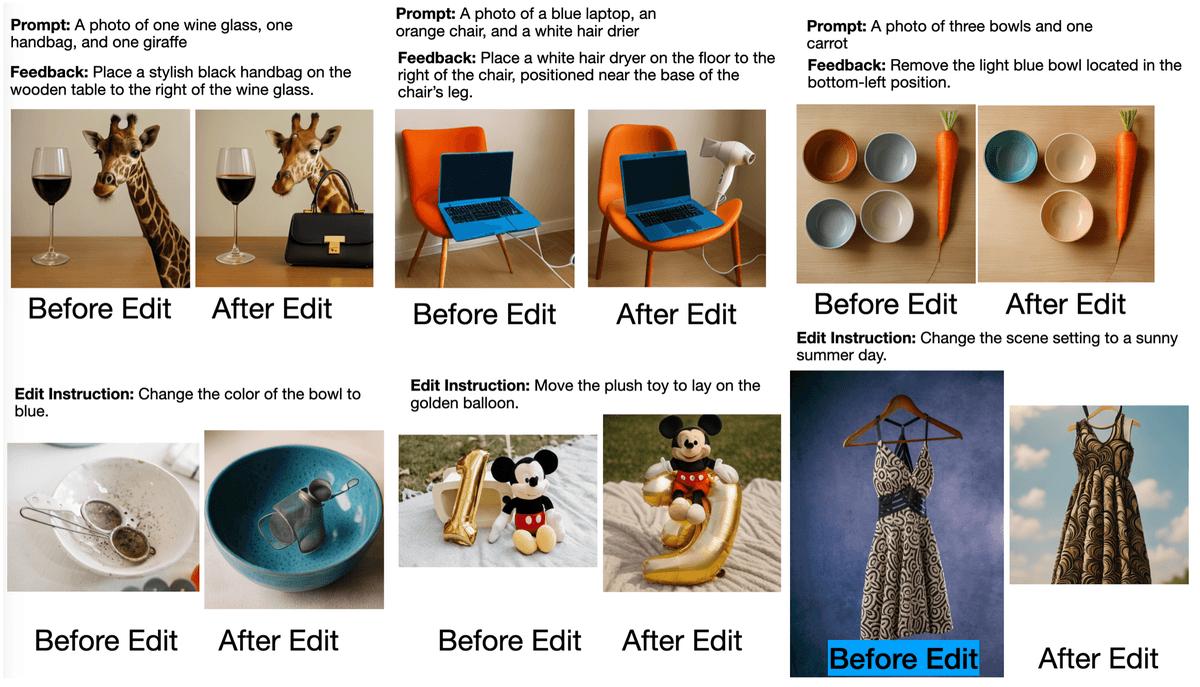
FiRe replaces that single question with many small ones. If the prompt asks for a pink oven, FiRe decomposes it into whole-entity(oven) and attribute-color(oven, pink), then asks "Is the oven pink?" against the current image. If the VQA says the oven is white, that becomes a targeted edit instruction rather than a full regeneration.
The six-step loop

The reasoning process runs the same six steps until the image satisfies every checkable requirement or a maximum iteration count is hit:
This story is for Pro members
You've reached the end of the free preview. Upgrade to AlphaSignal Pro to read the full article - and everything else behind the paywall.
Comments
