
King's College London's EDIT Teaches AI to Grade Exams for the Right Reasons
EDIT trains LLMs to grade student answers by diagnosing exactly which reasoning step went wrong and fixing only that step, beating standard RL baselines on real exam data.
 Pro
Takeaways
- EDIT is a two-phase LLM training framework that improves rubric-faithful grading by diagnosing exactly which reasoning step went wrong using the model's own internal belief signals.
- Phase 1 (EDIT-SFT) surgically rewrites only the broken reasoning step using a rubric checklist as privileged context, avoiding disruption to the rest of the chain.
- Phase 2 (EDIT-RL) adds a belief-guided reward shaping term to GRPO that penalizes large mid-trajectory belief drifts while tolerating small exploratory fluctuations.
- On two real-world benchmarks (SAS-Bench and a proprietary GCSE dataset), EDIT-RL improves macro-QWK from 0.727 to 0.794 on fully out-of-distribution questions.
- EDIT also outperforms baselines on rubric faithfulness -- how well the model's scores track when the mark scheme is deliberately modified.
- No code or weights are released; the paper is available on arXiv and the public SAS-Bench dataset can be used to reproduce part of the evaluation.
Getting an LLM to assign a score is easy. Getting it to assign a score for the right reasons is a much harder problem. A new paper from researchers at King's College London, the University of Cambridge, and UK exam board AQA tackles this head-on with EDIT (Evidence-Diagnosed Intervention Training), a two-phase training framework that teaches LLMs to grade student exam answers in a way that is genuinely grounded in the mark scheme.
The problem with grading as a reasoning task
LLMs are increasingly deployed as automatic graders, but training them to grade reliably remains difficult. The challenge is structural. The final mark depends on a sequence of intermediate judgements, such as which rubric criteria are satisfied, what evidence supports them, which mark band applies, and how partial credits compose. This makes rubric grading a demanding credit-assignment problem -- the task of figuring out which step in a chain of reasoning actually caused the wrong answer.
Outcome-based reinforcement learning methods such as GRPO assign a single final reward to the whole reasoning trajectory and cannot identify which reasoning step caused an incorrect mark. More fine-grained credit assignment methods offer a possible remedy, but these methods were primarily designed for self-contained reasoning tasks like mathematics. Rubric grading is fundamentally different: it requires checking whether each step correctly invokes an external rule, not just maintaining internal logical consistency.
Rubric grading has two additional requirements. First, it requires external grounding -- each judgement step must be anchored in both the marking scheme and the student's written evidence. Second, rule-based reasoning is an uncertainty reduction process: the model's belief about the final mark should progressively converge. Existing RL methods ignore harmful belief shifts that occur in the middle of reasoning, while token-level constraints can over-penalize benign exploratory phrasing.
Two phases, one goal: faithful grading
EDIT addresses this with a two-phase pipeline. The first phase, EDIT-SFT, builds better training data by surgically fixing broken reasoning. The second phase, EDIT-RL, calibrates the model's behavior during RL using the model's own internal belief state as a signal.

The key innovation in both phases is the use of internal state signals -- probes into what the model actually believes at each step of its reasoning chain, rather than relying on the model to self-report errors through prompting.
How the internal diagnostics work
EDIT extracts two signals from the model's own activations at each reasoning step boundary:
- Posterior belief probe: At each step, the framework appends a "scaffold" prompt and reads the model's next-token logits over valid mark values. This gives a probability distribution over possible scores at every point in the reasoning chain, revealing whether the model's internal belief is drifting toward or away from the correct mark.
- Mask-based grounding audit: For each reasoning step, the framework measures how much the step depends on three information sources -- the rubric, the student answer, and the prior reasoning. It does this by masking each source in turn and measuring how much harder it becomes to predict the step. If masking the student answer makes the step much harder to predict, then the step is likely grounded in the student answer.
Together, these signals let EDIT pinpoint the exact step where the model's belief first moved away from the correct mark AND where the reasoning became weakly grounded in the actual evidence.
Phase 1: Surgical SFT data construction
EDIT-SFT builds a supervised training pool by revising small parts of incorrect rollouts. Each rollout passes through four sub-stages: rubric-checklist generation, candidate step selection using internal signals, atomic revision, and outcome filtering.
The process works like this:
- Generate a rubric checklist: For each training example, the model is prompted (with the gold mark as privileged context, only available during training) to list every marking criterion and whether the student answer satisfies it.
- Locate the broken step: Using the belief probe and grounding audit, EDIT identifies which reasoning steps most strongly pushed the model's belief away from the correct mark and which were weakly grounded in the rubric or student answer.
- Atomic revision: The selected step is rewritten into 1-3 new sub-steps that fix only the local error. The rubric checklist is provided as context, but the model is constrained not to simply copy it -- a "locality constraint" prevents the revision from destroying the surrounding reasoning structure.
- Filter and mix: Only revisions that lead to a correct final mark are kept. These are mixed with originally correct rollouts to form the SFT training set.
The ablation studies confirm that each component matters. Removing any module degrades performance. Excluding the rubric-checklist context leads to the largest drop in QWK and MAE while leaving accuracy largely unchanged, suggesting increased variance in grading behavior. Edit-SFT without internal-signal localisation exhibits the largest drop across all metrics, highlighting the critical role of step-candidate selection for revision.
Phase 2: Belief-guided RL
EDIT-RL applies distance-aware GRPO augmented by a belief-guided reward shaping term. By re-using the same posterior probe, this shaping term calibrates marking accuracy while penalising harmful drifts in intermediate beliefs.
The reward has two components. The outcome reward gives partial credit for being close to the correct mark. The shaping term adds a penalty whenever the model's intermediate belief drifts too far from the correct mark at any step -- but only beyond a configurable tolerance threshold, so small exploratory fluctuations are allowed. The posterior belief probe is run on the frozen EDIT-SFT checkpoint rather than the active policy. This maintains a stationary shaping signal, reduces computational overhead, and prevents reward hacking.

Benchmarks and results
Experiments are run on two complementary benchmarks. The first is SAS, drawn from SAS-Bench, a Chinese short-answer scoring benchmark covering History, Geography, and Physics. The second is Private-Science, a proprietary collection of student responses to GCSE-level science exam questions in Biology and Physics, each marked by trained examiners against an official mark scheme. The main metric is Quadratic Weighted Kappa (QWK) -- a standard measure of agreement between predicted and gold scores that penalizes large errors more heavily than small ones.
All methods use Qwen3-8B fine-tuned with LoRA, keeping the backbone fixed so that differences reflect the training objective rather than model capacity. The baselines include vanilla GRPO, DGPO (a token-level credit redistribution method), and InT (a self-proposed intervention method).
The results are consistent across both benchmarks:
- On SAS (fully out-of-distribution), EDIT-RL improves macro-QWK from 0.727 for the base model and 0.731 for InT to 0.794.
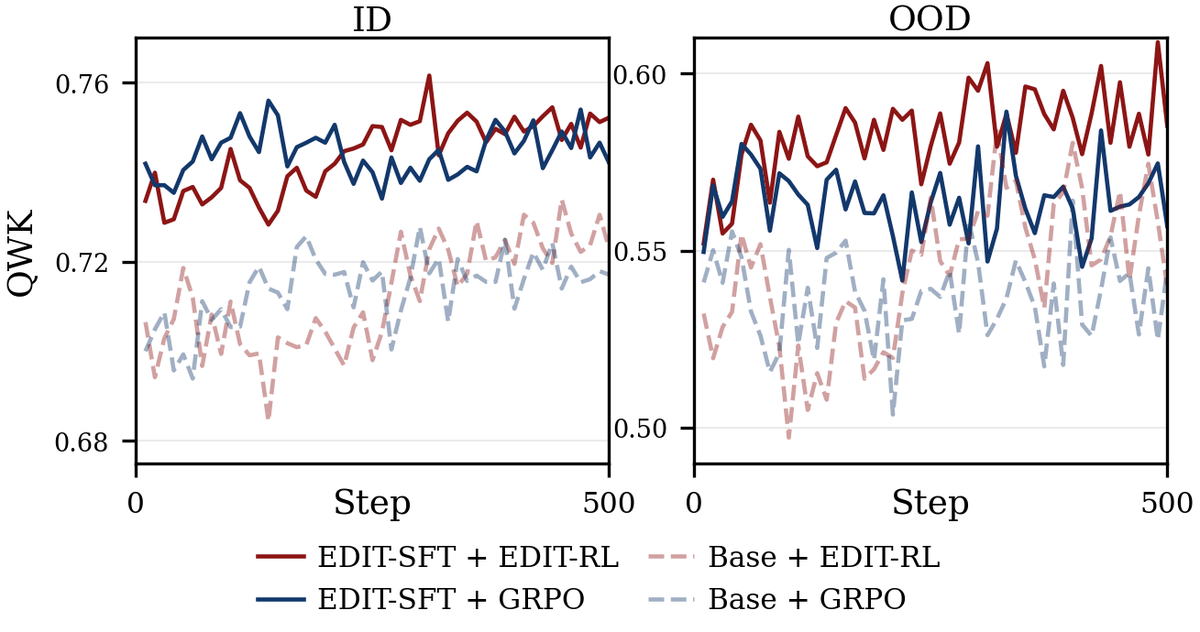
- On Private-Biology, EDIT-SFT beats all baselines, improving macro-QWK by +0.027 on the in-distribution test split and +0.04 on the out-of-distribution split over the strongest baseline (GRPO).
- EDIT-RL further improves over EDIT-SFT, with the larger OOD gain suggesting that belief-guided reward shaping is especially useful when the model must grade unseen questions.
- Applying EDIT-RL directly to the base model does not improve OOD performance over standard GRPO. In contrast, applying RL after EDIT-SFT gives stronger results, and the full combination EDIT-SFT + EDIT-RL is best on every metric.
Does it actually follow the rubric?
Beyond accuracy, the paper tests whether the model genuinely responds to changes in the mark scheme -- a property they call rule faithfulness. The test involves making deterministic edits to the rubric (shifting mark bands, rescaling point values) and measuring whether the model's scores change proportionally. EDIT-SFT achieves the strongest average responsiveness across all interventions, with in-rubric Rule-Sensitivity Ratio biases of only -0.005 and -0.014 from the ideal value of 1.
There is one notable weakness: multiplicative point rescaling collapses in-rubric RSR to 0.1-0.35 on up-rescales and inflates floor rates to 21-32%, evidence of absolute-count anchoring that no method removes. When the total marks available are multiplied, all models struggle to adapt -- they appear to anchor on the absolute number of points they expect rather than re-reading the rescaled scheme. This is a known failure mode that EDIT does not fully solve.
What it's good for -- and where it falls short
EDIT is directly applicable anywhere you need an LLM to grade against an explicit, structured rubric: standardized testing, coding assessments with detailed rubrics, structured interview scoring, or compliance checks against policy documents. The out-of-domain gains are particularly relevant -- the model generalizes to unseen questions rather than memorizing question-specific patterns.
The paper is candid about three limitations:
- Scope: Only tested on short-answer and fill-in-the-blank questions. Long-form essay scoring (like the ASAP benchmark) is untested.
- Complexity: The overall framework still relies on a heavy multi-stage process: rigorous SFT data construction followed by a calibration RL phase. This multi-step orchestration increases both computational complexity and engineering effort.
- Rubric quality: EDIT relies on explicit, structured rubrics. Performance may degrade when rubrics are vague, holistic, or implicitly defined by human graders.
No code or model weights have been released alongside the paper. The Private-Science dataset is proprietary and cannot be publicly released due to licensing constraints, though the SAS-Bench dataset used is publicly available.
The real breakthrough
The deeper contribution here is not just better grading scores. It is a new way of thinking about credit assignment for rule-application tasks -- tasks where the model must check external criteria, not just solve a self-contained problem. The insight that a model's internal belief trajectory is a meaningful diagnostic signal, and that you can use it both to locate training failures and to shape RL rewards, is likely to generalize well beyond grading. Legal document review, medical coding against clinical guidelines, and policy compliance checking all share the same structure: a sequence of judgements that must be anchored in external rules. Future work will explore generalizing the framework to broader domains, streamlining the training pipeline, and dynamically decomposing holistic rubrics.