

kimodo.cpp Brings NVIDIA's Kimodo Motion AI to Any GPU Without CUDA
A community port strips NVIDIA's text-to-motion diffusion model down to C++ and GGML, running SMPL-X skeleton generation on CPU or Vulkan.

 PRO
PRO- kimodo.cpp ports NVIDIA's Kimodo text-to-motion diffusion model to C++/GGML with CPU and Vulkan backends
- Currently supports only
Kimodo-SMPLX-RP-v1, generating SMPL-X22 rotations and root translations from text prompts - Ships GGUF loading, safetensors conversion, DDIM sampling, a C API, and a Go web demo
- Text encoder uses LLM2Vec on top of Llama 3 8B, bundled into GGML format via included script
- Missing features: SOMA, G1 robot skeleton, constraints, GLB export, and quantised weights
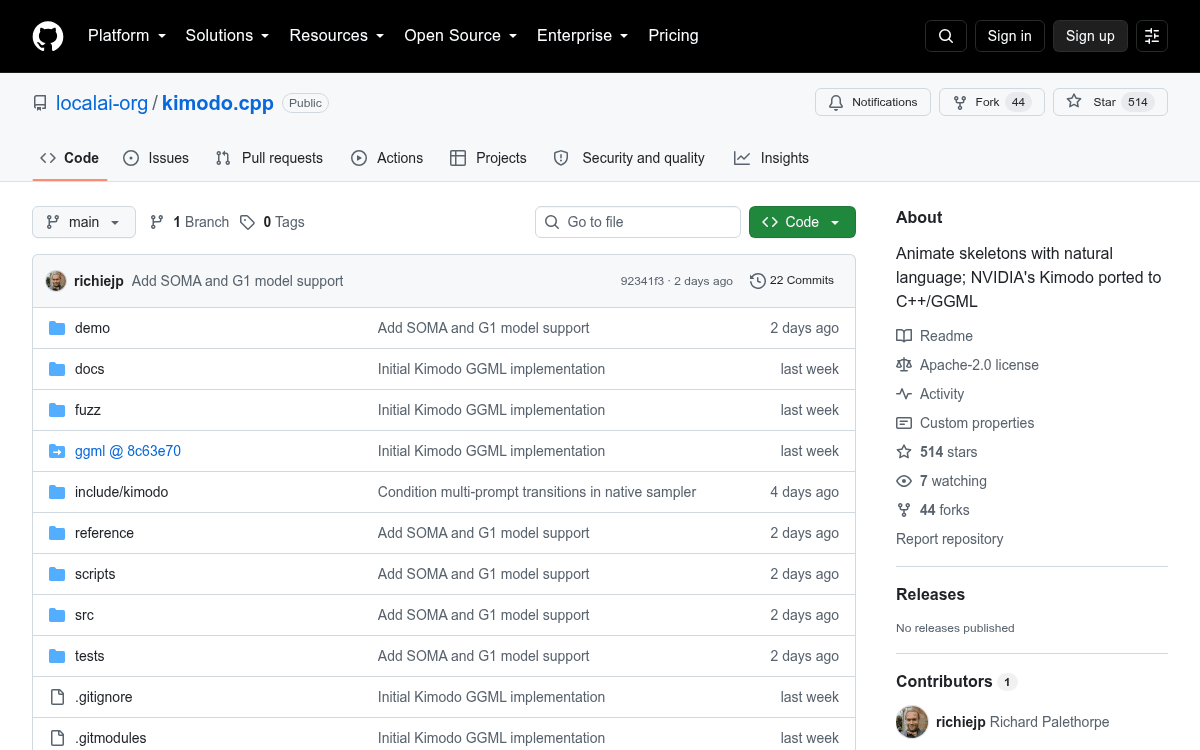
- Repo hit 514 stars in a week after a viral launch tweet with 2,300+ likes
The llama.cpp playbook has come for character animation. A new project called kimodo.cpp ports NVIDIA's Kimodo text-to-motion diffusion model to GGML and pure C++, letting you type a prompt like a person walks forward then jumps and get back a full skeletal animation, without a CUDA GPU in sight. The repo has picked up 514 stars in under a week off the back of a viral launch tweet, which suggests the animation and robotics crowd has been waiting for something like this.
From CUDA research code to a portable binary
The upstream model, Kimodo, comes out of NVIDIA Research. Kimodo (Kinematic Motion Diffusion) generates 3D skeletal body animations from a text prompt and optional motion constraints like full-body poses, end-effector joint positions, paths, and waypoints. The official release ships as a PyTorch stack with a Docker image and expects an NVIDIA GPU.
kimodo.cpp rebuilds the inference path on top of GGML, the same tensor library that powers llama.cpp and whisper.cpp. The current status is narrower than the full research repo: Kimodo-SMPLX-RP-v1 is the only checkpoint wired up, and it accepts either a UTF-8 prompt or a precomputed LLM2Vec embedding, then generates SMPL-X22 local rotations plus root translations on CPU or Vulkan. Vulkan support means AMD, Intel, and Apple GPUs are on the table rather than locked out.
This story is for Pro members
You've reached the end of the free preview. Upgrade to AlphaSignal Pro to read the full article - and everything else behind the paywall.
Comments
