

Keio Researchers Prove Voice AI Embeddings Often Mislead Human Perception
A new study tests 40+ speech models against human voice similarity judgments, revealing which architectures and layers actually match how humans hear voices.
 PRO
- Core finding: Speaker embedding distances from 40+ speech foundation models often don't align with how humans perceive voice similarity.
- Encoder-only wins: Encoder-based architectures (HuBERT, wav2vec 2.0, WavLM) produce more perceptually aligned embeddings than encoder-decoder models like Whisper.
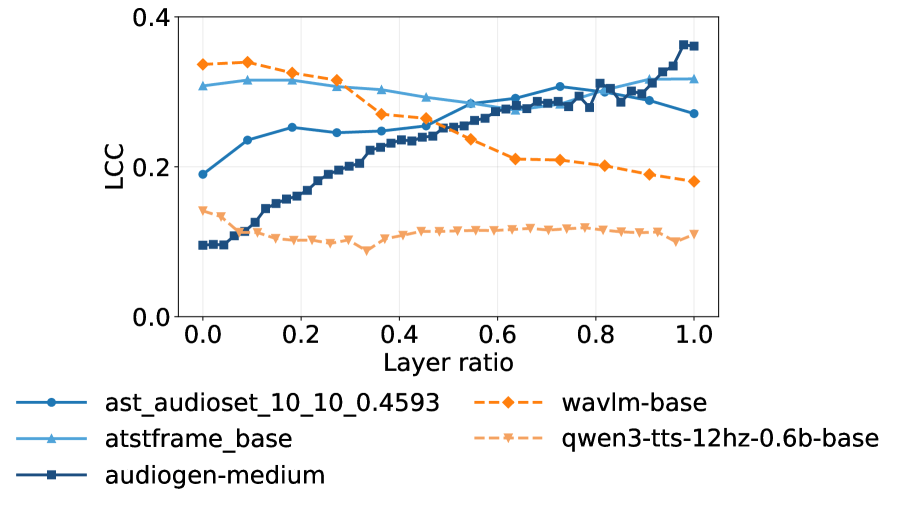
- Layer selection is critical: The best layer for perceptual alignment is not always the final one -- it varies by model family and must be probed explicitly.
- Verification ≠ perception: Models with near-perfect speaker verification EER can still have weak correlation with human similarity judgments.
- Datasets used: Human perceptual scores from JVS and CSTR-VCTK datasets; correlation measured via LCC, SRCC, Frobenius, and spectral distance metrics.
- No code released, but methodology is reproducible using public HuggingFace models and existing perceptual datasets. Read the paper.
When a TTS system clones a voice or a speaker verification model decides two recordings belong to the same person, it relies on speaker embeddings -- compact numerical vectors that encode a speaker's identity. The assumption baked into nearly every voice AI pipeline is that the distance between two embeddings reflects how similar those voices actually sound to a human ear. A new paper from researchers at Keio University and the University of Tokyo puts that assumption to the test, and the answer is: sometimes, but not always, and the gap depends heavily on which model you use and which layer you tap.

The gap between geometry and perception
Human listeners can judge speaker similarity on a continuous scale, discerning how similar two voices are, while speech foundation models embed speaker characteristics into numerical representations. The question the paper asks is deceptively simple: does the numerical distance between speaker embeddings in these models truly align with the similarity perceived by humans?
This matters because speaker embeddings are used as a proxy for human perception across a wide range of real-world systems. When cloning a voice, the key question is how closely the generated speech matches the original speaker, and speaker similarity is measured using cosine similarity between speaker embeddings. If those embeddings don't actually reflect what humans hear, then every benchmark score and quality metric built on top of them is measuring the wrong thing.
A benchmark built on 40+ models
The researchers conducted a comprehensive investigation using more than 40 models to compare model-derived distances with human-perceived similarity scores, and identified which factors in model configuration contribute most to a speaker embedding that mirrors human perception. The model zoo spans the major families of speech foundation models: encoder-only self-supervised models like HuBERT, wav2vec 2.0, and WavLM; encoder-decoder models like Whisper; and audio models trained on general sound rather than speech.
This story is for Pro members
You've reached the end of the free preview. Upgrade to AlphaSignal Pro to read the full article - and everything else behind the paywall.
Comments
