

Kaggle Now Lets ML Engineers Cite Competition Solutions as Real Research
Kaggle now lets users mint permanent DOIs for competition writeups, making ML solutions citable in academic papers for the first time.
- New feature: Kaggle now supports DOI generation for competition solutions and project Writeups, registered through DataCite.
- Permanent citations: DOIs cannot be deleted and resolve permanently, making Kaggle writeups citable in academic papers like any journal article.
- BibTeX auto-generated: Kaggle automatically produces a BibTeX entry alongside the DOI, ready to paste into LaTeX or any reference manager.
- DataCite integration: The same infrastructure used by universities and research repositories worldwide indexes the work in Google Dataset Search and other academic discovery tools.
- Addresses a long-standing gap: Thousands of competition writeups containing novel ML techniques have historically been uncitable; this changes that.
- How to use it: Open any Writeup on Kaggle, navigate to the citation section, and click "Generate DOI."
Kaggle has quietly done something that the ML community has needed for years: it now lets anyone generate a DOI (Digital Object Identifier) for their competition solutions and project Writeups. The identifiers are registered through DataCite, the same infrastructure used by universities and research institutions worldwide to make datasets permanently citable. It sounds like a small administrative detail, but the implications for how practical ML work gets credited are significant.
Why this gap existed in the first place
Kaggle Writeups are rich technical documents. After a competition concludes, participants publish solution write-ups explaining their approach, the technologies used, and any noteworthy modeling decisions -- a practice especially encouraged for top-performing teams, who are often incentivized with additional monetary rewards or recognition. Over time, these writeups have become a genuine knowledge base for the field. A structured dataset of 4,419 competition write-ups -- primarily from top-ranking and winning teams -- captures the extracted technologies, techniques, and generated summaries that have shaped how practitioners think about problems.
The problem was that none of this work had a stable, permanent address. A URL to a Kaggle discussion page is not the same as a citable academic reference. If a researcher wanted to credit a Kaggle solution in a paper, they were stuck with fragile links and informal citations. DOIs have been adopted by the scholarly communication community as the default identifier for publications, and in recent years they have been adopted as identifiers for data publication, enabling data citation and reuse. Kaggle writeups had none of that.
What DataCite actually provides
DOIs are persistent identifiers (PIDs), meaning they are intended to be a permanent means of identifying and accessing a particular research output or resource -- and DOIs cannot be deleted. That permanence is the key property. DOIs enable unique, persistent identification for objects as an important part of the open research infrastructure that helps make research and scholarly communication more FAIR: Findable, Accessible, Interoperable, and Reusable.
DataCite is a widely adopted service providing DOIs for data that also specifies a level of minimum metadata required to create a new DOI. When Kaggle registers a writeup through DataCite, it attaches structured metadata -- author, title, publication year, resource type -- that makes the work indexable by academic search engines and citation trackers. DataCite is one of the largest sources for the general-purpose data discovery service Google Dataset Search, providing metadata for a large number of repositories.
What changes for Kagglers
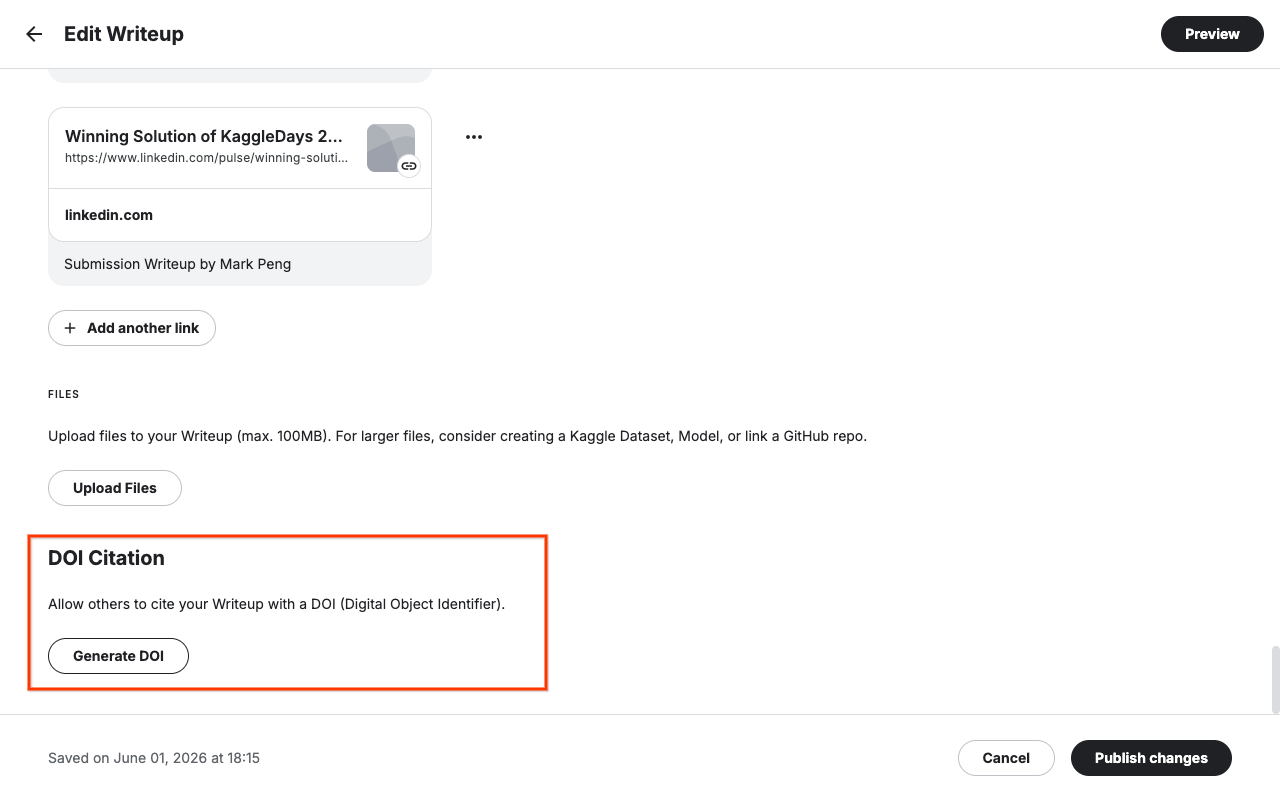
The feature is available directly inside the Writeup editor. Users can generate a DOI from the citation section of their writeup page, and Kaggle automatically produces a BibTeX entry that anyone can drop into a LaTeX document or reference manager. The workflow looks like this:
- Open your competition solution or project Writeup on Kaggle
- Navigate to the citation section in the editor
- Click "Generate DOI" -- Kaggle registers it with DataCite
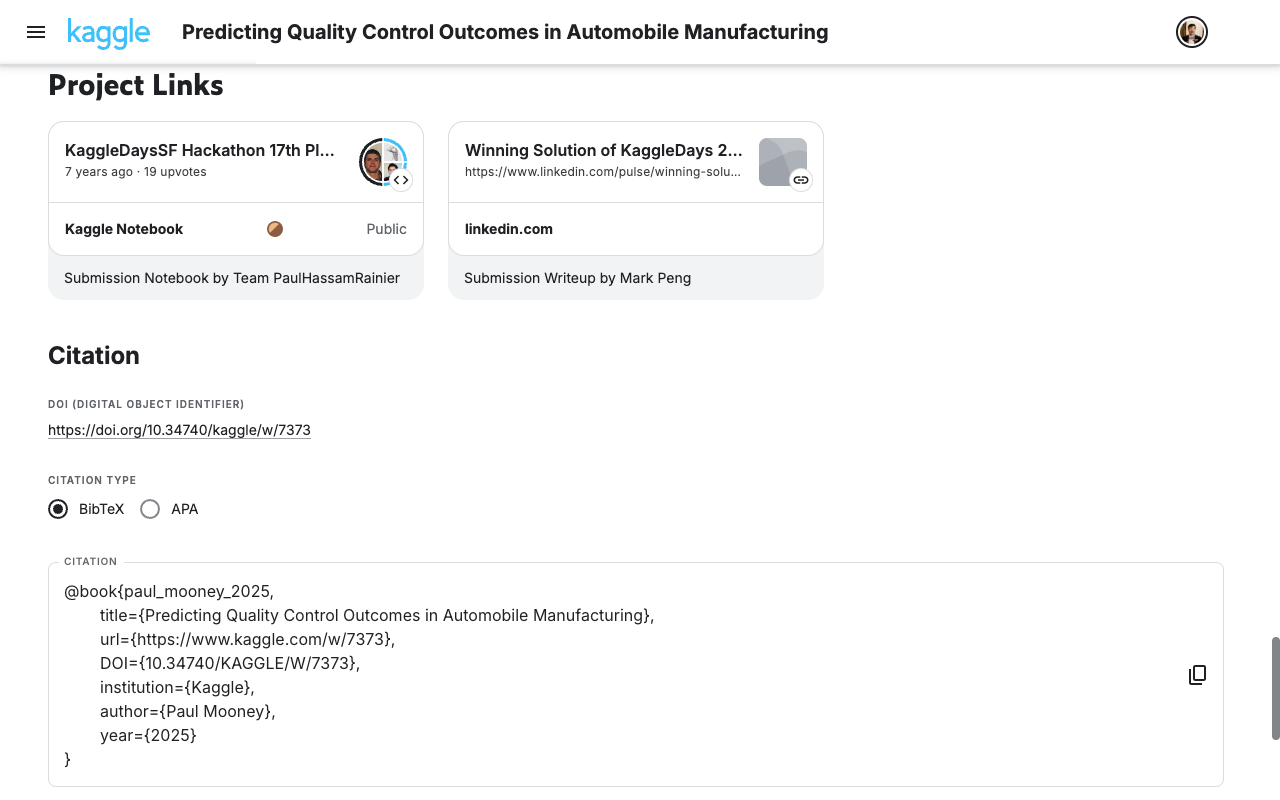
- Copy the auto-generated BibTeX citation for use in papers
The result is a permanent, globally unique identifier in the format doi:10.xxxxx/kaggle/... that resolves to the writeup page and will continue to do so regardless of any future URL changes on Kaggle's end.
The bigger picture: grey literature gets a seat at the table
This move is part of a broader shift in how the research community treats non-traditional outputs. Kaggle writeups fall into what academics call "grey literature" -- technically valuable work that exists outside the formal peer-review pipeline. Connections between research outputs can be made explicit using persistent identifier metadata, including DataCite DOI metadata, to better represent the scholarly record and track the influence of research.
The practical value is real. Competition solutions regularly introduce novel preprocessing pipelines, ensemble strategies, and domain-specific augmentation tricks that later show up in published papers -- often without attribution, simply because there was no clean way to cite them. The more metadata included in a DOI, the more useful it will be towards making research and scholarly materials more FAIR. A DOI-backed Kaggle writeup now has the same citability infrastructure as a dataset published on Zenodo or Figshare.
For anyone who has spent weeks engineering a winning solution to a major competition, this is a meaningful change. The work is no longer just a forum post -- it is a citable research artifact with a permanent record. That matters for academic CVs, for attribution in follow-on papers, and for the long-term health of a community that has been generating genuinely novel ML techniques for over a decade.
Comments
