

ITMO Builds a Tool That Shows What Your Optimizer Misses About Curvature
A new formalism cracks open the Hessian of arbitrary neural architectures, exposing per-layer curvature interactions that standard autodiff hides.
 PRO
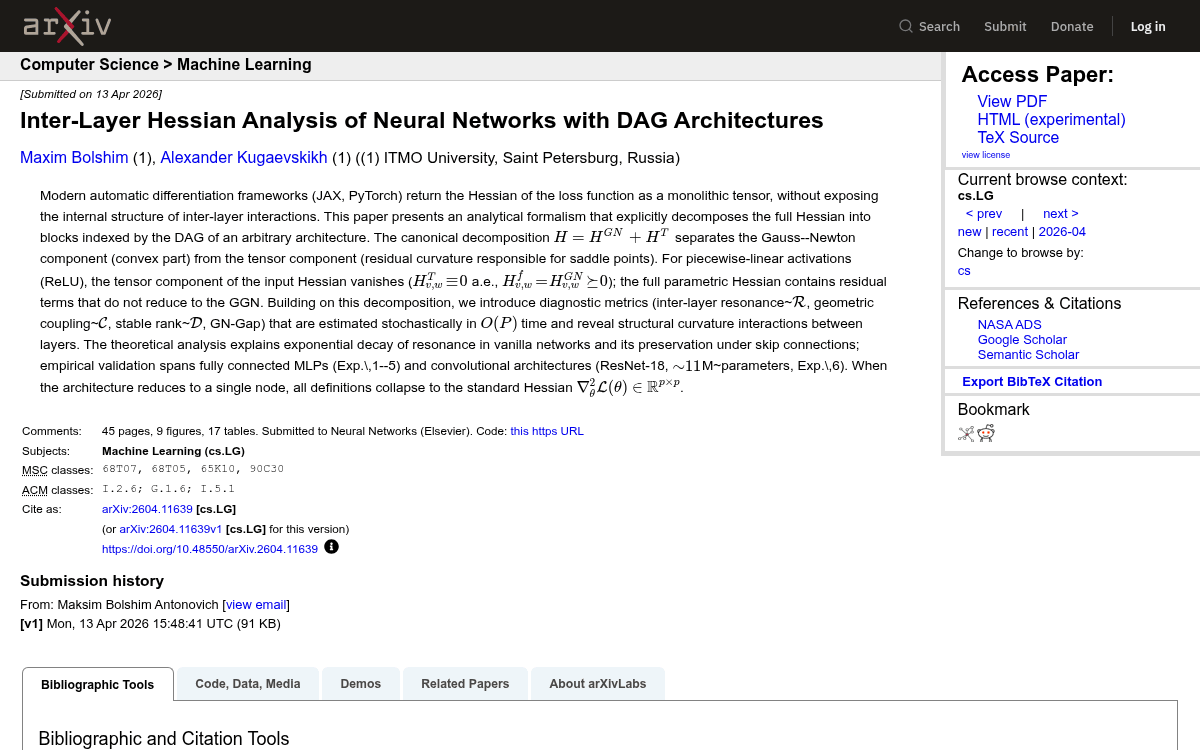
- New formalism decomposes the neural network Hessian into DAG-indexed blocks, exposing inter-layer curvature interactions hidden by standard autodiff.
- Canonical split H = H^GN + H^T isolates the convex Gauss-Newton part from the residual curvature responsible for saddle points.
- Four diagnostics (resonance, coupling, stable rank, GN-Gap) computable in O(P) via Hessian-vector products.
- Proves exponential resonance decay in vanilla nets and its preservation under skip connections, quantifying why ResNets train deeper.
- Softmax attention creates dense Q-K cross-blocks with GN-Gap around 69, versus 10^-8 for ReLU MLPs.
- PyTorch code released at github.com/comiam/dag-hesse, validated on ResNet-18 with 11M parameters.
If you have ever tried to understand why second-order optimizers work well on some networks and fall apart on others, you have probably hit the same wall: modern autodiff frameworks give you the Hessian as one giant opaque matrix. A paper from researchers at ITMO University proposes an analytical decomposition that indexes the Hessian by the computation graph itself, turning that monolithic object into a set of interpretable inter-layer blocks with quantitative diagnostics.
The blind spot in every autodiff framework
Modern autodiff frameworks such as JAX and PyTorch return the Hessian of the loss as a single tensor, without exposing the internal structure of inter-layer interactions. The paper presents an analytical formalism that decomposes the full matrix into blocks indexed by the DAG of an arbitrary architecture. A lot of what we care about, including saddle points, curvature coupling between layers, and why skip connections stabilize training, lives in the cross-terms between layers rather than on the diagonal.
Existing tools work around this rather than solving it. K-FAC and Shampoo approximate block-diagonal pieces. Pearlmutter-style HVP gives you exact Hessian-vector products but reveals nothing about which layers are interacting. Per-layer spectral analyses look at diagonal blocks in isolation. None of these expose the off-diagonal structure between arbitrary node pairs in a DAG.
Splitting curvature into convex and residual parts
The core contribution is a canonical decomposition: H = H^GN + H^T. This separates the Gauss-Newton component, the convex part, from the tensor component, which is the residual curvature responsible for saddle points. The GN component always sits inside the positive semi-definite cone, which is exactly why optimizers built on it, with K-FAC as the poster child, are structurally blind to negative curvature.
This story is for Pro members
You've reached the end of the free preview. Upgrade to AlphaSignal Pro to read the full article - and everything else behind the paywall.
Comments
