

Inception's Mercury 2 Hits 1,000 Tokens per Second, Now Chasing Enterprise
Inception is hiring its first Forward Deployed AI Engineer as enterprise demand for Mercury 2 — the world's only production diffusion LLM hitting 1,000+ tokens/sec — outpaces what its research team can handle alone.
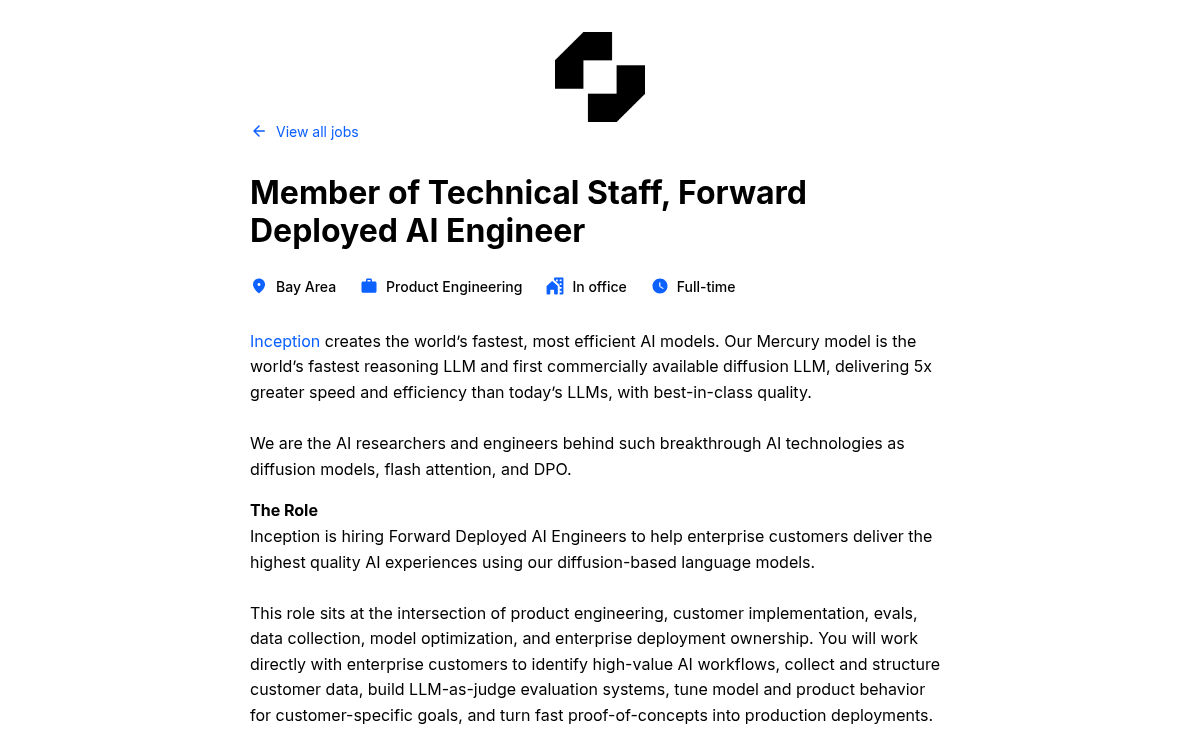
- Inception is hiring its first Forward Deployed AI Engineer, signaling a shift from pure research to enterprise go-to-market.
- Mercury 2 hits 1,000+ tokens/sec using diffusion architecture, roughly 10x faster than Claude Haiku and GPT-5 Mini at comparable quality.
- Founded by Stanford, UCLA, and Cornell professors including CEO Stefano Ermon, co-inventor of the diffusion methods behind Midjourney and Sora.
- Backed by $50M from Menlo Ventures, NVIDIA, Microsoft M12, Databricks, Snowflake, and angel investors Andrew Ng and Andrej Karpathy.
- Mercury 2 uses an OpenAI-compatible API, making migration a three-line config change; available on Amazon Bedrock and SageMaker JumpStart.
- Inception is currently the only company shipping a production-grade diffusion LLM; Google's text diffusion model remains experimental.
Inception just posted its first-ever go-to-market hire: a Forward Deployed AI Engineer. That might sound like a routine job listing, but for a company that has spent its entire existence as a research-first lab, it's a meaningful signal. Enterprise demand for Mercury 2 has grown faster than a small academic team can serve, and now Inception is building the customer-facing muscle to match.
The model that started it all
To understand why this hire matters, you need to know what Mercury 2 actually is. Mercury 2 is a family of large language models built by Inception Labs using a diffusion-based architecture rather than the autoregressive approach used by most modern LLMs. The distinction is fundamental.
Standard LLMs , think GPT, Claude, Gemini , generate text one token at a time, left to right, waiting for each word before producing the next. Instead of generating text one token at a time, Mercury 2 refines entire output sequences in parallel through a process adapted from image diffusion. Think of it like the difference between writing a sentence word-by-word versus sketching a rough draft and progressively sharpening it. Autoregressive models are slower because they move data through memory instead of doing math. Diffusion models focus on parallel computation, which is what GPUs were built for.
The numbers are hard to ignore
In standard benchmarks, Mercury 2 achieves approximately 1,000 tokens per second output throughput, compared with Claude 4.5 Haiku Reasoning at approximately 89 tokens per second and GPT-5 Mini at approximately 71 tokens per second. That is roughly a 10x throughput advantage over the fastest competing models.
The quality trade-off is real but bounded. On quality benchmarks, Mercury 2 scored 91.1 on AIME 2025, 73.6 on GPQA, 71.3 on IFBench, and 67.3 on LiveCodeBench. These scores place Mercury 2 within competitive range of Claude 4.5 Haiku and GPT 5.2 Mini on quality, while delivering roughly 10x the throughput. In other words: you are not getting GPT-4-level reasoning, but you are getting Haiku-class intelligence at a fraction of the latency and cost.
The use cases where this trade-off makes obvious sense:
- Agent loops: multi-step workflows where latency compounds at every step
- Real-time voice and search: where p95 and p99 latency determine whether the experience feels natural
- High-volume code generation and editing: where throughput directly limits how fast the feedback loop can spin
- Structured output generation: function calling, JSON schemas, document processing at scale
Who built this, and who is backing it
The company was founded by professors from Stanford, UCLA, and Cornell, who led the development of core AI technologies, including diffusion, flash attention, decision transformers, and direct preference optimization. CEO Stefano Ermon is a co-inventor of the diffusion methods that underlie systems like Midjourney and OpenAI's Sora. Ermon published the foundational text diffusion paper that won Best Paper at ICML 2024.
He founded Inception in 2024 alongside Aditya Grover and Volodymyr Kuleshov, professors from Stanford, UCLA, and Cornell. Their engineering roster includes veterans from DeepMind, Microsoft, Meta, OpenAI, and HashiCorp.
The investor list is a who's-who of infrastructure-focused capital. Inception Labs raised $50 million in funding, led by Menlo Ventures, with participation from Mayfield, Innovation Endeavors, NVentures (NVIDIA's venture arm), Microsoft's M12, Snowflake Ventures, and Databricks Investment. Andrew Ng and Andrej Karpathy provided additional angel funding. The presence of NVIDIA as an investor is especially notable: GPU giant Nvidia is helping optimize the serving engine.
Why this hire, why now
Inception's tweet is candid about the situation: enterprise demand has outpaced what a research-led team can serve. The Forward Deployed AI Engineer role is a classic scaling move , a hybrid of solutions engineering, customer success, and product feedback loop. The person will scope proofs-of-concept, build evaluations, and run customer engagements, turning real deployments into signal for the next generation of models.
This is also the right moment structurally.
Mercury 2 uses an OpenAI-compatible API. Migration requires three changes: set the base URL to https://api.inceptionlabs.ai/v1, change the model string to mercury-2, and use your Inception Labs API key. Existing prompt and tool definitions work without modification.
The low switching cost removes a major barrier for enterprise pilots.
Mercury has already been integrated into development tools including ProxyAI, Buildglare, and Kilo Code. The model is also available through Amazon Bedrock Marketplace and Amazon SageMaker JumpStart. Distribution is in place. Now Inception needs the human layer to convert that reach into durable enterprise contracts.
What this means for the broader LLM landscape
Inception is the only company currently shipping a production-grade diffusion LLM. Google has a text diffusion model, but it remains experimental. That first-mover window will not stay open indefinitely , the major labs are aware of the architecture and have the resources to pursue it. The question is whether Inception can lock in enough enterprise relationships and model iteration cycles before a larger competitor closes the gap.
Code generation, document processing, AI agent workflows that need to generate many intermediate outputs, and real-time applications all fit this profile. The likely outcome is not that diffusion models replace autoregressive models , it's that they become the right choice for a specific class of use cases where throughput is the primary constraint.
For teams running high-volume agent pipelines, voice applications, or any workload where inference cost is becoming the dominant line item, Mercury 2 is worth a serious evaluation. The API is OpenAI-compatible, the benchmarks are public, and Inception now has a dedicated team member whose entire job is to make your deployment work.
Comments
