

Hugging Face's TRL Hits v1.0 With 3M Monthly Downloads and a Stability Promise
Hugging Face's TRL hits v1.0 with a formal stability contract, GRPO for reasoning models, vLLM integration, and Harbor for agentic training

 PRO
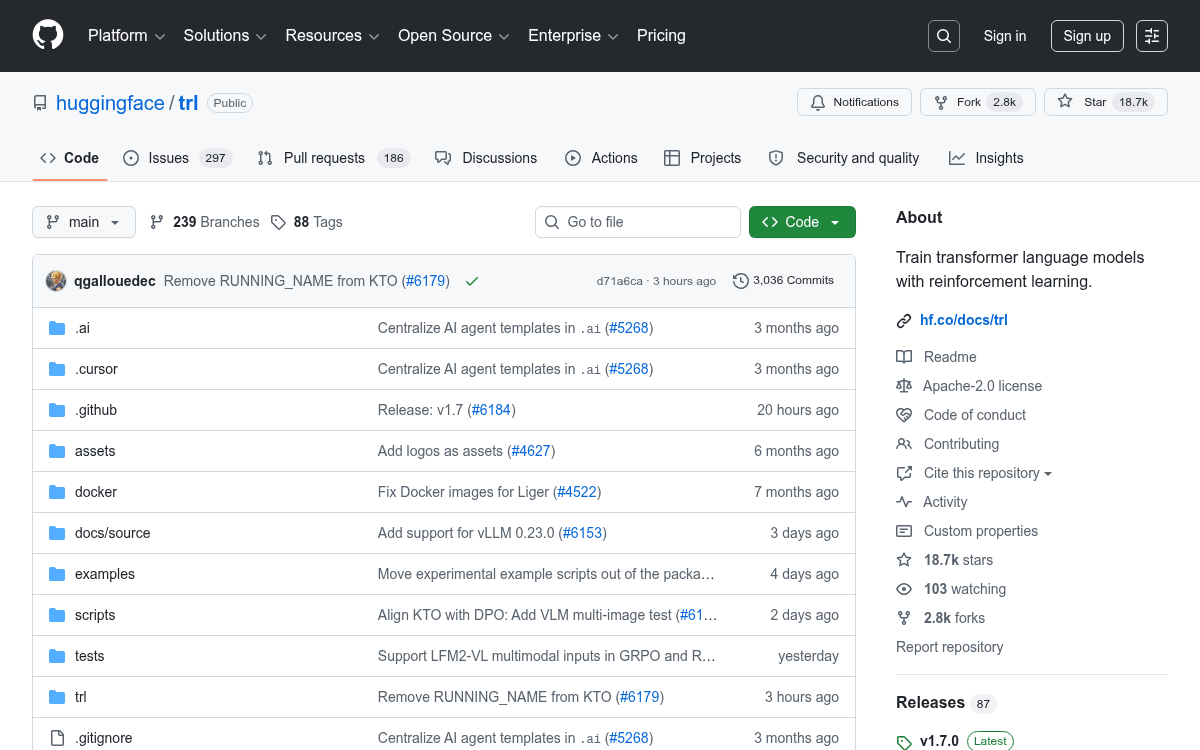
PRO- TRL v1.0 released: Hugging Face's post-training library gets a formal stability contract and semantic versioning after 6 years and 3M monthly downloads.
- Two-tier stability model: Stable trainers (SFT, DPO, GRPO, RLOO) vs. experimental (
trl.experimental) with no breaking-change guarantees. - GRPO is now first-class: The algorithm behind DeepSeek-R1 is fully supported with built-in reward functions for math and reasoning tasks.
- vLLM integration: Two modes (colocate and server) to accelerate online training generation, removing the key bottleneck in GRPO-style loops.
- Harbor for agentic training: Train agents against sandboxed task environments via
GRPOTrainer'senvironment_factory— no custom infra needed. - Roadmap includes async GRPO: Decoupled generation and training for higher throughput, plus agent-legible training diagnostics.
TRL (Transformers Reinforcement Learning) has reached v1.0 , and this isn't just a version number change. What started as a research codebase for RLHF has quietly become the infrastructure backbone for post-training at scale, downloaded 3 million times a month and depended on by major projects like Unsloth and Axolotl. The v1.0 release is Hugging Face's formal acknowledgment of that reality, and it comes with a real stability contract, a redesigned architecture, and a set of new capabilities that reflect where post-training is actually headed.
Six years of chasing a moving target
Post-training has not evolved as a smooth refinement of one recipe. It has moved through successive centers of gravity, each changing not just the objective, but the shape of the stack. PPO required a policy, a reference model, a learned reward model, and a full RL loop. Then DPO-style methods cut through all of that , preference optimization without a separate reward model. Then GRPO shifted the center again, bringing back sampling and rollouts but replacing learned reward models with verifiers and deterministic checks.
The lesson is not just that methods change. The definition of the core keeps changing with them. Strong assumptions here have a short half-life. TRL's design was shaped by this pressure over six years, and v1.0 is the first time it's making that design philosophy explicit.
A stability contract, finally
Projects like Unsloth and Axolotl , with thousands of users between them , had built directly on top of TRL's trainers and APIs. A breaking change in TRL propagated instantly into their stacks. A renamed argument, a shifted default, a restructured output , any of these became someone else's incident. v1.0 is TRL acknowledging it's infrastructure, not just a research repo.
The key design decision is a two-tier system: stable and experimental coexist in the same package, with explicitly different contracts.
- Stable:
SFTTrainer,DPOTrainer,GRPOTrainer,RLOOTrainer,RewardTrainer, these follow semantic versioning - Experimental (
trl.experimental): newer methods likePPOTrainer,KTOTrainer,ORPOTrainer,OnlineDPOTrainer, fast-moving, no stability guarantees
Promotion from experimental to stable isn't automatic. What matters is the ratio between maintenance cost and actual usage. Some methods earn their place through heavy community use; others get promoted when the codebase can absorb them cheaply.
This story is for Pro members
You've reached the end of the free preview. Upgrade to AlphaSignal Pro to read the full article - and everything else behind the paywall.
Comments
