

Hugging Face's OpenEnv Gives Open-Source Developers a Shared RL Training Standard
OpenEnv gains a multi-org governance committee spanning Meta, NVIDIA, Hugging Face, and more — becoming the shared infrastructure layer for open-source agentic RL training.

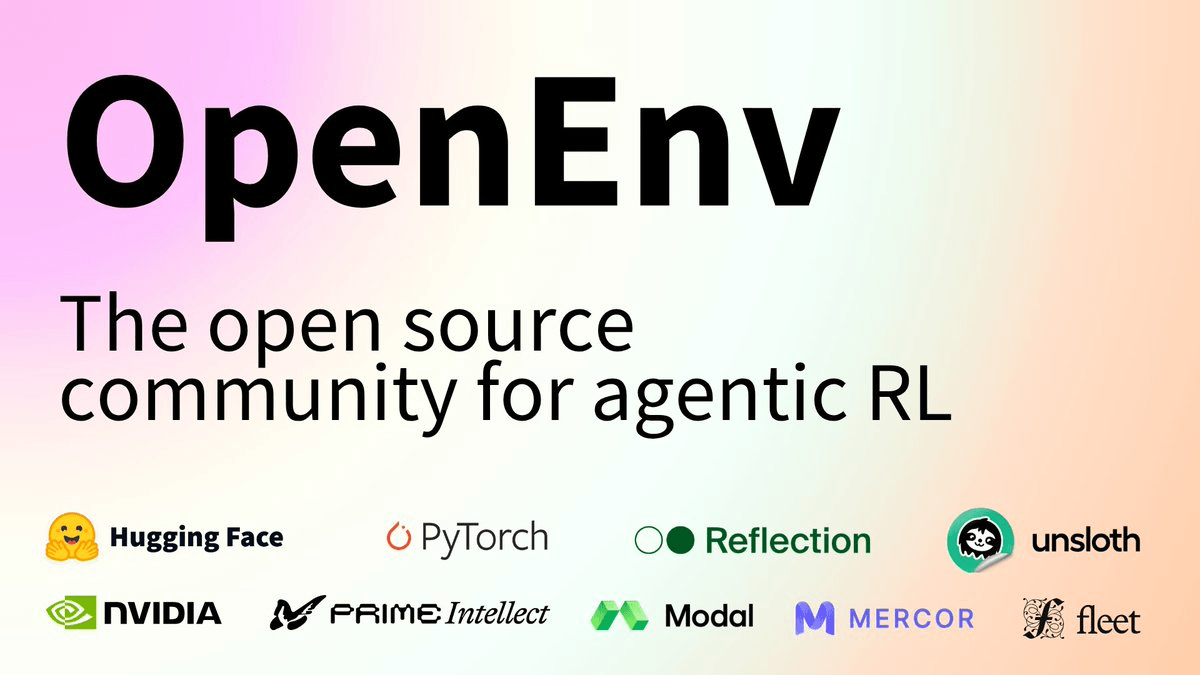
- OpenEnv gains a formal governance committee including Meta-PyTorch, NVIDIA, Hugging Face, Unsloth, Modal, and Prime Intellect.
- The project is now hosted at huggingface/OpenEnv and is BSD-3 licensed and free to use.
- OpenEnv is a protocol layer, not a reward framework: it standardizes how RL environments are published, deployed, and consumed by agents.
- Environments expose a Gymnasium-style API (
reset(),step(),state()) served over HTTP/WebSocket in Docker containers. - MCP (Model Context Protocol) is a first-class citizen, making environments compatible with production agent deployments.
- Roadmap includes tasksets via HF datasets, external reward support, harness integration, and auto-validation of environment quality.
Frontier AI labs have a quiet advantage: their models are trained to use their own tools. Claude is trained on Claude Code. GPT-5.5 is optimized for Codex. The model and the harness are tuned together, and the performance gains are real. Open-source developers, working with any model and any framework, haven't had an equivalent. OpenEnv is the project trying to close that gap, and it just got a lot more serious.
OpenEnv is a tool for creating agentic execution environments like terminals, browsers, or anything an agent can interact with. The project has now formalized its governance with a broad industry coalition. Starting today, OpenEnv will be coordinated by a committee that includes Meta-PyTorch, Reflection, Unsloth, Modal, Prime Intellect, NVIDIA, Mercor, Fleet AI, and Hugging Face, and the project now lives at huggingface/OpenEnv.
Why the open-source RL stack needed this
The reinforcement learning community has long struggled with a fundamental infrastructure problem: every research group and company builds their own execution environments from scratch, meaning researchers spend significant time on infrastructure rather than algorithms, and sharing work requires substantial integration effort.
While OpenAI Gym and Gymnasium standardized the interface for simulated environments, production RL training for modern agents requires something different: secure, isolated execution spaces that can run arbitrary code, interact with external systems, and scale across infrastructure. OpenEnv is the answer to that gap.
OpenEnv is supported and adopted by organizations including PyTorch Foundation, vLLM, SkyRL (UCB), Lightning AI, Axolotl AI, Stanford Scaling Intelligence Lab, Mithril, OpenMined, Scale AI, Patronus AI, Surge AI, and others.
A protocol layer, not another framework
The most important clarification in this announcement is what OpenEnv is not. It does not define rewards. It does not run your training loop. In recent releases, OpenEnv has become an interoperability layer for RL environments, standardizing how environments are published, deployed, and consumed by agents. It will not dictate how rewards are defined or how training loops work. Reward definition, scoring rubrics, and trainer-specific logic belong in the libraries that specialize in them. OpenEnv is the common socket they can all plug into.

Think of it like HTTP for RL environments. Any trainer that speaks OpenEnv can drive any compliant environment, without writing custom adapter code for each combination. All environments expose the familiar Gymnasium-style API (reset(), step(), state()) running on a client/server architecture, meaning a trainer that speaks OpenEnv can drive any compliant environment without bespoke code.
How it actually works
Training RL agents in agentic settings like code generation, web browsing, or game playing requires environments that are isolated (each agent instance runs in its own sandboxed environment) and scalable (environments can be deployed as HTTP services or containerized with Docker, enabling distributed training across clusters).
The architecture is straightforward: each environment runs as a Docker container exposing a FastAPI server over WebSocket. Clients connect to it using the standard EnvClient base class. Here is what using a pre-built environment looks like:
import asyncio
from echo_env import CallToolAction, EchoEnv
async def main():
    async with EchoEnv(base_url="https://openenv-echo-env.hf.space") as client:
        result = await client.reset()
        result = await client.step(
            CallToolAction(
                tool_name="echo_message",
                arguments={"message": "Hello, World!"},
            )
        )
        print(result.reward)
asyncio.run(main())
And scaffolding a new environment from scratch takes a single CLI command:
openenv init my_game_env
cd my_game_env
openenv push  # deploys to Hugging Face Spaces
Environments are served over standard protocols like HTTP and WebSocket and packaged with Docker. MCP (Model Context Protocol) is a first-class citizen, so OpenEnv environments are instantly compatible with MCP servers, and the same environment behaves consistently in both simulation (train/eval) and production modes.
What you can build with it today
The project ships several reference environments out of the box:
- Coding environment: sandboxed Python code execution via smolagents, capturing stdout/stderr/exit codes, with persistent episode context and detailed error handling.
- Chess environment: a chess RL environment with configurable opponents and full rules support.
- Atari environment: classic Arcade Learning Environment tasks for RL benchmarking.
- FinRL environment: financial market simulations for algorithmic trading experiments.
- Echo environment: a minimal testing ground for learning the framework and verifying container deployment.
On the trainer side, there are working examples for GRPO BlackJack training with torchforge, a 2048 game example, SkyRL integration, ART integration, and Oumi integration. TRL and Unsloth are also supported.
What's coming next
The roadmap focuses on turning OpenEnv from a fast-growing project into a dependable standard. The five priorities are:
- Tasksets via datasets: wiring environment tasks directly to Hugging Face datasets so environments and benchmarks compose cleanly.
- External rewards: letting rewards be defined in whichever library you already use, with OpenEnv purely as the deployment layer.
- Harness integration: first-class support for agentic harnesses like Claude Code and Codex.
- End-to-end examples: full training and evaluation walkthroughs in TRL, Unsloth, and beyond.
- Auto-validation: automated measurement of environment quality and its contribution to model learning, enabling community hackathons around environment quality.
The bigger picture
The governance expansion is the real signal here. OpenEnv is not just a library, it is a bet that the open-source community needs shared infrastructure the same way it needed shared model hubs. In the open, developers use any harness, any model, any inference engine, on whatever use case they value. This is fundamental to the community, but it's also a challenge that requires infrastructure and tooling to tackle.
Getting Meta-PyTorch, NVIDIA, Hugging Face, Unsloth, and a dozen other organizations to coordinate on a single interface spec is the kind of alignment that turns a useful library into an industry standard. The repo is public, BSD-3 licensed, and already at 1.9k stars. It is early and explicitly experimental, but the coalition behind it suggests this is the direction the open-source agentic RL stack is heading.
Comments
