

Hugging Face's Candle Runs LLaMA2 in a 48MB Rust Binary Without Python
Hugging Face's Candle brings PyTorch-like ML to Rust, enabling serverless inference and Python-free production deployments with 20k+ GitHub stars

 PRO
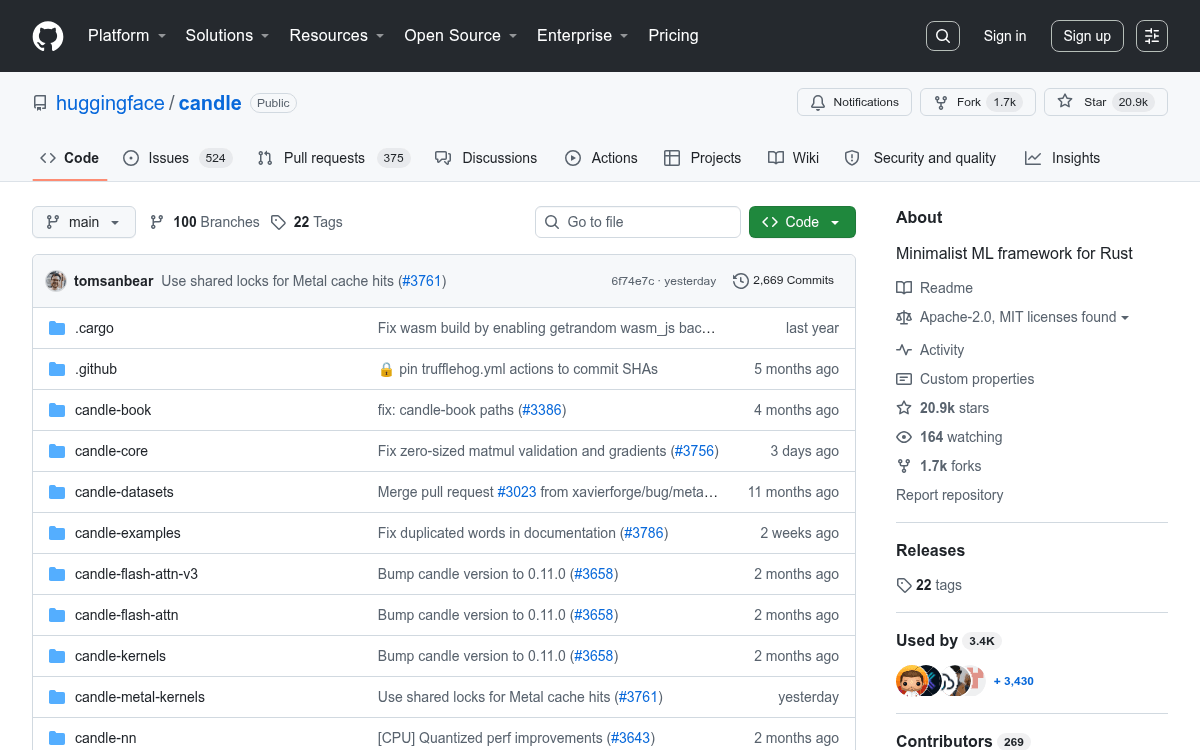
PRO- What it is: Candle is Hugging Face's minimalist ML framework for Rust, focused on fast, Python-free inference with 20k+ GitHub stars.
- Core goal: Enable serverless inference via tiny binaries (22 MB Whisper, 48 MB LLaMA2-7B q4k) and eliminate Python GIL overhead from production stacks.
- Model coverage: Ships ready-to-run implementations of LLaMA, Mistral, Gemma, Qwen3 MoE, Whisper, Stable Diffusion, YOLO, SAM, and dozens more across all modalities.
- Hardware support: CUDA, Apple Metal, Intel MKL, Accelerate, and WASM -- models can run in a browser tab with no server.
- Limitations: Training is experimental and inference-first; dynamic graphs are maturing; Windows CUDA support lags Linux.
- License & access: Free and open-source under Apache 2.0 / MIT; available now on crates.io.
Candle is Hugging Face's Rust-based ML framework built for one purpose: running serious models in production without a Python runtime. With over 20,000 GitHub stars and implementations spanning LLMs, vision, audio, and diffusion, it has moved well past proof-of-concept territory.
The problem with Python in production
Python works well for research and iteration. In production, it creates friction. Full ML frameworks can weigh hundreds of megabytes, which slows serverless cold starts. Python's Global Interpreter Lock (GIL) limits true parallelism and adds interpreter overhead that complicates high-throughput deployments.
Candle addresses both. Instead of shipping a Python environment and a large framework, you ship a single compiled binary. The size difference is significant: Whisper tiny compiles to 22 MB, LLaMA2-7B at 4-bit quantization to 48 MB, and Phi-2 to 38 MB. A comparable PyTorch container runs into the hundreds of megabytes before your model weights are even counted.
Familiar API, compiled output
The API mirrors PyTorch closely enough that existing code is immediately readable. The mapping is direct:
| Operation | PyTorch | Candle |
|---|---|---|
| Create tensor | torch.zeros((2, 2)) | Tensor::zeros((2, 2), DType::F32, &Device::Cpu)? |
| Matrix multiply | a.matmul(b) | a.matmul(&b)? |
| Move to GPU | tensor.to(device="cuda") | tensor.to_device(&Device::new_cuda(0)?)? |
This story is for Pro members
You've reached the end of the free preview. Upgrade to AlphaSignal Pro to read the full article - and everything else behind the paywall.
Comments
