

How to Run Qwen 3.8 27B as a Local Coding Agent
Pick a file, an engine, and a harness for your Mac RAM. Install steps live in an interactive HTML page

- The official Qwen3.8-27B release is around 55 GB, and the download to start with is Unsloth's
UD-Q4_K_XLat 17.6 GB, or the 11.8 GB GSQ-RCO IQ3_S file when that 4-bit copy crowds RAM. - MTPLX's Optimized Speed pack downloads at 20.4 GB and peaks at 23.6 GB, which is why 32 GB+ is the recommended seat and 16 GB is not this model.
- Turn the draft-ahead head on at draft depth 3, and a 48 GB Mac still gets a governor of 196,608 tokens, under the card's 262,144.
- Point the harness at
127.0.0.1:8000, and do not average a 128 GB thinking-off speed into a 24 GB result, because that laptop underxhighplus Chrome is already swapping. - Do not QLoRA this 27B on a 24 GB MacBook: Unsloth's 24 GB recipe is a CUDA card, Kaggle T4 and RTX, not unified memory.
Qwen3.8-27B is a recent small coding model, released last August, open-source under Apache 2.0, so you can run it, change it, and ship with it.
People keep lining it up with Opus 4.6 which was the frontier from a few months ago on coding tables.
Does this mean that we can put that class of model on a consumer machine like a Mac? Yes, but running local AI is not just about the model, it's about the entire stack.
The weights are the easy download, but you still have to build a professional stack around them, an engine that quotes peak RAM rather than the file size, a harness with a stop, and tests you own.
Because a powerful coding agent is that model plus tools and permissions, so it can edit your repo and keep going until something says stop.
24 GB of unified memory loads a 4-bit copy (which is still perfect for most tasks), and 32 to 48 GB is where it can actually perform agentic coding tasks.
If you already use Claude Code or Codex, this stack acts as a private, zero-marginal-cost executor to run repetitive agent loops alongside your paid API workflows.
Here I discuss the decision layer, which file to download, which engine to serve it with, which harness to wrap it in, how a session is allowed to stop, and what not to do this week.
Also I made an interactive HTML page that sits next to it with the pull commands, MTPLX install, skill files, GitSpawn check, /goal block, verify skill, fail-note template, and the Unsloth how-to, so you can copy the steps without turning this article into a code dump.
Which Qwen 3.8 27B file should you run? (The model)
The official release of Qwen3.8-27B is around 55 GB, which is unwieldy for a local device. Instead, I recommend downloading Unsloth's 4-bit GGUF, UD-Q4_K_XL at 17.6 GB, from Unsloth's card.
A well-calibrated 4-bit quantized model reduces memory footprint enough to run on a laptop without sacrificing precision or code-generation capabilities. If you already live in Apple's MLX stack, take their 4-bit pack or the oQ4e pack instead of the GGUF.
And if that 4-bit file crowds the rest of RAM, switch to a tighter 3-bit GGUF so context has room (you can find the pull commands for all three in the interactive webpage). The squeeze file I would look at first is GSQ-RCO IQ3_S at 11.8 GB, which reportedly matches the BF16 release on a couple of hard tests, and that is a size claim to check on your hidden tests, not a crown.
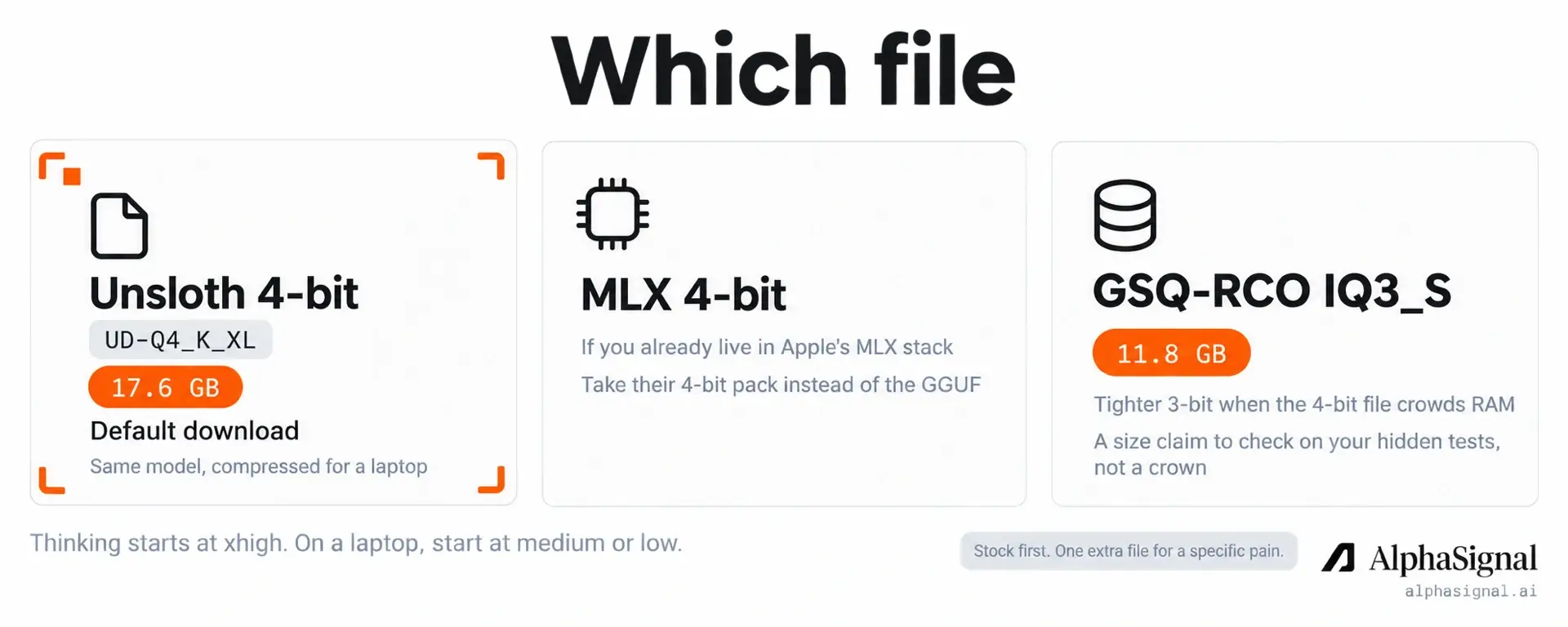
By default, Qwen3.8-27B has thinking on at the heaviest setting (xhigh). When running the model on a laptop, I recommend starting with medium or low thinking and only turn to high thinking when a hidden test is actually hard.
The open-source ecosystem around Qwen3.8-27B is already vast. There are quant packs (same weights, smaller file size), efficiency fine-tunes (same job, cheaper thinking), and uncensored / obliterated builds (refusal edited out).
Start with a trusted 4-bit build of the official base weights. Only swap in community fine-tunes or extreme quants if you encounter a concrete issue, such as memory exhaustion or slow thinking loops..
Picture a Tuesday afternoon when you ask it to tidy a Python helper, it thinks for a long time, then writes a function whose body is indented one space off.
A community efficiency fine-tune can cut that thinking time. The current one on this 27B is Qwopus Flash, and an independent check also caught a real indent collapse on a public Python test, so try it on your hidden tests before it becomes the daily file.
Uncensored builds such as OrcaRouter and huihui remove safety guardrails, and are useful if base models refuse your requests, such as security-probing scripts. But that freedom comes at a cost.
Experiments on a Mac Studio reveal a drop in code-generation accuracy compared to the official base release. Reserve these builds for red-teaming and security experiments, not as your primary coding driver.
The card has image and video, and most coding setups skip the extra projector file, with desktop computer-use out of scope here.
Qwen's software-engineering comparison used the Claude Code harness on a refined set, so treat this 27B as a local coding executor, and my read is that your primary engineering challenge is building the harness, tools, and guardrails around it.
How much Mac memory does Qwen 3.8 27B need? (The runtime)
Peak memory decides whether the agent is usable, because file size is only the download.
Don't miss what's next in AI
Join 300,000+ engineers and researchers who get the signal, not the noise. Create a free account to read the rest of this story.
- Full access to in-depth AI research breakdowns
- Be the first to know what's trending before it hits mainstream
- Daily curated papers, repos, and industry moves
Comments
