

HKUST's AMA Framework Cuts AI Memory Costs by 80% Using Four Specialized Agents
A four-agent memory framework aligns retrieval granularity with query intent, cutting token use by 80 percent while lifting long-context accuracy across benchmarks.
 PRO
- AMA introduces a four-agent memory framework (Constructor, Retriever, Judge, Refresher) for LLM agents.
- Stores memory at three granularities: raw text, structured facts, and episode summaries.
- Retriever routes queries via a four-dimensional intent vector to the right granularity.
- Achieves 0.774 LLM Score on LoCoMo versus 0.717 for full context, using 80 percent fewer tokens.
- Refresher module drives knowledge-update accuracy from 0.568 to 0.897 on LongMemEval.
- Trade-off: multi-agent orchestration adds latency and depends on strong backbone reasoning.
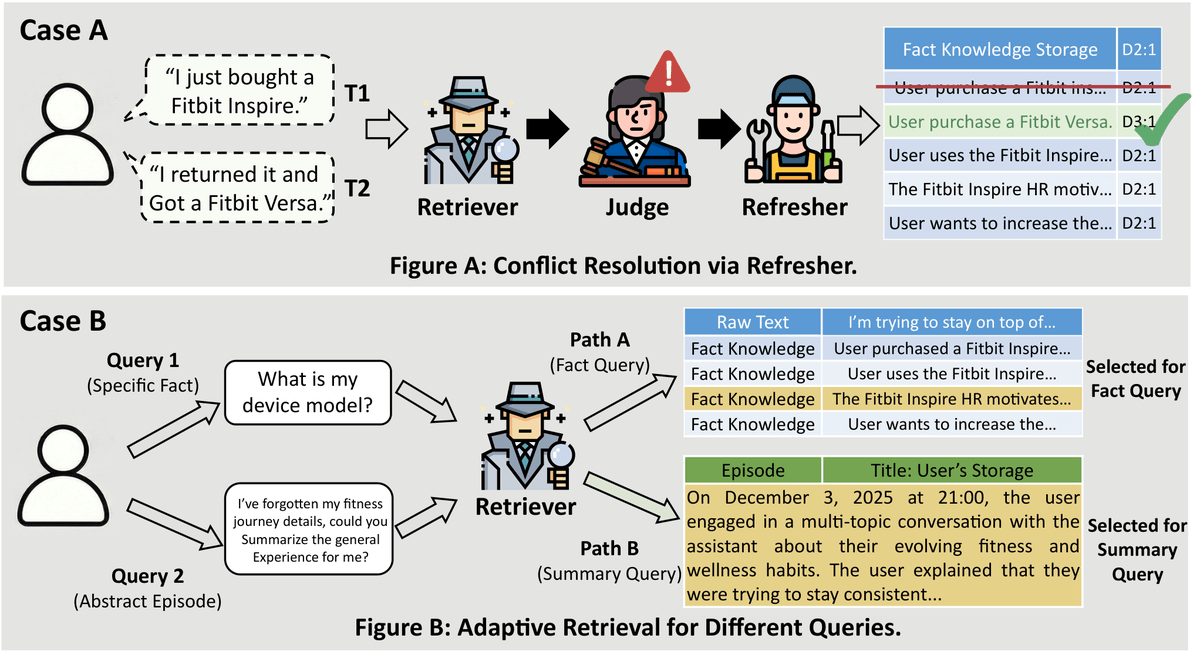
Long-running LLM agents keep hitting the same wall. Their memory systems either stuff everything into context, chunk it into rigid fixed-length blocks, or summarize it into blobs that lose the details needed for precise questions. A team from HKUST Guangzhou, Shandong University, NTU, and SUSTech has proposed a way out with AMA (Adaptive Memory via Multi-Agent Collaboration), a framework that treats memory management as a coordinated pipeline of four specialized agents rather than a single monolithic controller.
The headline result: AMA matches or beats state-of-the-art memory baselines while cutting token consumption by roughly 80 percent compared to full-context methods, and it reaches nearly 90 percent accuracy on knowledge-update tasks where facts change over time.
The granularity dilemma
Existing agentic memory systems make a choice up front about how to store information, and then they live with it. Static approaches typically rely on fixed-length text chunking or coarse-grained summaries, which disrupts the semantic coherence of what gets stored. Coarse retrieval drags in noise. Fine-grained retrieval fragments logical dependencies. Neither scales cleanly across a mix of question types.
A second problem compounds over time. Most systems support create-read-update-delete on memory entries, but they lack a mechanism to detect when new information actually contradicts old information. Outdated facts pile up, and the agent starts confidently returning stale answers.
Four agents, one memory lifecycle
AMA decomposes the memory pipeline into four roles that each do one thing well:
- Constructor turns raw dialogue into structured memory entries at three granularities.
- Retriever rewrites the query, classifies its intent, and routes it to the right granularity.
This story is for Pro members
You've reached the end of the free preview. Upgrade to AlphaSignal Pro to read the full article - and everything else behind the paywall.
Comments
