

HauhauCS Strips Alibaba's Qwen3.6 of All Refusals, Hits 3M Downloads
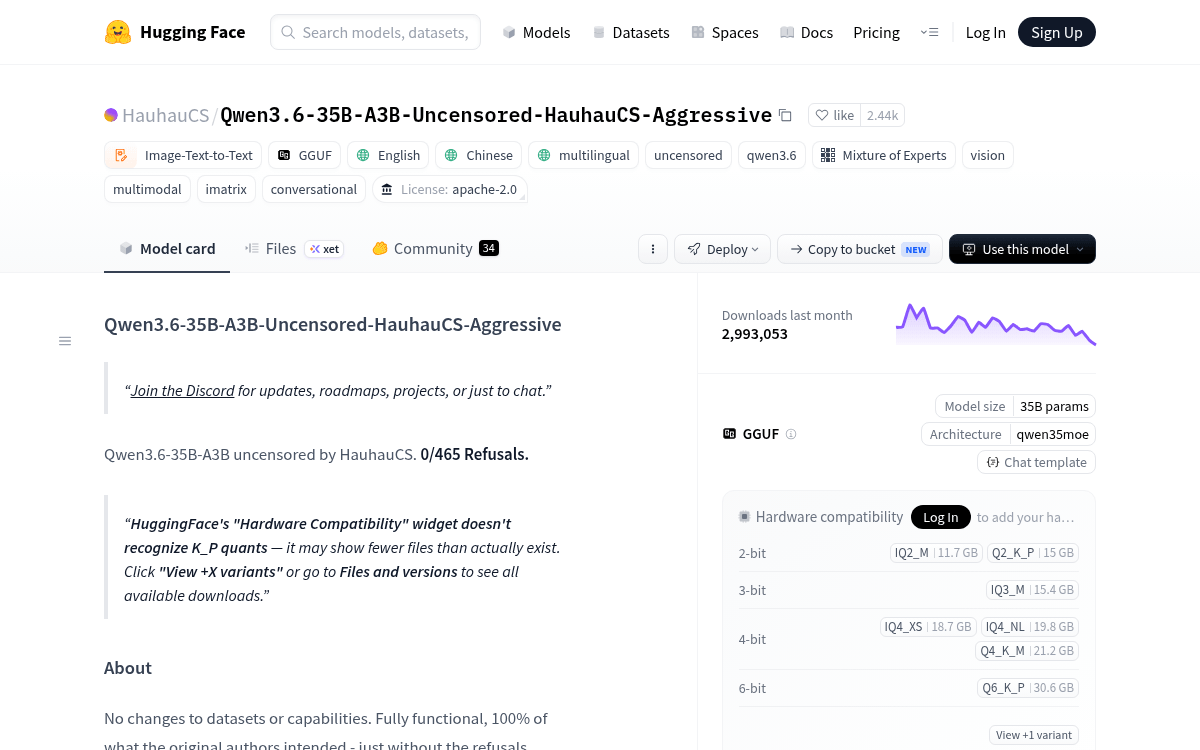
HauhauCS abliterates Qwen3.6-35B-A3B and ships it as GGUF with 0 refusals out of 465 tested prompts, pulling nearly 3 million downloads
 PRO
- HauhauCS abliterated Qwen3.6-35B-A3B and released it on Hugging Face with 0/465 refusals and nearly 3M downloads.
- Abliteration removes refusal behavior by projecting out the "refusal direction" from model weights -- no retraining required.
- The base model is a 35B MoE with only 3B active parameters per forward pass, strong coding benchmarks, and native vision support.
- HauhauCS introduces custom K_P quants and imatrix calibration to recover quality lost during abliteration.
- Runs locally on a 24GB GPU (Q4_K_M) via llama.cpp, LM Studio, Ollama, or vLLM -- Apache 2.0 licensed and free.
- No independent benchmarks yet compare the uncensored variant's reasoning quality against the original Qwen3.6-35B-A3B.
Someone took Alibaba's powerful Qwen3.6-35B-A3B, surgically removed its refusal behavior, and dropped the result on Hugging Face. The model, released by HauhauCS under the name Qwen3.6-35B-A3B-Uncensored-HauhauCS-Aggressive, has since pulled nearly 3 million downloads and sparked the kind of reaction you'd expect: equal parts excitement and unease.
What's the base model, and why does it matter?
Qwen3.6-35B-A3B is a sparse Mixture-of-Experts model with 35 billion total parameters and only 3 billion active parameters per forward pass. Despite its efficiency, it delivers outstanding agentic coding performance, surpassing its predecessor Qwen3.5-35B-A3B by a wide margin and rivaling much larger dense models such as Qwen3.5-27B and Gemma4-31B.
The architecture is what makes this interesting from a hardware standpoint. Three out of every four layers use linear attention (Gated DeltaNet) instead of standard full attention, with only every 4th layer using full Gated Attention. This makes it much more memory-efficient for long contexts. If you have 24 GB of VRAM on a desktop GPU, or a Mac with 32 GB of unified memory, you can run this today.
The base model's benchmark numbers are strong:
- 51.5 on Terminal-Bench 2.0 (agentic terminal coding), beating Qwen3.5-27B at 41.6, its predecessor Qwen3.5-35B-A3B at 40.5, and Gemma4-31B at 42.9.
- 1397 Elo on QwenWebBench for frontend artifact generation. The predecessor scored 978 -- a 400+ Elo jump in a single generation.
- 86.0 on GPQA Diamond, a graduate-level science reasoning benchmark.
- Native vision support for image-text-to-text tasks, with an MMMU score of 81.7 and RealWorldQA at 85.3.
What abliteration actually does
Abliteration is a post-training technique, not a fine-tune. It uses representation engineering to locate the specific direction in a model's activation space responsible for refusal, then orthogonalizes the model weights against that direction. This removes safety guardrails without retraining. The key insight, from Arditi et al.'s original research, is that refusal in LLMs is mediated by a single direction regardless of request context. Find that direction, project it out, and the model stops refusing.
This story is for Pro members
You've reached the end of the free preview. Upgrade to AlphaSignal Pro to read the full article - and everything else behind the paywall.
Comments
