

H Company's Holo 3.1 Brings Computer-Use AI Agents Fully Local at 2x Speed
H Company's Holo 3.1 brings computer-use agents fully on-device, from MacBooks to DGX Spark, with 2x speed gains and a major mobile leap
- H Company releases Holo 3.1, the first computer-use agent family with quantized local inference checkpoints (FP8, NVFP4, Q4 GGUF).
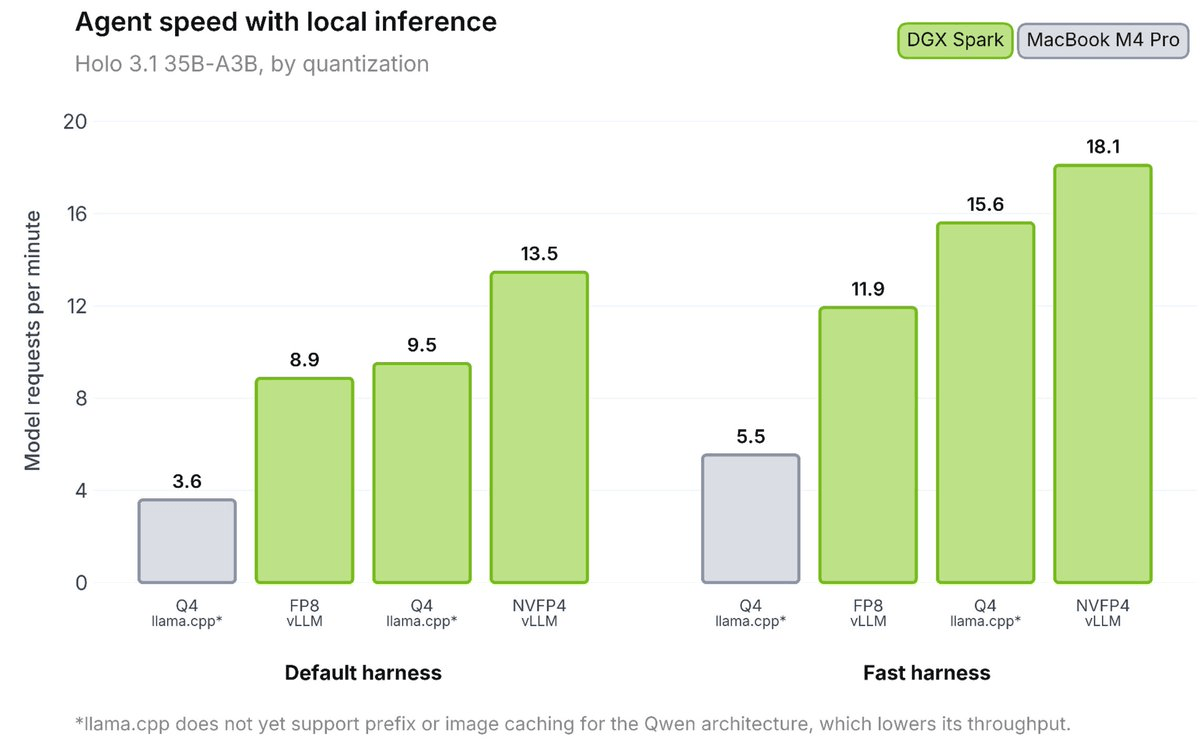
- Step times on DGX Spark cut from 6.8s to 3.3s via NVFP4 quantization; 140ms/step on a 12GB consumer GPU.
- AndroidWorld benchmark jumps from 67% to 79.3% on the 35B model, and from 58% to 72% on 4B/9B variants.
- Four model sizes (0.8B, 4B, 9B, 35B-A3B) all available on Hugging Face under Apache 2.0.
- API pricing starts at $0.25/1M input tokens for the 35B model; free tier available at 10 RPM with no credit card.
- Native function-calling support added for compatibility with third-party agent frameworks like LangChain.
Computer-use agents , models that look at a screenshot of a screen and autonomously click, type, and navigate GUIs to complete tasks , have mostly lived in the cloud. You send a screenshot up, get an action back, and hope your data doesn't linger somewhere you didn't intend. Holo 3.1, the latest release from Paris-based H Company, is a direct challenge to that model. The whole family is designed to run locally, on hardware you already own, with nothing leaving your network.
What broke in production
Holo 3.1 is a direct response to what broke when teams shipped the previous Holo3 generation: performance in one environment didn't transfer to another, third-party agent frameworks behaved differently, and almost everyone wanted to run the model closer to the workflow instead of in someone else's cloud. The fix isn't a single tweak , it's a full-family release that addresses all three pain points simultaneously.
As teams moved Holo3 from evaluation to production, the same challenge kept surfacing: strong performance in one setting does not necessarily transfer to another. Mobile devices, alternative agent harnesses, and different execution frameworks all introduce their own sources of distribution shift. Holo 3.1 was built specifically to close those gaps.
The model family: 0.8B to 35B
Holo 3.1 is H Company's family of computer-use agent models, built on the Qwen architecture, that operate across web, desktop, and mobile. It ships in four sizes , 0.8B, 4B, 9B, and a 35B-A3B flagship , and, for the first time in the Holo line, quantized FP8, NVFP4, and Q4 GGUF checkpoints so the agent can run fully locally on a Windows or Mac machine, or on a DGX Spark on the same network.
The 35B-A3B naming reflects a mixture-of-experts design: a 35-billion-parameter model with roughly 3B active parameters per token, which is why it can be both the top performer and a realistic target for quantized local inference. Mixture-of-experts (MoE) means only a fraction of the network activates for any given input, making a nominally large model behave much cheaper at inference time. MoE means you get 35B-level accuracy at roughly 3B-level inference cost , which is how a 35B model fits in 12GB VRAM with Q4 quantization.
The speed story
The headline improvement is raw throughput. For NVFP4, H Company used NVIDIA's Model Optimizer in a W4A16 configuration. These checkpoints enable fast local inference with little to no degradation in model performance , FP8 and NVFP4 achieve the same OSWorld scores, only about two points below the full-precision BF16 checkpoint. On DGX Spark, NVFP4 W4A16 delivers 1.41x the total token throughput of FP8 and 1.74x that of BF16.
The compound effect is even more dramatic end-to-end. By combining NVFP4 quantization with agent harness optimizations developed with NVIDIA, average step times on DGX Spark drop from 6.8 seconds down to 3.3 seconds , roughly a 2x wall-clock speedup for a full agent loop. On a 12GB GPU using the Q4 GGUF variant of the 35B-A3B model, that translates to 140ms per step.
Here is a quick breakdown of the three quantization formats and what they target:
- NVFP4 (W4A16) , highest throughput on NVIDIA hardware (DGX Spark, RTX); 1.74x faster than BF16 with ~2 point accuracy drop
- FP8 , good balance of speed and precision on enterprise NVIDIA GPUs; same OSWorld score as NVFP4
- Q4 GGUF , runs on consumer hardware (MacBook Pro, Windows PC with 12GB VRAM); the format used by tools like llama.cpp
Mobile is the real leap
Desktop was already covered. The more surprising number is on Android. Holo 3.1 expands beyond browser and desktop control, delivering major gains on mobile environments. On AndroidWorld , the standard benchmark for Android task automation , the 35B-A3B model improves from 67% to 79.3%, while the smaller 4B and 9B variants improve from 58% to 72%. That's a 12-point jump on the flagship and a 13-point jump on the compact models, which is not a rounding error.
On the desktop side, Holo 3.1 closes the gap with GPT-5.4 Computer Use at 74.2% on OSWorld, a 6-point improvement over Holo3. Holo 3.1 also delivers more than a 25% improvement over Holo3 when evaluated inside H Company's own Holotab product harness.
Framework compatibility, finally
One of the quieter but practically important changes is how the model talks to agent frameworks. To better support teams deploying Holo inside third-party agent stacks, Holo 3.1 introduces native support for function-calling protocols in addition to the structured JSON outputs already available in Holo3. Across OSWorld and an internal benchmark suite covering e-commerce, business software, and collaboration workflows, function-calling and native execution now achieve near-parity performance. Previously, wiring Holo into a LangChain or custom agent harness meant working around the output format. That friction is gone.
How it was built
Holo3-35B-A3B is based on the Qwen3.5 architecture and has been reinforced to strengthen its core agentic pillars: perception and decision-making. The training pipeline uses a carefully curated mix of open-source datasets, large-scale synthetic trajectories, and high-quality human-annotated samples to ensure reliable multi-step reasoning. H Company also built what they call a Synthetic Environment Factory , a proprietary system that reproduces the reality of enterprise systems and serves as one of the training environments the model was forged in.
Pricing and access
All weights are available now on Hugging Face under Apache 2.0 for the 35B-A3B model. The quantized checkpoints (NVFP4, FP8, GGUF) are included. For teams that want a hosted API instead, H Company's Models API offers:
| Model | Input price | Output price | Tier |
|---|---|---|---|
| Holo3-1-35B-A3B | $0.25 / 1M tokens | $1.80 / 1M tokens | Free + Paid (Apache 2.0) |
| Holo3-122B-A10B | $0.40 / 1M tokens | $3.00 / 1M tokens | Paid only (research license) |
The free tier gives rate-limited access to the 35B model at 10 requests per minute , enough to prototype. No credit card required to start.
What it's good for, and where it still falls short
The practical use-cases that fit this model well:
- Private enterprise automation , workflows where screenshots can't leave the building (legal, finance, healthcare)
- Mobile app testing and automation , the AndroidWorld gains make this one of the strongest open options for Android agent work
- Browser and desktop RPA , form filling, data extraction, navigating business software without APIs
- Edge deployment , the 0.8B and 4B models open up on-device agent scenarios where cloud latency is unacceptable
The honest caveats: the published quantized checkpoints are currently only for the 35B-A3B variant, the largest local-inference improvements are demonstrated on NVIDIA's DGX Spark hardware, and the desktop harness that ties it all together is described as upcoming rather than shipped. And as one observer noted about the broader category, a 78.85% OSWorld score sounds high until you realize it means roughly 1 in 5 attempts fails , computer-use accuracy is still task-dependent enough that you should benchmark against your specific workflow before committing.
The bigger shift
Computer-use was always going to land local, but the model quality just wasn't there yet. Holo 3.1 closes that gap. This category is going local fast. The combination of MoE efficiency, aggressive quantization, and a model purpose-built for GUI control , rather than a general LLM with a screenshot tool bolted on , is what makes this release different from prior attempts. For builders, this is the inflection point where computer-use agents become a realistic component of a local AI stack: not just a hosted API you call from the cloud, but a model you run on a developer laptop, a Mac workstation, or a private server that never sends screenshots offsite.
Comments
