
Guillaume Meyer's watermarks-remover Hits 15K Stars Stripping Claude's Invisible Marks
A new MIT-licensed agent skill and HTTP service scrubs Claude, Gemini, and OpenAI provenance signals from text, images, and documents.
 Pro
Takeaways
- MIT-licensed watermarks-remover hit 15.7k GitHub stars stripping AI provenance signals from text and files.
- Three layers: deterministic Unicode scrub, statistical LLM rewrite, and C2PA/EXIF/XMP metadata cleaning.
- Covers Claude, Gemini/SynthID-Text, OpenAI and open-LLM Kirchenbauer-style watermarks.
- Ships as an agent skill plus stdlib Python HTTP service with OpenAPI spec and batch endpoints.
- Optional pixel-domain removal via CtrlRegen ControlNet regeneration for SynthID-class image marks.
- Rewrite pass is best-effort only; Anthropic has not released a public detector to verify results.
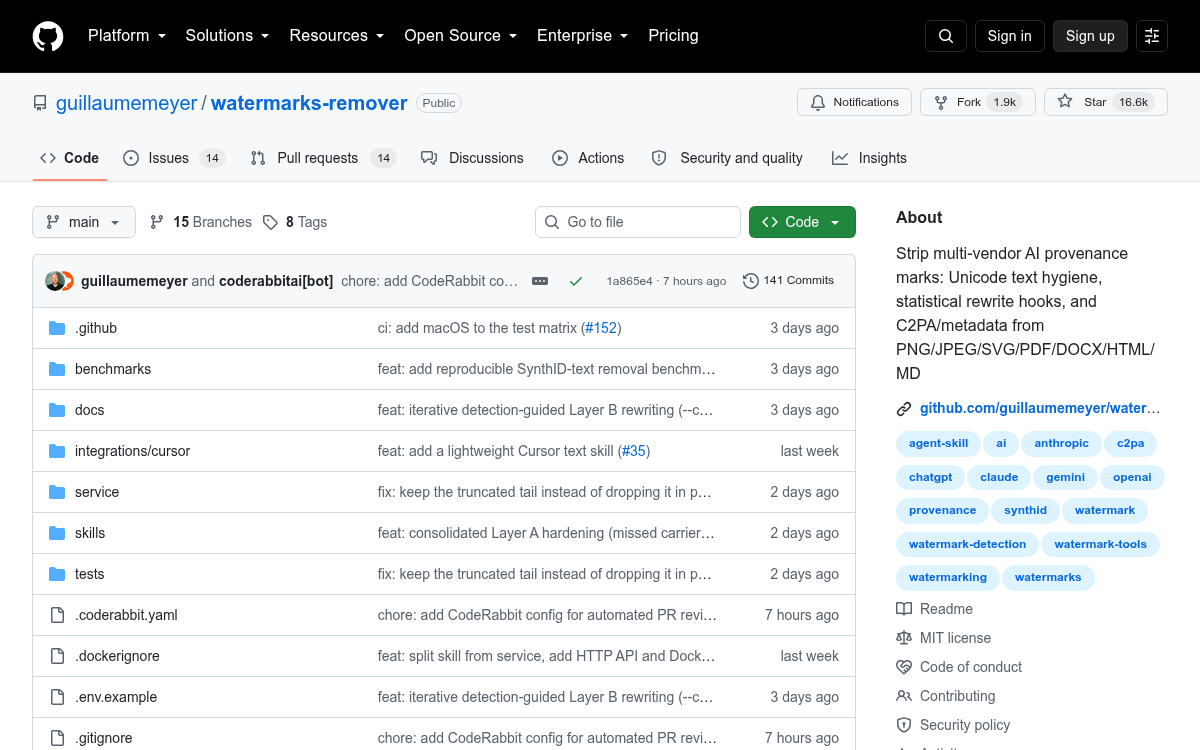
A GitHub project called watermarks-remover raced up the trending charts this week, collecting more than 15,000 stars within days of launch. Built by developer Guillaume Meyer, the tool ships an agent skill plus a Python HTTP service that strips provenance signals vendors have started baking into model outputs. Coverage from BleepingComputer notes the release landed days after Anthropic disclosed switching on invisible marks in everything Claude writes, and the project now targets multiple providers at once.
Three layers of scrubbing
The project splits the problem into three orthogonal jobs, which matters because different watermark classes need entirely different attacks:
- Layer A (deterministic text scrub): Python scripts remove invisible Unicode characters, exotic spaces, bidirectional control characters, and tag characters. Removal is 100 percent reliable.
- Layer B (statistical rewrite): An agent-driven rewrite pass targets token-sampling watermarks. This covers marks used by Claude, Google SynthID-Text, OpenAI attribution markers, and Kirchenbauer-type schemes commonly employed by open-source models.
- File metadata cleaners: C2PA manifests, EXIF, XMP and doc properties get stripped from PNG, JPEG, WebP, AVIF, HEIC, SVG, PDF, DOCX, XLSX, PPTX, EPUB, HTML, Markdown, MP4, WAV, MP3 and more.
How it plugs into an agent
The architecture is clean: the skill ships no code and calls a service over HTTP. You install the skill (markdown only), start the service, then set WATERMARKS_SERVICE_URL if it is not http://127.0.0.1:8765. The agent host does not need Python installed. The service itself is stdlib-only Python 3.10+ with no dependencies for the core cleaning pipeline.
Invocation happens through a slash command like /remove-ai-marks or a natural language ask. There is also a dedicated Cursor skill for cleaning manuscripts and docs, plus pre-commit hooks that fail a commit if suspicious characters land in a staged file.
The HTTP API
Anything can call the service. The endpoints follow a simple base64-in, base64-out convention:
WM="http://127.0.0.1:8765"
curl -s "$WM/health"
curl -s -X POST "$WM/clean" -H 'Content-Type: application/json' \
  -d "{\"file\": \"$(base64 < notes.md | tr -d '\n')\", \"name\": \"notes.md\"}"
Batch endpoints, an OpenAPI 3.0.3 spec at /openapi.json, and optional bearer-token auth via WATERMARKS_SERVER_API_KEY round it out. The service binds to loopback by default.
Where it works, and where it hedges
Deterministic Unicode cleanup and metadata stripping are verifiable. The rewrite pass is not. The README is explicit that removing a Claude watermark is a three-stage process, and only two of the three stages can be directly verified. The rewrite step cannot, because Anthropic keeps the detector private.
The maintainers built verification harnesses anyway. There is a MarkLLM integration for same-config KGW and SynthID text detection, a same-key replay for Aaronson-style keyed-Gumbel schemes (useful if you self-host arbi-serve), and an optional pixel-domain removal path via the CtrlRegen ControlNet regeneration attack for SynthID-class image marks.
A rewrite loop introduced in the latest changelog now generates multiple candidates and stops as soon as an evaluator marks a variant clean, with priority gumbel > markllm > lexical divergence. In practice, the tool will loop until it either passes a same-key check or exhausts its budget.
Tradeoffs the README refuses to hide
The disclaimer section is unusually candid for a tool of this type. Because statistical watermarks live in the wording itself, wiping them means rewriting most of the sentences, which flattens the original prose to the ceiling of whatever rewrite model you use. The doc even asks the obvious question: if you are going to rewrite with a cheaper model, why pay for the premium model in the first place?
Other honest caveats worth knowing before you deploy this:
- Rewriting Claude text with Claude re-stamps the output. Use a non-origin model.
- PDF cleaning needs
qpdfinstalled. Without it,exiftoolonly appends an incremental update and the original metadata bytes stay recoverable in the file. - C2PA soft binding (in-content marks that re-link to a remote manifest) is out of scope.
- Audio and video watermarks are out of scope.
- Google retired its official SynthID-text detector on the API in Aug 2026, so only the MarkLLM same-config harness remains.
Why it is drawing attention
The context is a policy shift more than a tool release. Anthropic recently turned on invisible marks by default across Claude outputs, including runs where users pipe their own prose through the model for a translation or summary. The company acknowledges the mark indicates content was processed by Claude, not necessarily written by it. Send your own draft through for a grammar pass, a translation or a summary and the output comes back marked. That is the practical friction watermarks-remover is aimed at, and why the repo picked up thousands of stars per day. The project is framed for privacy hygiene on content you own, and pointedly not for academic fraud or false human-written claims.