
GPU MODE's Free 100-Episode Series Closes the Gap Between PyTorch and Real Hardware
GPU MODE's open lecture series and GitHub repo bring real-world GPU kernel expertise to anyone willing to learn, for free
 Pro
Takeaways
- GPU MODE is a free, community-run lecture series on GPU programming with 100+ episodes, a GitHub repo with 6,200+ stars, and a 28,000-member Discord.
- Created by Mark Saroufim and Andreas Köpf, it started as a reading group for the PMPP textbook and grew into a full curriculum.
- Lectures cover the full GPU stack: CUDA kernels, Triton, Flash Attention, quantization, multi-GPU communication, CUTLASS, SASS, and more.
- Speakers include Jeremy Howard, Adam Paszke, Meta PyTorch engineers, and contributors to FlashInfer, Liger Kernel, and Unsloth.
- The ecosystem includes a LeetGPU-style kernel leaderboard and GPU Puzzles for hands-on practice from day one.
- All content is free; videos on YouTube, code and slides on GitHub, community on Discord at discord.gg/gpumode.
There's a gap between knowing PyTorch and knowing what PyTorch is actually doing on the hardware. Most ML practitioners live comfortably on the Python side of that gap. GPU MODE is a community-run initiative that wants to close it, and their free lecture series, now past 100 episodes, has become one of the most comprehensive open resources for GPU programming in the ML ecosystem.
From reading group to 28,000-member community
GPU MODE is a GPU reading group and community created by Mark Saroufim and Andreas Köpf. What started as a structured read-through of the classic textbook Programming Massively Parallel Processors (PMPP) has grown into something much larger. The GPU MODE Discord now has over 28,000 members, and the community-driven lecture series spans topics from profiling to kernels to CUTLASS to SASS (SASS is the low-level assembly that runs natively on NVIDIA GPUs).
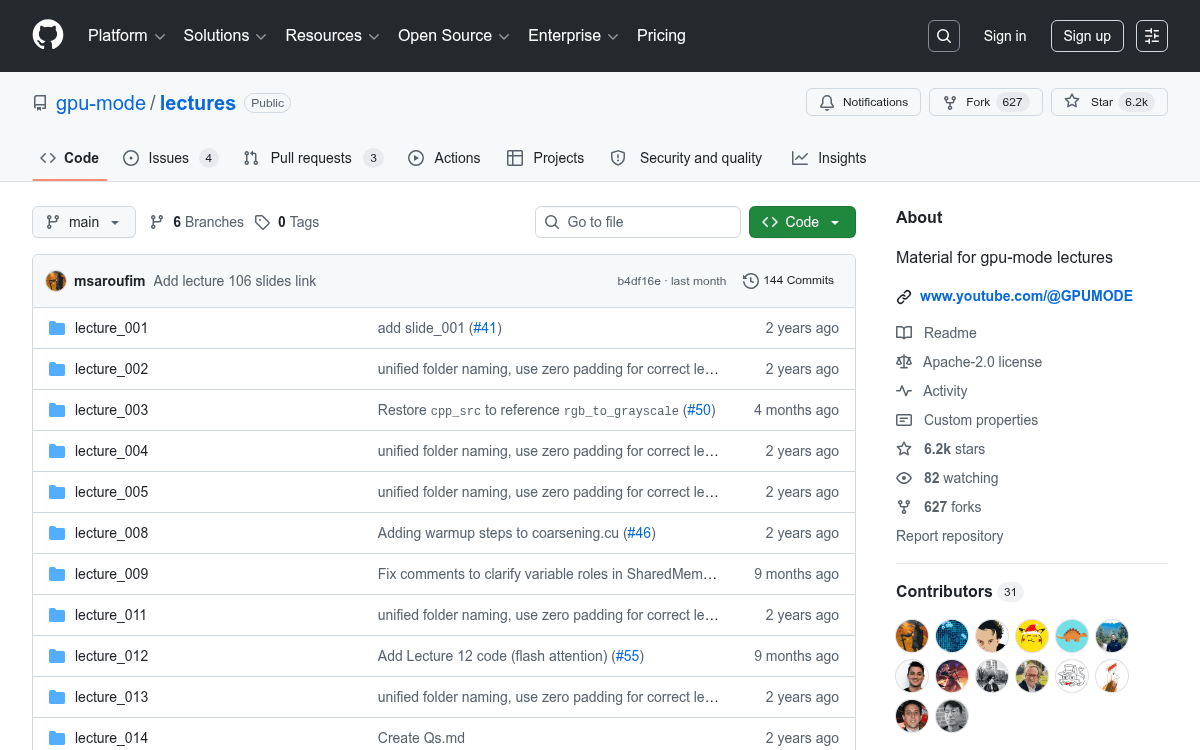
Recordings of the weekly lectures are published on the YouTube channel, and material including code and slides for individual lectures can be found in the lectures repository. The GitHub repo itself has crossed 6,200 stars with over 620 forks, a signal that people aren't just watching but actually working through the material.
What's actually in the curriculum
The lecture list reads like a tour of the entire GPU software stack. Early lectures ease you in with PyTorch integration and PMPP chapters. Then the series goes deep fast. A sampling of what's covered:
- Lecture 1 covers integrating and profiling custom CUDA kernels within PyTorch, using tools like
load_inline, Triton, and NVIDIA Nsight Compute. - Lecture 12 covers Flash Attention, including the tiling strategy, softmax stabilization, and its limitations.
- Lecture 8 covers CUDA performance optimization techniques including memory coalescing, occupancy, control divergence, tiling, privatization, and thread coarsening.
- Lectures 22 and 35 cover speculative decoding in vLLM and SGLang performance optimization, respectively, bringing inference systems into scope.
- Lectures 30 and 69 cover quantized training and 4-bit training, including the Quartet method for INT4 fine-tuning.
- Lectures 71–75 form a ScaleML sub-series covering long-context modeling, positional encodings, and ThunderKittens (a DSL for writing fast GPU kernels).
- Lecture 104 covers Gluon, a new tile-based GPU programming model with low-level control.
The speakers are not random. They include Jeremy Howard (fast.ai), Adam Paszke (JAX/PyTorch), engineers from Meta's PyTorch team, NVIDIA researchers, and contributors to projects like FlashInfer, Liger Kernel, and Unsloth. This is practitioner knowledge, not textbook summaries.
The ecosystem around the lectures
The lectures are just one piece. GPU MODE also maintains official problem sets and reference kernels for a GPU MODE leaderboard, a competitive benchmarking platform where you can submit kernels and see how they rank. Think of it as LeetCode, but the metric is actual hardware throughput rather than algorithmic complexity. Separately, LeetGPU offers 50+ problems covering matrix ops, memory optimization, and kernel fusion, with execution on real hardware directly in the browser.
For those who want structured practice before jumping into the lectures, GPU Puzzles by Sasha Rush skips the theory and throws you directly into coding GPU kernels, using NUMBA to map Python code to CUDA kernels. In a few hours, you can go from basics to understanding the real algorithms that power most of deep learning today.
Who this is actually for
The curriculum is structured to be useful at multiple levels. If you're an ML engineer who has never written a kernel, lectures 1–5 are a solid on-ramp. Lecture 3 is a beginner-friendly introduction to CUDA programming with PyTorch, demonstrating how to write and execute CUDA kernels within a Python environment. If you already write kernels and want to go deeper, later lectures on CUTLASS, CuTE layout algebra, SASS microarchitecture, and multi-GPU collective communication are where the real density is.
The content is also notably hardware-agnostic in places. There are lectures on AMD's Composable Kernel, Intel SYCL, Apple Metal kernels, and ARM low-bit kernels alongside the NVIDIA-focused content. That breadth reflects the community's actual scope.
Why this matters now
GPU programming used to be a niche skill held by a small number of systems engineers at big labs. That's changing fast. As model inference costs dominate deployment budgets, and as custom hardware accelerators multiply, the ability to write and reason about GPU kernels is becoming a core competency for serious ML work. The GPU MODE Discord runs weekly lectures and maintains a kernel leaderboard, keeping the community active rather than just archival.
The repo is free, the videos are free, and the Discord is open. The only real cost is the time it takes to go from reading about thread blocks to actually writing one. For anyone who has been putting that off, the GPU MODE lecture series is the most practical starting point available.