

Google's TimesFM-3 Tops Three Forecasting Leaderboards With 330M Parameters
Google's new 330M-parameter time series foundation model handles multivariate forecasting zero-shot in a single forward pass, topping Gift-Eval, FEV-Bench and Time.
- Google released TimesFM-3, a 330M parameter zero-shot multivariate time series foundation model.
- Pre-trained on over 1 trillion time points from real and synthetic data.
- Generates the entire forecast horizon in one forward pass via Contiguous Patch Masking, outputting 9 quantiles.
- Alternating causal temporal attention and full variate attention capture both time and cross-series structure.
- Tops Gift-Eval, FEV-Bench and Time benchmarks against Chronos-2, Toto 2.0 and TimesFM-2.5.
- Available on GitHub and Hugging Face, BigQuery integration coming.
Google Research has released TimesFM-3, the next iteration of its time series foundation model, and this version finally crosses the univariate barrier. The model is natively pre-trained for multivariate forecasting, has 330 million parameters, and was trained on a corpus of real-world and synthetic sequences comprising more than 1 trillion time points. It is available today on GitHub and Hugging Face, with a BigQuery integration promised in the coming weeks.
Why univariate fell short
Since TimesFM debuted in 2024, Google's forecasting models have been picked up in retail, finance, observability, manufacturing, healthcare, and the natural sciences. A persistent gap remained. Through TimesFM-2.5, released in September 2025, the models were strictly limited to univariate forecasting, predicting from the history of a single series and nothing else.
That mismatch runs deep, because most real-world forecasting problems are inherently multivariate, with several series and external features jointly shaping the future of any one of them. Forecast ice cream sales from past sales alone and you miss the picture. Weather, foot traffic, planned promotions, related SKUs, and holidays all move demand, and previous TimesFM releases had no principled way to consume any of them.
Three input types, zero fine-tuning
TimesFM-3 handles three flavors of input in zero-shot mode, meaning no task-specific training is required:
- Multiple targets: forecast several related series simultaneously (for example, jointly predicting different brands of ice cream), with both point and quantile outputs for each target.
- Past covariates: incorporate features that are only known historically, like past foot traffic.
- Past-future (dynamic) covariates: leverage known future events such as planned promotional campaigns or weather forecasts.
The model jointly predicts multiple coevolving series and captures dependencies that improve overall accuracy without any task-specific fine-tuning.
A 2D attention grid instead of a single time axis
Under the hood, TimesFM-3 keeps the decoder-only transformer backbone of its predecessors but reorganizes attention into a grid. Contiguous data points are grouped into patches of 32 time steps, with per-series normalization to handle vastly different scales.
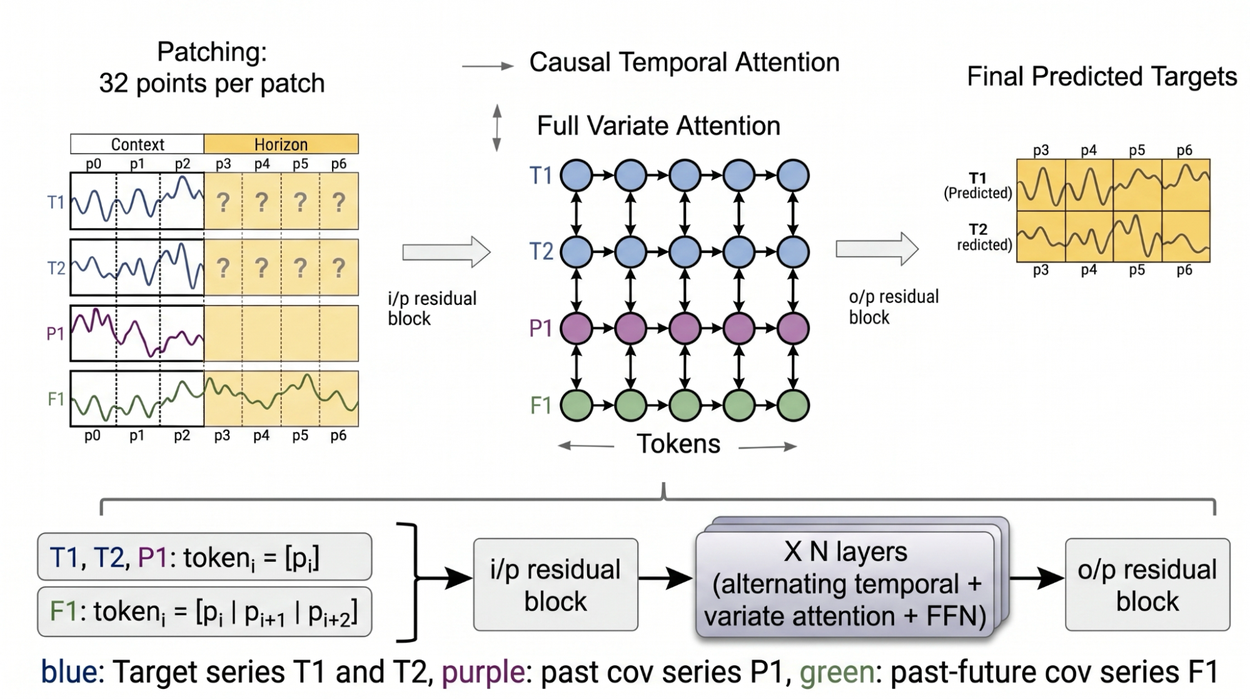
Tokenization has a subtle trick for known-future signals. For target and past-covariate series, each token is built from a single patch. For past-future covariates, TimesFM-3 uses a lookahead strategy where each token concatenates the current patch with future patches, letting the model peek at upcoming known signals.
Once tokenized, patches flow through alternating layers of two attention types:
- Causal temporal attention: tokens attend horizontally across time, strictly causally, so a token can only look at past tokens within its own series.
- Full variate attention: tokens attend vertically across series, so at any given time step a token can look at every other series in the dataset, learning cross-series correlations like how a promotion on one product lifts sales of another.
These two mechanisms alternate for several layers, blending temporal patterns with cross-series relationships.
The whole horizon in one forward pass
For latency-sensitive workloads, this next change is the payoff. Earlier TimesFM releases generated forecasts one patch at a time, adding latency, compounding error, and burning compute. TimesFM-3 drops the autoregressive loop entirely.
The model uses Contiguous Patch Masking to generate the entire horizon in a single forward pass, appending masked placeholder tokens for the future alongside the observed context. Target and past-covariate series are masked in the horizon since their future values are unknown, while past-future covariates remain visible so the model can condition on holidays or scheduled events. It predicts 9 quantiles, from the 10th to the 90th percentile, for each target series at every horizon step, giving a full probabilistic view of uncertainty.
What the promotion example actually shows
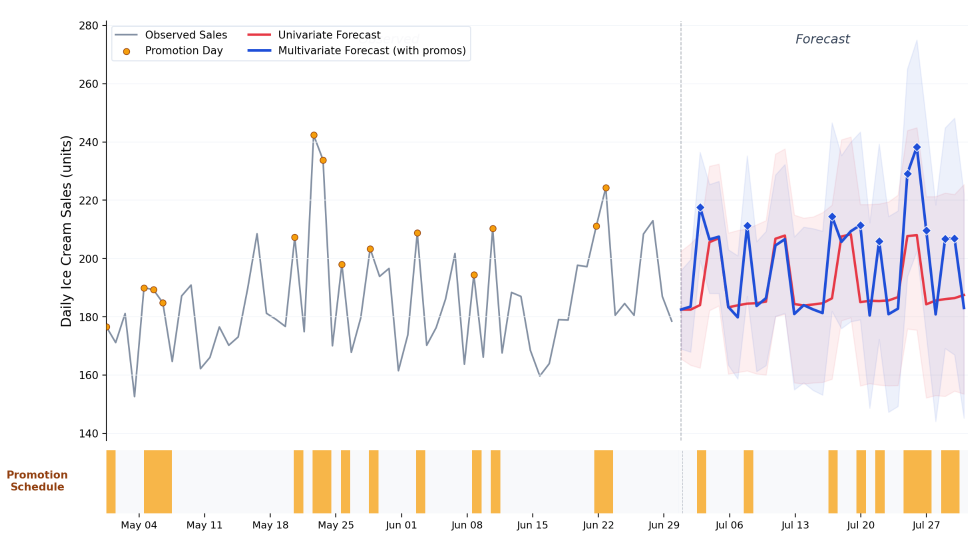
Google's ice cream example is a concrete illustration of what multivariate covariates buy you. A standard univariate model looks at historical sales and projects a weekly pattern forward, blind to promotions on specific days. TimesFM-3 takes the promotion schedule as a past-future covariate, learns the relationship between promotions and sales lift from the historical context, and applies that relationship to future days on the calendar. The resulting forecast anticipates a roughly 20% sales bump on each promotion day.
Top rank across three leaderboards
TimesFM-3 was evaluated on three public forecasting benchmarks: Gift-Eval, FEV-Bench, and Time. It ranks first on all three in both point and probabilistic metrics among pre-trained foundation models. The comparison set includes recent entrants such as Chronos-2, the Toto 2.0 family, and the previous TimesFM-2.5.
One interesting wrinkle: strip TimesFM-3 down to univariate mode with no covariates and it still holds up, matching or beating competing models when each target is treated independently. Switching to full multivariate mode delivers another jump, producing the best average rank in both point and probabilistic forecasting across the board.

How to actually use it
Both the checkpoint and reference code are already public. You can pull the weights from Hugging Face at google/timesfm-3.0-pytorch and run inference through the timesfm package on GitHub. The BigQuery path is not ready yet for TimesFM-3, though the earlier generation is: TimesFM-2.5 can be used immediately on univariate tasks through the AI.FORECAST command in BigQuery, with no ML expertise required.
The natural fit is any workload with known future signals or correlated series where the only prior options were to ignore the extra information, build a bespoke model, or bolt external regressors onto a pretrained univariate backbone. Retail demand planning with promotion calendars, energy load forecasting with weather inputs, financial series with macro indicators, and observability pipelines with correlated metrics all sit squarely in scope. Because inference is a single forward pass with quantile outputs, the model produces calibrated uncertainty bands cheaply enough for interactive dashboards rather than nightly batch jobs.
Comments
