

Google's TimesFM 3.0 Forecasts Multiple Time Series at Once Without Retraining
Google Research drops a 330M-parameter foundation model that forecasts multiple related time series jointly, topping three zero-shot benchmarks but locked to non-commercial use.

 PRO
PRO- Google released TimesFM 3.0, a 330M-parameter zero-shot foundation model for multivariate time-series forecasting.
- First TimesFM version to natively forecast multiple related series jointly with past and future covariates.
- Takes top average rank on GIFT-Eval, fev-bench, and TIME across point and probabilistic metrics.
- Generates the full horizon in one forward pass using Contiguous Patch Masking from TiRex.
- Outputs nine quantiles per target per step for uncertainty bands, not single points.
- Weights are non-commercial only; commercial use routes through BigQuery ML AI.FORECAST soon.
Google Research released TimesFM 3.0, a 330-million-parameter forecasting model that can predict several related time series simultaneously, incorporating signals you already know about the future, all without task-specific fine-tuning. Previous versions handled only one series at a time. This third generation is the first pretrained natively for multivariate forecasting, letting related signals inform each other in a single forward pass.
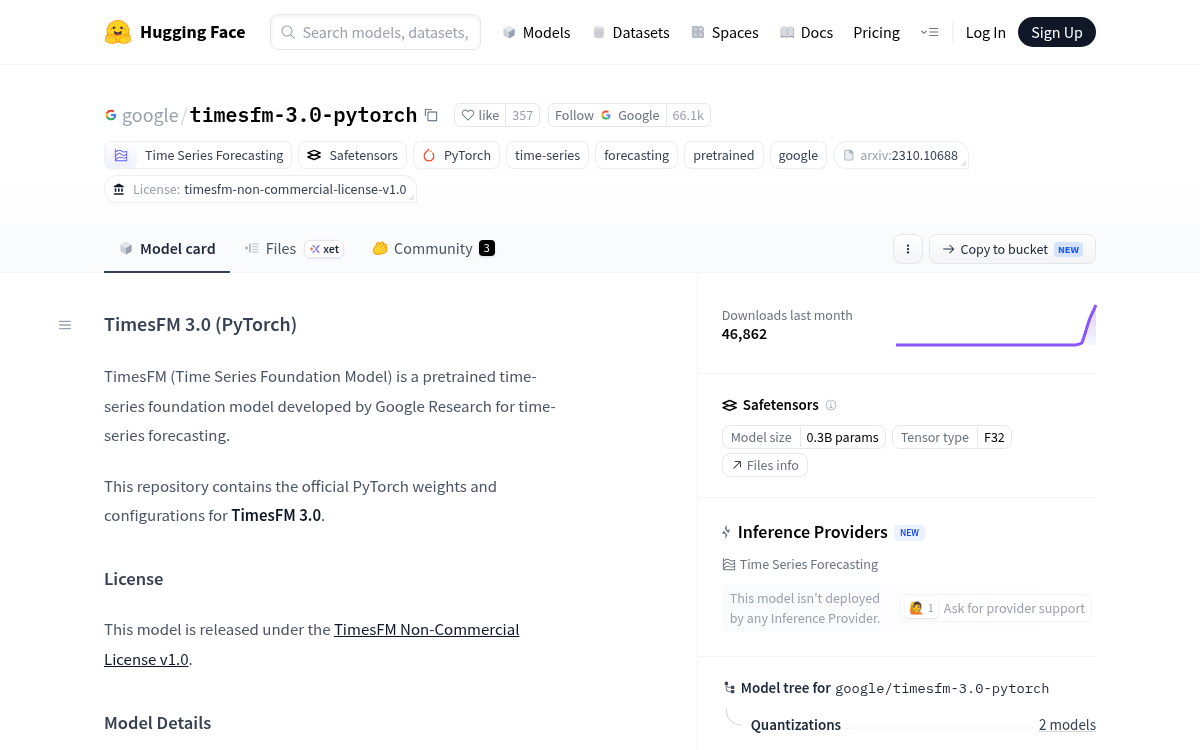
There is a licensing catch worth knowing upfront. TimesFM 2.5 shipped under Apache 2.0, but the 3.0 weights carry a new timesfm-non-commercial-license-v1.0 that explicitly prohibits production deployment and third-party mirroring. Benchmarking, prototyping, and academic publication are permitted. Shipping it behind a customer-facing forecasting API is not.
What changed under the hood
The architecture uses alternating causal and cross-series attention layers across 20 transformer layers at model dimension 1280 with 16 heads, a 32-step context patch length, and a 64-patch forecast horizon, trained on over a trillion data points. The alternating attention design is what enables zero-shot multivariate forecasting: causal layers handle temporal dependencies within a series, while cross-series layers let signals inform each other.
Inference is also restructured. Rather than decoding patch by patch, the model generates the entire forecast horizon in one forward pass using Contiguous Patch Masking, a training-time strategy introduced with TiRex. Masked placeholder tokens are appended for the full horizon. Targets and past covariates are masked there, while past-future covariates remain visible, so known future signals still reach the model. Every masked horizon patch is filled simultaneously.
This story is for Pro members
You've reached the end of the free preview. Upgrade to AlphaSignal Pro to read the full article - and everything else behind the paywall.
Comments
