Google's TabFM Beats XGBoost on Tabular Data Without Training
Google's TabFM does zero-shot tabular classification and regression in one forward pass, no training or hyperparameter tuning required.
 PRO
- Google releases TabFM 1.0.0 -- a zero-shot foundation model for tabular classification and regression, no training or tuning required.
- Single forward pass inference: Training rows are passed as context; the model predicts on new rows without updating any weights.
- Beats tuned tree ensembles: Evaluated on 51 datasets via TabArena Elo scores, TabFM outperforms heavily-tuned XGBoost and similar baselines in zero-shot mode.
- Trained on hundreds of millions of synthetic datasets generated by structural causal models -- no real-world proprietary data used.
- Hard limits to know: Max 10 output classes, ~500 feature ceiling, non-commercial weights license, no built-in explainability.
- BigQuery integration coming: Google announced an
AI.PREDICTSQL command for BigQuery; weights available now on Hugging Face.
For the past fifteen years, if you needed to predict something from a spreadsheet, the answer was almost always a gradient-boosted tree. XGBoost, LightGBM, CatBoost -- these dominated Kaggle leaderboards and production pipelines alike. The catch: you paid for that performance with hours of feature engineering, hyperparameter search, and a fresh training run every time you touched a new dataset. That reign came with an endless cycle of feature engineering, hyperparameter search, and per-dataset retraining. Google Research just shipped something that challenges that assumption directly.
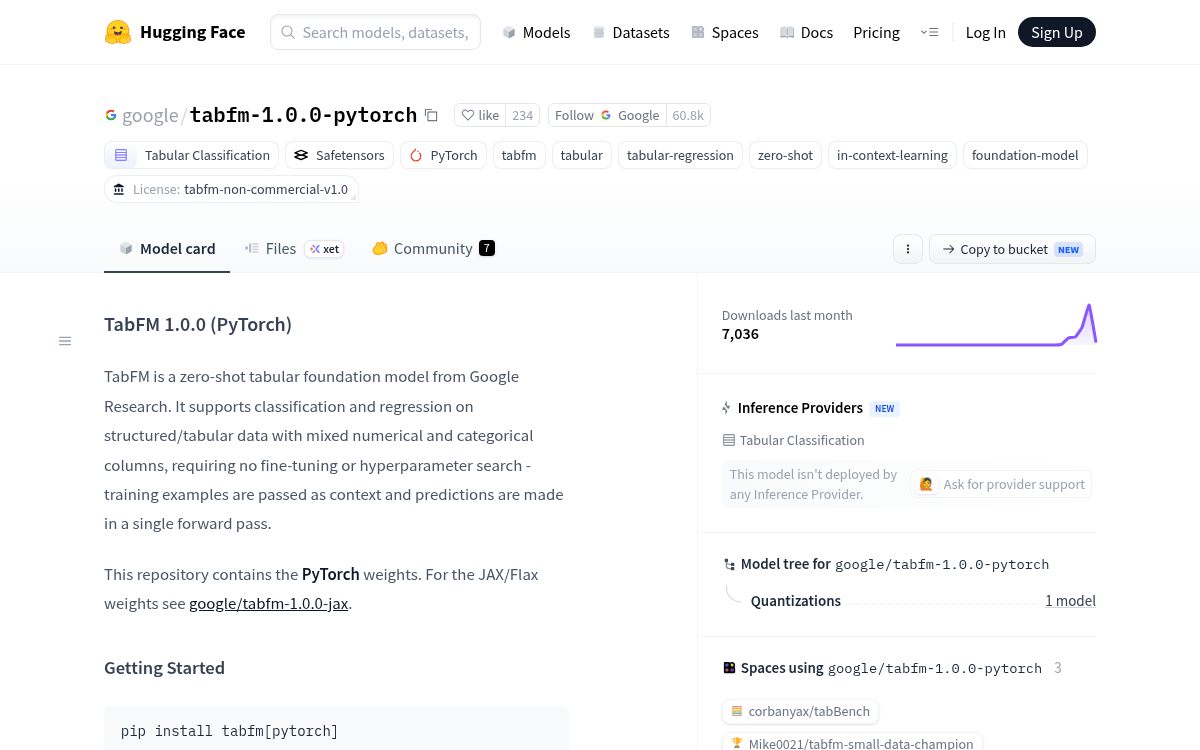
TabFM 1.0.0 is a zero-shot foundation model for tabular classification and regression, with public code on GitHub and pretrained weights on Hugging Face. The core idea: instead of training a model on your dataset, you hand the model your labeled rows as context, and it predicts on new rows in a single forward pass -- no weight updates, no tuning loops.
The trick that makes it work
The key concept here is in-context learning (ICL) -- a technique borrowed from large language models where a pretrained model learns a new task purely from examples provided in its input, without any gradient updates. TabFM uses in-context learning so teams can pass training examples and target rows as one prompt, avoiding per-dataset fine-tuning and hyperparameter search. The challenge is that tables aren't sequences: swapping two rows or two columns doesn't change the meaning of the data, so you can't just tokenize them like text.
The architecture combines TabPFN-style row/column attention with TabICL-style in-context learning. Concretely, the model has three stages:
- Column attention (Set Transformer): Each cell is embedded using Fourier features and a per-group linear projection, then the model attends across both rows and columns simultaneously to learn feature interactions -- the work that would otherwise require manual feature crafting.
This story is for Pro members
You've reached the end of the free preview. Upgrade to AlphaSignal Pro to read the full article - and everything else behind the paywall.
Comments