

Google's SynthID Turns Into an Industry Standard as OpenAI and ElevenLabs Sign On
Google's SynthID watermark goes cross-industry as OpenAI, ElevenLabs, and Kakao sign on, and detection lands inside Search and Chrome

- SynthID goes cross-industry: OpenAI, ElevenLabs, Kakao, and NVIDIA are now embedding Google's invisible AI watermark in their generated content.
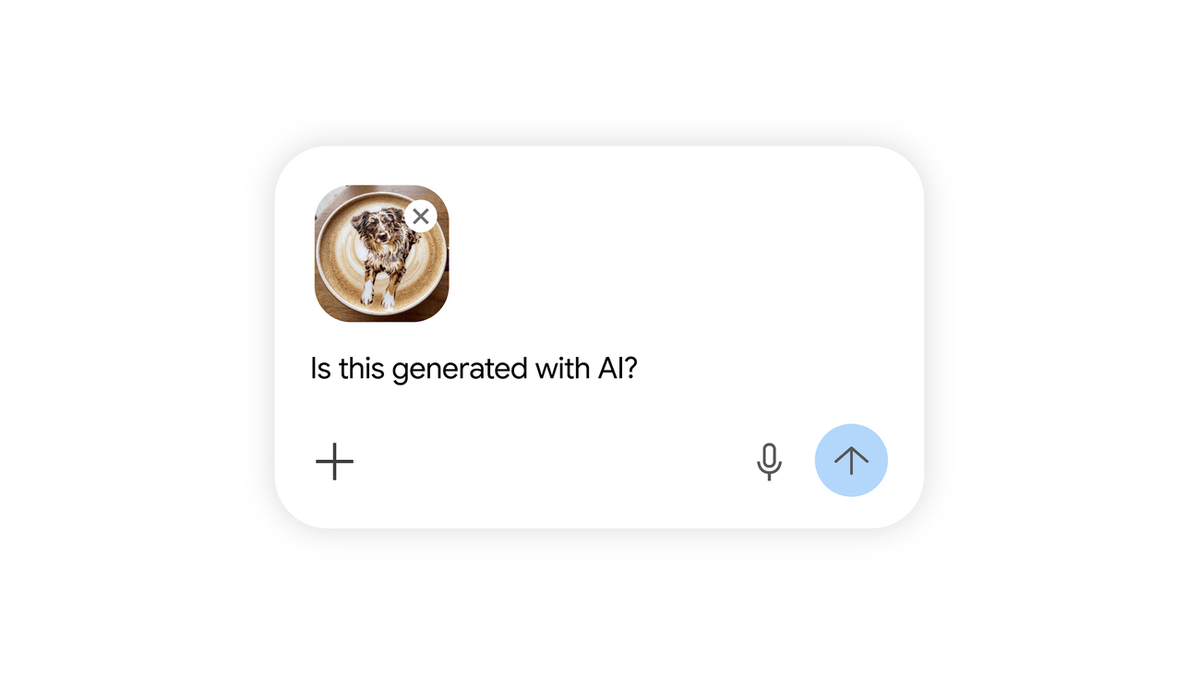
- Detection in Search and Chrome: Users can now ask "Is this AI?" directly in Google Search via Lens, AI Mode, and Circle to Search, with Chrome rolling out next.
- Massive scale: SynthID has already watermarked over 100 billion images/videos and 60,000 years of audio across Google's own products.
- New enterprise API: A Cloud AI Content Detection API launches for businesses to detect AI content from Google and other major models, with Shutterstock, Snap, Canva, and Fox Sports as early partners.
- SynthID Detector portal: A new standalone tool identifies not just whether content is AI-generated, but which specific parts are, with early access for journalists and researchers.
- Regulatory tailwind: EU AI Act Article 50 enforcement begins August 2026, making machine-readable AI content marking legally required across the EU.
Google just pulled off something that almost never happens in AI: it got its direct competitors to adopt its own technology. At Google I/O 2026, the company announced a sweeping expansion of SynthID, its invisible watermarking system for AI-generated content, bringing it into Google Search and Chrome, and signing OpenAI, ElevenLabs, and Kakao as new adopters. The move signals a shift from internal safety tooling to something closer to an industry-wide standard.
What SynthID actually does
SynthID works by embedding an imperceptible signal directly into the pixels of an image, the waveform of audio, or the token probability distribution of generated text at the moment of creation. Unlike metadata-based approaches, which can be stripped by simply re-saving a file, SynthID is designed to survive compression, cropping, rotation, and other common transformations. A detector then scans the content and reports whether the signal is present, absent, or uncertain.
The scale at which this is already deployed is striking. SynthID has already been applied to over 100 billion images and videos, and the equivalent of 60,000 years of content has been watermarked for audio. For context, that audio figure alone dwarfs any comparable system currently operating at scale.
From Gemini to everywhere you actually browse
Until now, SynthID verification lived mostly inside the Gemini app. That's changing fast. Until recently, checking whether something was AI-generated meant opening the Gemini app and uploading the file yourself. That verification step happened 50 million times globally. Useful, but not where most people actually look at images. Search is.
Google is expanding its SynthID verification tools to Search, with Chrome support planned over the coming weeks. Users will be able to check the origin of images through Search features such as Lens, AI Mode, and Circle to Search. The interface is intentionally simple: you can check whether an image was made with AI through features like Lens, AI Mode, and Circle to Search, by asking questions like "Is this made with AI?" or "Is this AI generated?"
Google is also layering in support for C2PA Content Credentials (the Coalition for Content Provenance and Authenticity standard, which embeds a cryptographically signed record of how a file was created and modified). Google is adding verification for C2PA Content Credentials, an industry standard for recording how media was created and modified. The C2PA verification feature is rolling out in the Gemini app and will roll out to Search and Chrome in the coming months.
The competitor twist
Google just convinced some of its fiercest competitors to adopt its AI watermarking system. OpenAI, Kakao, and ElevenLabs are all integrating SynthID into their own platforms. This is not a minor footnote.
- OpenAI: OpenAI is adopting SynthID, starting with images created through ChatGPT, Codex, and the OpenAI API. This builds on OpenAI's existing commitment to content provenance, demonstrated by the addition of Content Credentials to DALL-E 3, ImageGen, and Sora.
- ElevenLabs: The leading AI audio generation platform, meaning SynthID watermarks will now be embedded in a large share of AI-generated voice content on the web.
- Kakao: South Korea's dominant messaging and AI platform, extending SynthID's reach into one of Asia's largest digital ecosystems.
- NVIDIA: NVIDIA already integrated SynthID back in January 2026 to watermark video from its Cosmos world foundation models.
The watermark does not make AI-generated content universally detectable, since open-source models trained outside these partnerships will continue to produce unlabeled output. But the alignment of Google, OpenAI, and NVIDIA around a single watermarking standard creates a de facto baseline for the commercial AI image ecosystem.
New tools for builders and newsrooms
Two new products shipped alongside the partner announcements that are worth paying close attention to.
First, the SynthID Detector portal: a standalone portal that scans uploaded images, audio, video, and text snippets and highlights exactly which portions of the content carry the watermark. Early access is going to journalists, media professionals, and researchers first, with a public waitlist available. The key capability here is granularity: the portal answers not just "is this AI" but "which part of this is AI," which matters for partial edits, deepfaked faces inside real photos, and AI-generated audio dropped into otherwise real video.
Second, the AI Content Detection API on Google Cloud: an AI Content Detection API on the Gemini Enterprise Agent Platform inside Google Cloud, aimed at feed moderation and insurance fraud teams that need to flag AI content from any major model, not just Google ones. Google is previewing the API to a group of trusted partners, including Shutterstock, Snap, Fox Sports, Canva, and others, to refine it based on their feedback.
Why this is happening now
The timing is not accidental. The regulatory environment is tightening fast. On August 2, 2026, Article 50 of the EU AI Act takes full effect, forcing any company offering an AI system that produces synthetic images, video, or audio to mark those outputs in a machine-detectable way. California SB 942 already took effect January 1, 2026. Companies that haven't built provenance infrastructure are running out of runway.
There's also a trust problem that's hard to ignore. The number of deepfake videos alone skyrocketed 550% from 2019 to 2024. Today, AI-generated images, audio clones, and video deepfakes are indistinguishable from authentic content by unaided human review, and any piece of media can now be fabricated at scale and passed off as real with minimal friction.
The real story: a standard is forming
The deeper narrative here is about standardization. The partnerships represent a rare moment of cross-industry alignment in AI, where companies that normally compete for market share are instead collaborating on a shared problem: proving whether the content you're looking at was made by a human or a machine.
Google is playing a dual role: it is both the technology provider (SynthID) and a member of the C2PA steering committee, the standards body that governs the metadata-based credential layer. Partnerships with Meta will bring automatic authenticity labels to Instagram for Pixel-captured media. The practical implication is that a photo taken on a Pixel phone and shared to Instagram will soon carry a machine-readable certificate of authenticity, end-to-end, without any user action.
What this means in practice
Here's what changes depending on where you sit:
- End users: You'll be able to right-click or long-press an image in Search or Chrome and ask if it's AI-generated, with no separate tool required.
- Developers building on OpenAI, ElevenLabs, or Kakao: Content your apps generate will now carry SynthID watermarks by default, which means it will be detectable by Google's verification tools across Search, Gemini, and Chrome.
- Enterprise teams: The new Cloud API lets you build AI content detection into your own pipelines, covering content from Google models and other major generators, with use cases from feed moderation to insurance fraud detection.
- Newsrooms and fact-checkers: The SynthID Detector portal is the most targeted tool yet for forensic analysis of mixed-origin content, with part-level detection rather than binary yes/no verdicts.
- Pixel users: Pixel 10 was the first smartphone to provide Content Credentials for images in its native camera app. Google will expand the feature to video on Pixel 8, Pixel 9, and Pixel 10 phones in the coming weeks.
The gaps that remain
No watermarking system is a complete solution. Metadata can be stripped. A bad actor who wants to pass off synthetic content as authentic can simply remove content credentials before distribution. The absence of credentials then proves nothing: it could indicate manipulation or simply indicate that the content predates credential systems.
SynthID's pixel-level approach is more robust to stripping, but open-source image generators, which represent a huge share of synthetic content in the wild, are entirely outside this ecosystem. The watermark only works if the model generating the content has opted in. That's the fundamental ceiling on what any voluntary standard can achieve, and it's why the regulatory layer matters so much. For now, Google has built the most credible cross-industry coalition in AI content provenance. Whether that coalition becomes the default infrastructure for the web's trust layer is the question the next few years will answer.
Comments
