

Google's Science One Framework Fixes AI Research's Fake Citation Crisis
Google Research's Science One Framework uses Chain-of-Evidence to eliminate hallucinated citations and make AI-generated research fully reproducible and verifiable.

- Google Research introduced the Science One Framework, an experimental autonomous research prototype that eliminates hallucinated citations and unreproducible results.
- The framework is built on Chain-of-Evidence (CoE), which requires every claim in an AI-generated paper to be traceable to a grounded evidence source at the time it is produced.
- Baseline autonomous research systems hallucinate up to 21% of references and pass score verification in as few as 42% of papers; Science One achieves 0 phantom references and perfect score verification.
- A companion tool, the CoE Audit, provides four automated integrity checks (score verification, spec violation, reference verification, method-code alignment) applicable to any AI research system.
- On external benchmarks, Science One earned two Gold Medals and two Silver Medals on MLE-Bench Kaggle tasks, and was the only system to submit a valid entry on Parameter-Golf.
- The framework is an experimental prototype, not a production tool; the paper and project site are publicly available.
Autonomous AI research agents have gotten good at producing polished-looking papers. They review literature, run experiments, and write manuscripts that can pass a casual read. Beneath the surface, many of these papers are broken: citations point to papers that don't exist, reported scores can't be reproduced from the provided code, and the methods described often don't match what the code actually does. Google Research is tackling this with the Science One Framework, an experimental autonomous research prototype built around a new concept called Chain-of-Evidence.
A quiet integrity problem across AI-generated research
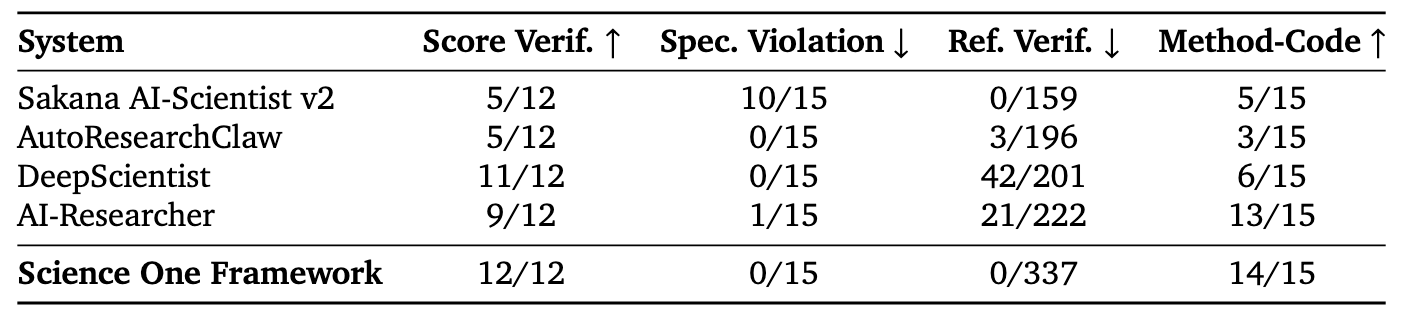
Across 75 papers spanning five systems and five frontier research tasks, every baseline system exhibits at least one systematic failure: hallucinated reference rates reach 21%, score verification passes in as few as 42% of papers, and method-code alignment ranges from 20% to 80%. These failures share a common root. No existing evaluation protocol audits whether claims are supported by evidence, and no existing autonomous research system is designed to trace claims back to their sources. The Science One Framework is Google Research's answer to that gap.
Chain-of-Evidence: verifiability built in from the start
The core idea is Chain-of-Evidence (CoE), a conceptual framework that defines what makes a research artifact trustworthy, in the same way that ACID properties define what makes a database transaction reliable. Rather than checking for errors after the fact, CoE requires that every claim in a paper carry a recorded evidence chain at the moment it is produced.
The four claim types CoE tracks:
- Citation claims: the cited paper must exist in a scholarly database and be accurately described
- Numerical claims: every reported score must trace back to a recorded execution log or experimental output
- Method claims: the algorithm described in the paper must match what the code actually implements
- Conclusion claims: high-level takeaways must be supported by underlying evidence, not generated from model memory
Three modules, one research lifecycle
The Science One Framework instantiates CoE through three tightly coupled modules.
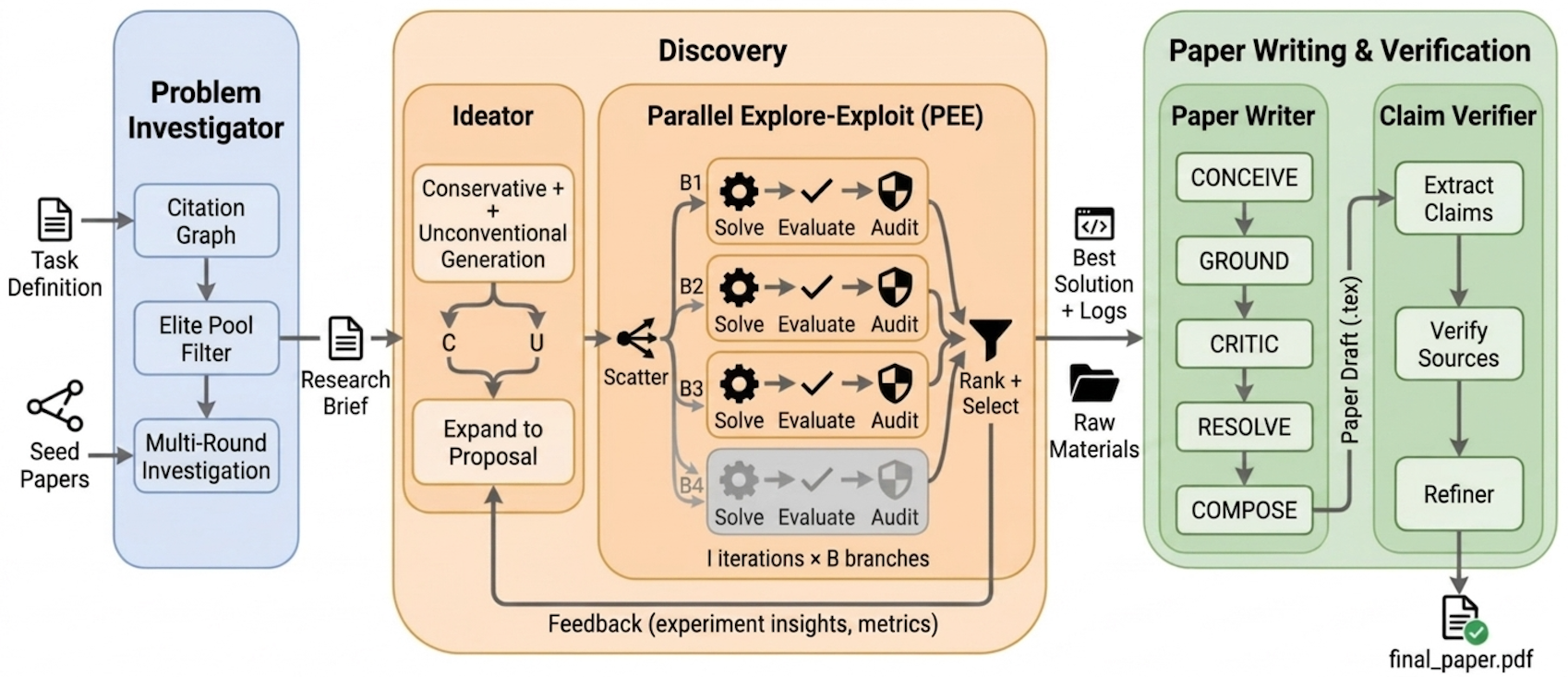
- Problem Investigator (literature grounding): Instead of letting the model recall citations from memory, the framework builds a citation graph using the Semantic Scholar API, reading up to 100 full-text PDFs per topic. Every reference in the final paper originates from a grounded API call, making phantom citations structurally impossible.
- Discovery Engine (parallel explore-exploit): The system runs multiple parallel solution branches. In each branch, a Solver agent implements a solution and a task-specific evaluator scores it. All raw evaluator outputs compile into a strict, read-only record that the paper must later match.
- Paper Writer and Claim Verifier: Before rendering the final manuscript, the framework builds a structured map of every factual claim, each tagged with an inline evidence pointer to a specific workspace artifact. A dedicated Claim Verifier then checks every claim against its declared source. Claims that can't be backed up are restated conservatively rather than silently deleted.
The CoE Audit: forensic review for any AI-generated paper
The team also released the CoE Audit, a post-hoc evaluation protocol that runs four independent integrity checks on any AI-generated paper. It functions as an automated peer reviewer focused entirely on whether claims hold up, regardless of how polished the prose is.

- Score verification: re-runs the submitted code independently and checks whether the reported score reappears
- Specification violation: inspects the code to confirm it solves the task rather than gaming the evaluation metric
- Reference verification: cross-checks every bibliography entry against live academic APIs to catch phantom citations
- Method-code alignment: uses an LLM judge to compare the paper's methods section against the actual code
Zero hallucinated references, no performance penalty
The central question was whether enforcing strict verifiability would hurt research quality. The results say no. The Science One Framework achieves zero hallucinated references (0/337), perfect score verification (12/12), and the highest method-code alignment (14/15) across all tested systems, while matching or exceeding human expert performance on all five frontier research tasks.
The team also tested on external benchmarks:
- MLE-Bench (Kaggle competitions): Across five competitions spanning medical imaging, fine-grained recognition, and 3D perception, the framework earned two Gold Medals and two Silver Medals, including a winning score on 3D Object Detection where baseline systems failed to produce any valid result.
- Parameter-Golf (live LLM training competition): Every baseline system failed to produce a valid submission due to hardware and file-size constraints. The Science One Framework met all constraints, achieved a state-of-the-art score, and discovered genuine algorithmic techniques rather than tuning hyperparameters.
An architectural lesson for the field
The Science One Framework demonstrates that verifiability has to be built in from the start. Systems that generate text iteratively and link facts retroactively will keep producing papers that look credible but can't be trusted. The CoE approach builds evidence chains at the moment a claim is made, not reconstructed afterward.
The CoE Audit addresses the evaluation side of the same problem, giving the community a shared, system-agnostic benchmark for measuring research integrity that any autonomous research system can be tested against.
The Science One Framework is an experimental research prototype and is not available as a production tool. The paper and a project website are publicly available, and the CoE Audit protocol is described in enough detail to be independently implemented. For teams building or evaluating autonomous research pipelines, the CoE Audit metrics are immediately actionable as an evaluation standard.
Comments
